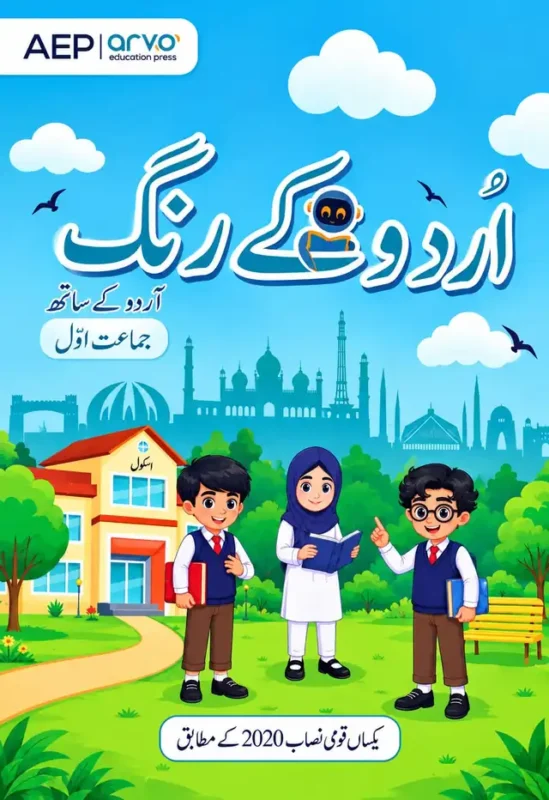
Urdu Kay Rang, Jamaat Awwal (Class 1) is the Class 1 Urdu book of Allied Schools, published by AEP (arvo education press), available to order now for the 2027-28 session. A line at the bottom of the cover says it is “according to the Single National Curriculum 2020”. The cover shows the title in large blue Urdu calligraphy with a robot reading a book, a school building, three smiling students in uniform with books (two boys and a girl in a dupatta), a park bench and the silhouette of well-known Pakistani landmarks in the background. The class, Jamaat Awwal, is written in a rounded tag under the title.
The book is in Urdu, so the contents (Fehrist) below are given in Roman Urdu with a short English note. It is built in two parts: a qaida (the letter and sound foundation, pages 1 to 31) and then 16 lessons, with a review (Jaiza) after every four lessons and a glossary (Farhang) at the end. The glossary starts on page 144, so the book is at least that long.
Full table of contents: Qaida, 16 lessons, 4 reviews and glossary
The contents are printed over two pages (the first page holds the qaida topics and Lessons 1 to 5; the second holds Lessons 6 to 16 and the glossary). Page numbers are as printed.
Part 1: Qaida (pages 1 to 31)
The first contents page lists the topics of the qaida, and a box of learning outcomes beside it. The topics are:
- Huroof-e-tahajji ba-tasveer (the alphabet with pictures)
- Huroof-e-tahajji ki aadhi shaklein (half shapes of the letters)
- Bhaari huroof (the heavy, aspirated letters)
- Musawwate and Musamte (vowels and consonants)
- Alfaaz saazi (making words)
- Zabar, Zer, Pesh and Jazm (the short vowel marks and the stop mark)
- Tashdeed and Tanween (the doubling mark and the nunation mark)
- Noon Ghunna and Madd (the nasal Noon and the long vowel sign)
- Basri alfaaz (words recognised by sight)
- Hamza
- Waw (maroof, laeen, maadoola) and Yay (maroof, laeen, maadoola), the long, diphthong and silent forms of Waw and Ye
Why it helps: This is the heart of a Class 1 Urdu course. A child cannot read a poem or a story until they can recognise the letters, know their half shapes (because letters change shape inside a word), and read the vowel marks. The learning outcomes in the box say the same: to read words by knowing letter sounds, to make words from letters, to tell words that begin or end with the same sound, to learn the order and half shapes of letters, and to pronounce longer words correctly. The heavy letters and the silent forms of Waw and Ye tend to need the most practice, so it is a help that the book gives each its own topic.
Part 2: Lessons 1 to 5
- Lesson 1: Hamd (poem) (p. 32)
- Lesson 2: Naat (poem) (p. 38)
- Lesson 3: Hazrat Muhammad Rasoolullah (peace be upon him) ki rahm dili (the Prophet’s kindness) (p. 45)
- Lesson 4: Guftagu ke adaab (manners of speaking), for reading (p. 51)
- Jaiza 1 (review 1) (p. 54)
- Lesson 5: Main aur mera ghar (me and my home) (p. 56)
Why it helps: The first lessons start with praise of Allah (Hamd) and of the Prophet (Naat), poems a child can memorise and recite, then a lesson about the Prophet’s kindness and one about how to speak politely. This is a common order in Pakistani Urdu books: faith and manners first, then home. The review (Jaiza 1) makes sure the child has understood before the book moves on.
Part 3: Lessons 6 to 8 and Review 2
- Lesson 6: Mera School (my school) (p. 64)
- Lesson 7: Allama Iqbal (may Allah have mercy on him) (p. 72)
- Lesson 8: Kitne pyare mausam! (what lovely seasons!) (p. 80)
- Jaiza 2 (review 2) (p. 89)
Why it helps: From home the book moves to school, then to the national poet, Allama Iqbal, so even a Class 1 child learns his name and a little about him, and then to the seasons, a theme any child can describe. Each of these lessons is about eight pages long, so the book now expects a little more reading stamina.
Part 4: Lessons 9 to 12 and Review 3
- Lesson 9: Asmaan ne sach bola (the sky told the truth), for reading (p. 91)
- Lesson 10: Des hamara Pakistan (our country Pakistan), poem (p. 93)
- Lesson 11: Jalte bujhte ishare (blinking signals) (p. 99)
- Lesson 12: Haar jeet to hoti rehti hai! (winning and losing go on), for reading (p. 107)
- Jaiza 3 (review 3) (p. 110)
Why it helps: This group mixes a story, a patriotic poem, a lesson about signals (the title suggests traffic or road signs) and a lesson on winning and losing. The “for reading” lessons (baraye mutalia) are marked as reading for enjoyment, which is a good way to build a love of reading. The title of Lesson 12 points to something parents appreciate: learning to take a loss well.
Part 5: Lessons 13 to 16, Review 4 and glossary
- Lesson 13: Kaale baadal aayenge (black clouds will come), poem (p. 112)
- Lesson 14: Phal aur sabziyan khao, sehatmand ban jao (eat fruit and vegetables, become healthy) (p. 118)
- Lesson 15: Aasmaan par rang (colours in the sky) (p. 126)
- Lesson 16: Jaago! Sone walo jaago! (wake up, sleepers, wake up!), poem (p. 134)
- Jaiza 4 (review 4) (p. 141)
- Farhang (glossary) (p. 144)
Why it helps: The book ends with the rain, with healthy food, with the colours of the sky, and with a wake-up poem, which makes a natural closing for the year. Each is something a child can see from the window. The glossary (Farhang) at the end lists the harder words from the lessons, so a child (and a parent) can check meanings without a dictionary.
What your child gains
- Confident recognition of every Urdu letter and its half shapes.
- The ability to read vowel marks and the special letters (heavy letters, Hamza, Noon Ghunna).
- Five poems (Hamd, Naat, Des hamara Pakistan, Kaale baadal aayenge, Jaago!) to recite.
- Reading for pleasure through story lessons.
- Everyday manners, kindness and love of country, taught through short lessons.
Who, what, when, where and how
Whom: Class 1 students of Allied Schools (about six years old). What: the printed Class 1 Urdu book with qaida, lessons and glossary. When: order before the 2027-28 session starts; the qaida in the first term, and the lessons afterwards. Where: at school, and at home where parents can listen to the poems. How: ask your child to recite one poem a week, read a short lesson aloud together, and let them find a word from the glossary every few days.
Frequently asked questions
Is the book in Urdu script?
Yes, the book is printed in Urdu script. This page gives the contents in Roman Urdu for convenience.
Which curriculum does it follow?
The cover says it is according to the Single National Curriculum 2020.
Is this the same as other “Urdu Kay Rang” books?
This is the AEP | arvo education press edition made for Allied Schools; check that the cover shows the AEP | arvo logo and “Jamaat Awwal” as in our photo before you order, or WhatsApp us.
Order Urdu Kay Rang online with Cash on Delivery across Pakistan, or collect it from our Lahore shop. Message us your child’s class and campus on WhatsApp and we will confirm the edition before we dispatch.