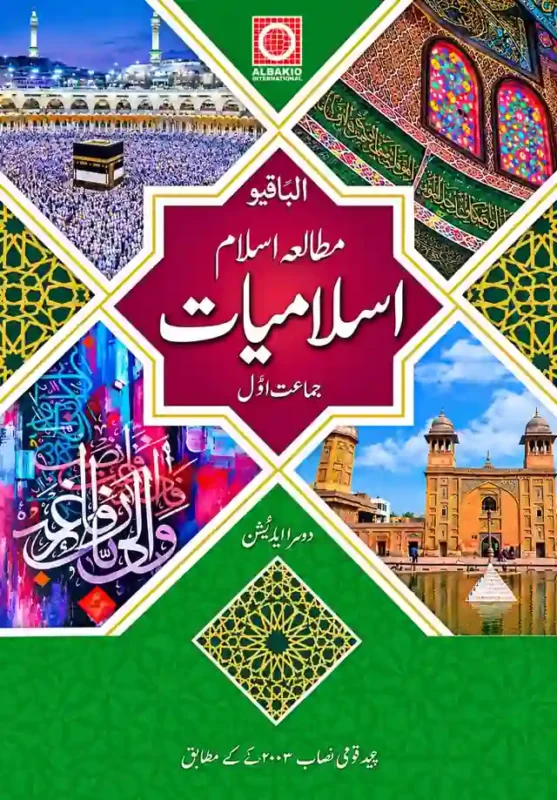
Islamiat (Mutalia Islam), Class 1 (Jamaat Awwal) is the Class 1 Islamic studies book for Allied School, published by Albakio International, available to order now for the 2027-28 session. The cover is a green and gold design with a red star at the centre carrying the Urdu title, the Albakio International logo at the top, the words “Second Edition” and, at the bottom, a line giving the national curriculum 2003. Around the central star are photographs of the Kaaba with worshippers, an ornate mosque ceiling, colourful Islamic calligraphy and a historic mosque.
The book is in Urdu, so the contents (Fehrist) below are given in Roman Urdu with a short English note. The contents page is made of coloured boxes, one for each chapter (Baab). There are five chapters and the book begins at page 1 with reading the Quran. It is the child’s first formal Islamiat textbook, so the lessons are short and the first chapters are about doing: reading, memorising and reciting.
Full table of contents: all 5 chapters, every lesson and page
Page numbers are as printed.
Chapter 1 (Baab Awwal): Quran Majeed aur Hadith-e-Nabawi (the Quran and the Hadith of the Prophet)
- 1. Nazra Quran Majeed (reading the Quran) (p. 1)
- 2. Hifz Quran Majeed (memorising the Quran) (p. 9)
- 3. Hifz o Tarjuma (memorisation and translation) (p. 10)
- 4. Hadith-e-Nabawi (a saying of the Prophet) (p. 15)
- 5. Duain, zabani (supplications recited by heart) (p. 18)
Why it helps: The book starts where Islamic learning starts: with the Quran. Reading comes first, then short surahs to memorise, then their meaning, then a hadith and the duas a child says every day. These 18 pages build the recitation habit that parents most want to see in a Class 1 child, and every later chapter leans on it.
Chapter 2 (Baab Doum): Imaniyat o Ibadat (faith and worship)
- Part A: Imaniyat (faith): 1. Tauheed (the oneness of Allah) (p. 19)
- Part A: 2. Nubuwwat o Risalat (prophethood and message) (p. 22)
- Part B: Ibadat (worship): 1. Masjid (the mosque) (p. 25)
- Part B: 2. Azan (the call to prayer) (p. 27)
- Part B: 3. Namaz (prayer) (p. 29)
Why it helps: The two articles of faith that a small child can understand (one God and the Prophets) come first, then the practice that goes with them: the mosque, the call to prayer, and the prayer itself. Children see the mosque and hear the azan every day, so these lessons connect school to the real world around them.
Chapter 3 (Baab Soum): Seerat-e-Tayyaba (the life of the Prophet, peace be upon him)
- 1. Hamare pyare Nabi Hazrat Muhammad Rasoolullah Khatam-un-Nabiyyin (peace be upon him) (our beloved Prophet) (p. 32)
- 2. Hazrat Muhammad Mustafa Khatam-un-Nabiyyin (peace be upon him) ke Akhlaq-e-Hasana (his good character) (p. 37)
Why it helps: Two lessons that introduce the Prophet as a person: who he is, and how good he was to others. Class 1 children learn best from a role model, and the chapter on his character gives parents something to point to the next time a child needs to share, tell the truth or be kind.
Chapter 4 (Baab Chaharum): Akhlaq o Adaab (character and manners)
- 1. Achhe Akhlaq (good character) (p. 40)
- 2. Salam karna (giving salam) (p. 44)
Why it helps: Manners are where Islamiat becomes everyday behaviour. Learning to give salam properly is a lesson a six-year-old can practise within the hour, at home with grandparents or at school with teachers.
Chapter 5 (Baab Punjum): Hidayat ke Sarchashme aur Mashahir-e-Islam (sources of guidance and famous figures of Islam)
- 1. Ambiya-e-Kiram (peace be upon them) ka Taaruf (an introduction to the prophets) (p. 46)
Why it helps: The book ends with the first introduction to the prophets, opening the stories that later classes continue, such as Hazrat Adam, Nuh, Ibrahim and Musa (peace be upon them) in Classes 3 and 4.
What your child gains
- The first steps in reading, memorising and understanding the Quran.
- The basic beliefs and the daily prayer, taught through the mosque and the azan.
- A picture of the Prophet’s life and character, with manners to match.
- Daily duas and the habit of saying salam.
Who, what, when, where and how
Whom: Class 1 students of Allied Schools (about six years old). What: the printed Class 1 Islamiat book, Mutalia Islam, Second Edition. When: order before the 2027-28 session starts, or in the first weeks of term. Where: in class and at home, where parents can hear the recitation. How: listen to your child recite one dua or surah a day, talk about one lesson a week, and let them lead the family’s salam.
Frequently asked questions
Is it in Urdu?
Yes, the book is printed in Urdu; this page gives the contents in Roman Urdu for convenience.
Which edition is this?
The Second Edition (Doosra Edition), as printed on the cover, published by Albakio International.
Which curriculum does it follow?
A line at the bottom of the cover says it is according to the national curriculum 2003.
Is there a version for other classes?
Yes, Mutalia Islam continues in other classes (Class 2, 3, 4, 5 and 6 are each listed on their own page).
Order Islamiat (Mutalia Islam) Class 1 online with Cash on Delivery across Pakistan, or collect it from our Lahore shop. Message us your child’s class and campus on WhatsApp and we will confirm the edition before we dispatch.