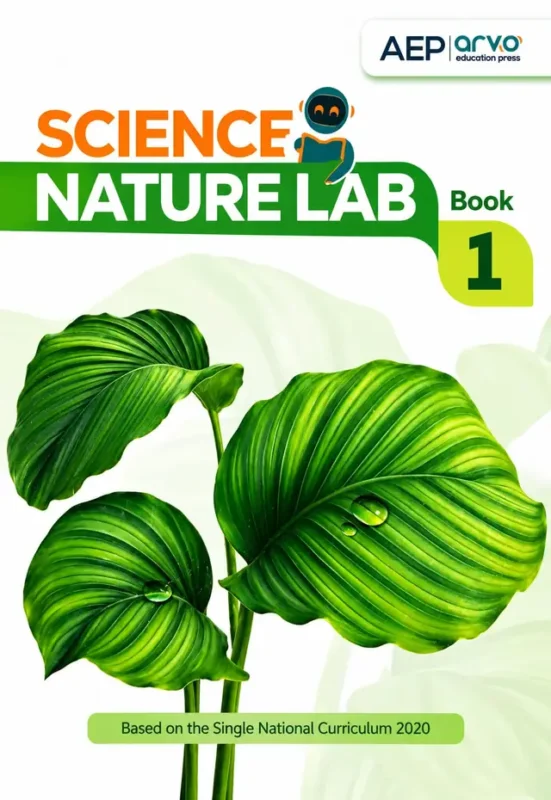
Science Nature Lab, Book 1 is the Class 1 science book of Allied Schools, published by AEP (arvo education press), available to order now for the 2027-28 session. The cover is clean and green: a pair of large leaves with water drops on a white page, a small robot reading a book beside the title, the number 1 in a lime-green tab, and a pill at the bottom saying “Based on the Single National Curriculum 2020”.
The title says it all: nature is the laboratory. The contents page (shown with the word CONTENT turned sideways in coloured blocks) lists nine chapters in colour-coded boxes, starting from the child’s own surroundings, living things and the body, moving through plants and animals, and ending with materials, forces, sound and the planet. It is a Class 1 book, so every topic is something a six-year-old can see, touch, hear or watch.
Full table of contents: all 9 chapters and every page
The contents page lists chapter titles and starting pages only; page numbers are as printed.
Chapter 1: Living and Non-Living Things (p. 1)
Why it helps: The first chapter gives the child their first scientific question: is it alive or not? A child who can sort a stone, a plant, a toy and a cat into “living” and “non-living” has started to classify, which is the base of all later science. It is also the easiest chapter to practise on a walk.
Chapter 2: Ourselves (p. 11)
Why it helps: From the world outside, the book turns to the child’s own body. Knowing parts of the body and what they do is useful for school, for health and for talking to a doctor, and it is a topic children love to be experts in.
Chapter 3: Staying Healthy and Fit (p. 24)
Why it helps: Healthy habits are taught right after the body, so the child sees why washing, eating well, sleeping and playing matter. Parents can use this chapter to settle daily routines without nagging.
Chapter 4: Plants (p. 38)
Why it helps: Plants are the easiest living things to observe: a seed in a cup on the windowsill turns a chapter into an experiment. The chapter gives the child names for the parts of a plant and a reason to look after one.
Chapter 5: Animals and Their Needs (p. 52)
Why it helps: Animals follow plants, and the title says “their needs”, so the lesson is about what living things need to stay alive: food, water, shelter. It builds care for living things alongside knowledge.
Chapter 6: Materials (p. 67)
Why it helps: Here the book moves from living things to the things around us: what objects are made of, such as wood, plastic, metal, glass and cloth, and why. Materials is the first real “lab” topic, because a child can touch, bend, float or sink things and compare them.
Chapter 7: Forces (p. 78)
Why it helps: Pushes and pulls are the first physics a child meets. This is the chapter where a toy car, a swing or a door explains itself. It is a short, practical chapter that teaches cause and effect.
Chapter 8: Sound (p. 90)
Why it helps: Sound is something a child can explore with a drum, a bell or a stretched rubber band. It trains careful listening and prepares the ground for music and, later, waves.
Chapter 9: Our Planet and Beyond (p. 105)
Why it helps: The book ends by looking up and out at Earth and the sky. After nine chapters of close observation, a child is ready for the big picture: the planet we live on and what lies beyond it. It is also a natural link to the Earth and space chapters in the Social Studies book.
What your child gains
- Observation habits: looking carefully, naming, sorting and comparing.
- A first vocabulary for the body, plants, animals, materials, forces and sound.
- Healthy routines they can explain.
- Curiosity about Earth and space, and a love of experiments with everyday objects.
Who, what, when, where and how
Whom: Class 1 students of Allied Schools (about six years old). What: the printed Class 1 science book, Science Nature Lab Book 1, nine chapters. When: order before the 2027-28 session starts, or in the first weeks of term. Where: in class and in the garden, kitchen and balcony at home. How: read one chapter, then find one real example of it at home that day (a leaf, a magnet, a drum made from a tin).
Frequently asked questions
Does it repeat the Social Studies book?
Some topics, such as plants and animals, appear in both books because a Class 1 child meets them from several sides. This is the science book, with chapters on materials, forces and sound as well.
Which curriculum does it follow?
The cover says it is based on the Single National Curriculum 2020.
Do we need a lab or special equipment?
No. The contents point to everyday topics, so a few home items (a cup, soil, a bell) are enough.
Order Science Nature Lab Book 1 online with Cash on Delivery across Pakistan, or collect it from our Lahore shop. Message us your child’s class and campus on WhatsApp and we will confirm the edition before we dispatch.