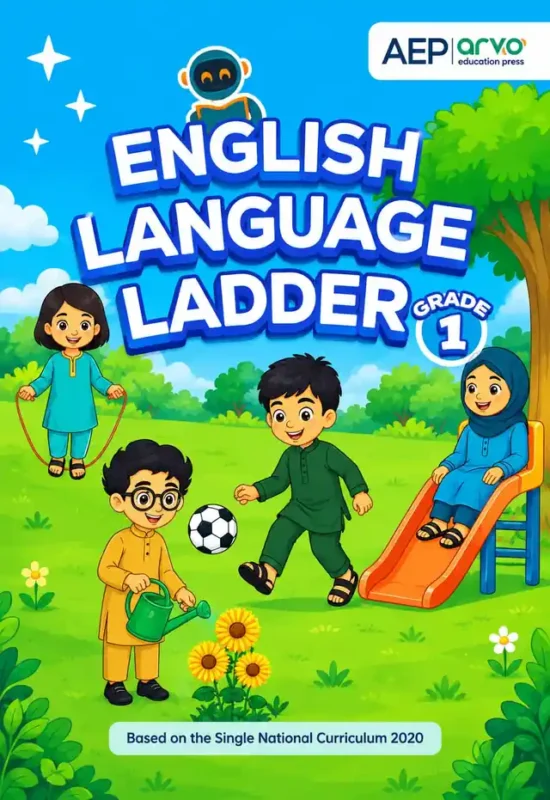
English Language Ladder, Grade 1 is the Class 1 English book of Allied Schools, published by AEP (arvo education press), available to order now for the 2027-28 session. The cover says “Based on the Single National Curriculum 2020” and shows a sunny park: a girl skipping, a boy with glasses watering sunflowers, a boy kicking a football and a girl sliding, with a little robot reading a book above the title and “Grade 1” in a round badge.
The best way to see how this book works is its two-page contents table. Instead of a simple list, it is a grid: every unit has a theme (such as Role Models, Nature or Life Skills), a sub-theme, and then what the child will learn in four strands: Reading and Critical Thinking, Vocabulary and Grammar, Oral Communication and Writing. In other words, each unit is a small, complete English lesson series, and the book is structured so that listening, speaking, reading and writing grow together instead of being taught separately. The book has 10 units, two review sections and a glossary, and runs to page 143.
Full table of contents: all 10 units, 2 reviews and the glossary
Each unit below is given with its page, theme, sub-themes and the four strands exactly as printed in the contents table.
Unit 1: The Kindness of Hazrat Muhammad (peace be upon him) (p. 1)
- Theme: Role Models: Hazrat Muhammad Rasoolullah (peace be upon him). Sub-theme: Incidents from the life of Hazrat Muhammad Rasoolullah (peace be upon him).
- Reading and critical thinking: Pre-Reading; One-Word Answers
- Vocabulary and grammar: Sight Words; Word Wall; Action Words
- Oral communication: Non-Verbal Communication; Active Listening; Role Play
- Writing: Pencil Grip; Handwriting Practice; Spelling Familiar Words
Why it helps: The year opens with a story of the Prophet’s kindness, which gives the child a real reason to read and a role model to talk about. The skills are the true first steps: how to hold a pencil, how to write neatly, the first sight words, and how to listen and respond without words (non-verbal communication). A child who can hold a pencil correctly on day one has an easier year.
Unit 2: My Loved Ones: Discovering Self, Family and Friends (p. 10)
- Theme: Self, people, places and globe. Sub-themes: Myself; My Family
- Reading and critical thinking: Pre-Reading; Letter Sounds; One-Word Answers; Question Words
- Vocabulary and grammar: Naming Words; Question Words; Describing Words; Word Opposites
- Oral communication: Listening and Responding; Taking Turns; Role Play
- Writing: Handwriting Practice; Writing with Spaces; Spelling Familiar Words; Completing Sentences
Why it helps: The topic is the child’s own family, so the first nouns, describing words and opposites are about people they love. Writing with spaces and completing sentences are the first steps towards a full sentence of their own.
Unit 3: Home Sweet Home: Discovering Where People and Animals Live (p. 24)
- Theme: Self, people, places and globe. Sub-themes: My Home; My Village/City
- Reading and critical thinking: Pre-Reading; Matching Activity; Rhythm Awareness; Letter Formation
- Vocabulary and grammar: Sight Words; Rhyming Words; Singular and Plural; Articles “a” and “an”
- Oral communication: Listening and Responding; Taking Turns; Asking Questions; Role Play
- Writing: Handwriting Practice; Phonetic Spelling; Writing Rhyming Words
Why it helps: Rhyme, singular and plural, and “a” and “an” are the first small rules of English, and this unit teaches them through familiar places such as home, village and city. Phonetic spelling lets a child write the sounds they hear, which builds spelling confidence early.
Unit 4: Kaavan’s Story: A Journey of Compassion and Care (p. 39)
- Theme: Nature. Sub-theme: Taking care of plants, animals and birds
- Reading and critical thinking: Guided Reading; Story Elements; Text Preferences; Sentence Meaning
- Vocabulary and grammar: Sight Words and Word Wall; Completing Words; Dictation Practice; Gender in Naming Words; Substitution Words
- Oral communication: Stress and Intonation; Role Play
- Writing: Spelling Familiar Words; Constructing Sentences; Story Sequencing
Why it helps: The first full story unit. Guided reading and story elements (who, where, what happened) teach a child to understand a story rather than just say the words. Dictation practice and story sequencing are the skills that turn into good comprehension and writing by Class 3.
Unit 5: Discovering Colours: Exploring the Wonderful World of Colours (p. 54)
- Theme: Nature. Sub-theme: Colours
- Reading and critical thinking: Sound and Letter Patterns; Comprehension; Reading with Punctuation Cues; Sentence Features
- Vocabulary and grammar: Sight Words and Word Wall; Expressing Feelings with Words; Dictation Practice; Constructing Sentences; Capitalisation and Full Stops
- Oral communication: Expressing Ideas and Interacting; Role Play
- Writing: Writing Letters and Words; Spelling Familiar Words
Why it helps: Colours are a joyful topic, and the grammar goal is serious: capital letters and full stops. Reading with punctuation cues teaches a child to pause at a full stop, which is the beginning of fluent reading.
Review: Units 1 to 5 (p. 67)
- Vocabulary and grammar: Requests and Commands; Constructing Sentences; Capitalisation and Full Stops
- Oral communication: Conversing Audibly; Role Play
- Writing: Writing simple Sentences
Why it helps: A halfway pause: the child revises requests and commands, builds sentences and writes simple ones of their own, so any weak area is found before the second half of the book.
Unit 6: Discovering Seasons: Exploring the Magic of Four Seasons (p. 72)
- Theme: Nature. Sub-theme: Seasons
- Reading and critical thinking: Identifying Sounds; Conventions; Silent Letters; Text Features and Purpose
- Vocabulary and grammar: Days and Months; Alphabetical Order; Habitual Actions; Position Words
- Oral communication: Conversing Audibly; Listening and Responding; Taking Turns; Role Play
- Writing: Constructing Sentences; Story Sequencing
Why it helps: Days, months and alphabetical order all arrive in a unit about the four seasons, which is a natural place for them. Silent letters and conventions are the “why is it spelt like that?” part of English.
Unit 7: Cleanliness Matters: Personal Hygiene and Cleanliness (p. 84)
- Theme: Health, personal safety, and drug education. Sub-theme: Personal cleanliness and hygiene; use of water after using the washrooms
- Reading and critical thinking: Sharing Text Preferences; Sentence Meaning
- Vocabulary and grammar: Days and Months; Habitual Actions; Capitalisation and Full Stops; Commas in a List
- Oral communication: Conversing Audibly; Taking Turns; Asking Questions; Role Play
- Writing: Writing Personal Information; Capitalisation and Full Stops
Why it helps: A practical unit on hygiene that also teaches commas in a list and writing personal information (name, age, address), which are skills a child uses every day at school.
Unit 8: Discovering Living and Non-Living Things: Exploring the Animate and Inanimate (p. 99)
- Theme: Nature. Sub-theme: Animate / Inanimate
- Reading and critical thinking: Following Instructions; Guided Reading
- Vocabulary and grammar: Using a Dictionary; Habitual Actions; Capitalisation and Full Stops; Substitution Words
- Oral communication: Sharing Experiences; Group Discussions; Role Play
- Writing: Writing Topic Sentences; Choosing Concluding Sentences
Why it helps: The same topic as science, but through English: following written instructions, looking words up in a dictionary and writing a topic sentence with a closing sentence, the shape of a paragraph. The words animate and inanimate are also good vocabulary stretch for Class 1.
Unit 9: Grandfather’s Story of Pilot Officer Rashid Minhas Shaheed (p. 114)
- Theme: Role Models. Sub-theme: Notable national personalities as role models and significance of Nishan-e-Haider
- Reading and critical thinking: Question Words; Text Purpose and Ideas; Parts of a Book
- Vocabulary and grammar: Habitual Actions; Capitalisation and Full Stops; Questioning Words
- Oral communication: Sharing Experiences; Group Discussions; Role Play Activities
- Writing: Writing Topic Sentences; Choosing Concluding Sentences
Why it helps: A story of a national hero told by a grandfather, which links English to Pakistan’s history and to family storytelling. The reading skills are asking good questions and knowing the parts of a book (cover, title, contents), a skill the child will use for the rest of school.
Unit 10: Being Grateful: Understanding Needs and Wants (p. 128)
- Theme: Life Skills. Sub-theme: Being Grateful
- Reading and critical thinking: Using a Dictionary; Recognising Text Features; Understanding Sentences; Reading for Information
- Vocabulary and grammar: Habitual Actions; Capitalisation and Full Stops; Questioning Words
- Oral communication: Sharing Experiences; Group Discussions; Role Play Activities
- Writing: Writing Topic Sentences; Choosing Concluding Sentences
Why it helps: The final unit teaches the difference between needs and wants and the habit of gratitude, and it closes with reading for information, a skill needed in every subject.
Review: Units 6 to 10 (p. 139) and Glossary (p. 143)
Why it helps: The second review checks the work of the whole second half before the year ends, and the glossary at the end gives a child a place to look up the harder words from the book.
What your child gains
- A secure start in handwriting: pencil grip, letter formation, spacing and neat writing.
- A growing set of sight words, rhymes, nouns, opposites and describing words.
- First grammar: capitals and full stops, commas in a list, singular and plural, “a” and “an”.
- Speaking and listening habits: taking turns, asking questions and sharing experiences.
- Reading for meaning and reading for information, and first paragraph writing.
Who, what, when, where and how
Whom: Class 1 students of Allied Schools (about six years old). What: the printed Class 1 English book, English Language Ladder Grade 1, ten units to page 143. When: order before the 2027-28 session starts, or in the first weeks of term, so handwriting habits start well. Where: in class and at home, where reading aloud and conversation do half the work. How: let your child say the new sight words aloud, practise a few lines of handwriting each day, and ask them to retell the unit’s story in their own words.
Frequently asked questions
Which curriculum does it follow?
The cover says it is based on the Single National Curriculum 2020.
Does it include a story about the Prophet and national heroes?
Yes, the contents show Unit 1 on the kindness of Hazrat Muhammad (peace be upon him) and Unit 9 on Pilot Officer Rashid Minhas Shaheed.
Is it a workbook or a textbook?
The contents list reading, grammar, oral and writing sections in each unit, so it is a combined textbook. Ask us on WhatsApp whether your child’s class also needs a separate practice book.
Order English Language Ladder Grade 1 online with Cash on Delivery across Pakistan, or collect it from our Lahore shop. Message us your child’s class and campus on WhatsApp and we will confirm the edition before we dispatch.