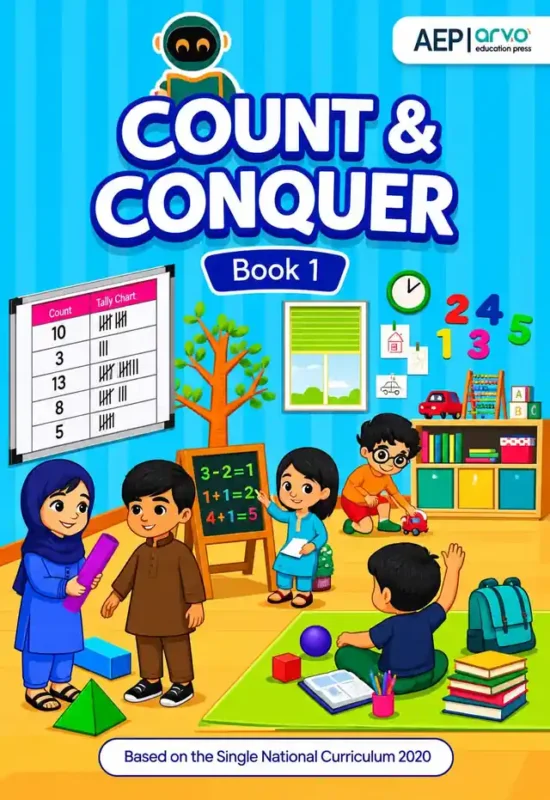
Count & Conquer, Book 1 is the Class 1 maths book of Allied Schools, published by AEP (arvo education press), available to order now for the 2027-28 session. A pill at the bottom of the cover says it is “Based on the Single National Curriculum 2020”. The cover is a bright blue classroom: a whiteboard with a tally chart (10, 3, 13, 8, 5), an easel chalkboard with sums (3 – 2 = 1, 1 + 1 = 2, 4 + 1 = 5), an abacus, number magnets, ABC blocks and a clock, with six children and a small robot reading a book above the title. The “Book 1” in the title means the Class 1 book.
The contents pages, set in purple with large chapter numbers, show 12 chapters across 227 pages. This is a full year of Class 1 maths in one book: counting and place value, addition and subtraction, Pakistani money, first multiplication and division, fractions, patterns, measuring, time, shapes and data. Every chapter is broken into short topics, which are listed below with their pages.
Full table of contents: all 12 chapters and every topic
The contents are printed over five pages; page ranges are as printed.
Chapter 1: Whole Numbers (pp. 1 to 33)
- Count and Read in Numerals and Words
- Concept of Ten – 10
- Place Value (Tens and Ones)
- Numbers from 11 to 20
- Numbers from 21 to 30
- Numbers from 31 to 40
- Numbers from 41 to 50
- Numbers Before, After, and Between
- Numbers from 51 to 60
- Numbers from 61 to 70
- Numbers from 71 to 80
- Numbers from 81 to 90
- Numbers from 91 to 99
- Comparing and Ordering Numbers
- Ordering Numbers
- Ordinal Number
Why it helps: The book builds numbers a block of ten at a time, from 11 up to 99, instead of throwing a hundred numbers at a six-year-old. Place value (tens and ones) comes early because it is the idea every later topic leans on. The pages on before, after and between, comparing and ordering, and ordinal numbers (first, second, third) turn counting into reasoning. Parents can use these topics with a pack of cards or a number chart on the wall.
Chapter 2: Addition (pp. 33 to 50)
- How Many More
- Addition Up to Three One-Digit Numbers
- Addition of Two-Digit Numbers and One-Digit Number (without regrouping)
- Addition of Two-Digit Numbers (without regrouping)
- Pictorial Representations
Why it helps: “How many more” is addition in a child’s own words. The book then goes step by step: three small numbers, then two-digit plus one-digit, then two-digit plus two-digit, all without regrouping (carrying), which comes later. Pictorial representations show the sum as a picture, so a child who cannot yet “see” the numbers can still solve it.
Chapter 3: Subtraction (pp. 50 to 68)
- How Many Less
- Subtraction One-Digit Numbers
- Subtraction of Two-Digit Numbers and One-Digit Number (without regrouping)
- Subtraction of Two-Digit Numbers (without regrouping)
- Subtraction Using Concrete Objects and Pictorial Representations
Why it helps: Subtraction mirrors addition in structure, so a child who has finished Chapter 2 can see the pattern. The last topic uses real objects and pictures, which is how Class 1 children actually learn to take away: by removing counters, then drawing it.
Chapter 4: Money (pp. 68 to 83)
- Pakistani Currency (Notes and Coins)
- Value of Money
- Addition of Money
- Subtraction of Money
Why it helps: Money is where maths meets daily life. Children learn the notes and coins they actually handle, what each is worth, and then add and subtract amounts. A small pretend shop at home turns this chapter into the most enjoyable week of the term.
Chapter 5: Multiplication (pp. 84 to 104)
- Count and Write in 2s, 5s and 10s
- Count and Write in 10s
- Multiplication as Repeated Addition
- Multiplication of 1-digit Number
Why it helps: Multiplication begins as skip counting (2, 4, 6; 5, 10, 15; 10, 20, 30) and then as repeated addition, so it feels like something the child already knows. This is a 21-page chapter, which gives plenty of practice before the tables arrive in later classes.
Chapter 6: Division (pp. 105 to 116)
- Division as Repeated Subtraction
- Division
- The Division of One Number by Another Number Cannot Be Done in Any Order
Why it helps: Division is introduced the way it works in real life: sharing and taking away again and again. The last topic is a clear idea for a young mathematician: unlike addition and multiplication, division cannot be done in any order, so 6 divided by 2 is not the same as 2 divided by 6.
Chapter 7: Fractions (pp. 117 to 130)
- Fractions
- Equal Parts: One-half (1/2)
- One-quarter (1/4)
- Two-quarters (2/4)
- Three-quarters (3/4)
Why it helps: Class 1 fractions are about equal parts: half a roti, a quarter of a pizza, three quarters of a glass. Seeing 2/4 as the same as a half is the first glimpse of equivalence, and it is easy to practise at the dinner table.
Chapter 8: Algebra (Patterns) (pp. 131 to 141)
Why it helps: Algebra in Class 1 means noticing what comes next: a pattern of colours, shapes or sizes. This is where the child learns to predict, and prediction is the root of all later algebra. The list of topics runs onto the next contents page.
Chapter 9: Measurement (pp. 142 to 172)
- Short, Shorter and Shortest
- Tall, Taller, and Tallest
- High, Higher, and Highest
- Heavy, Heavier, and Heaviest
- Light, Lighter, and Lightest
- More and Less
- Measuring Temperature
Why it helps: The largest chapter after Whole Numbers (about 30 pages) teaches comparison words in threes: short, shorter, shortest, tall, taller, tallest and so on. The words are the point: a child who can say “my bag is heavier than yours” is doing real measurement. Measuring temperature connects maths to the weather and to a fever thermometer at home.
Chapter 10: Time (pp. 173 to 189)
- Analogue Clock
- Digital Clock
- Days of the Week
- Solar Months
- Islamic Months
Why it helps: Reading both kinds of clock, then the days and months, is one of the skills parents notice at home. The book includes the Islamic months along with the solar ones, which suits Pakistani families who keep Ramadan, Eid and Muharram in mind.
Chapter 11: Geometry (pp. 190 to 210)
- 2D Shapes
- 3D Shapes
- Above and Below
- Inside and Outside
- Over and Under
- Far and Near
Why it helps: Shapes come first, then position words (above, below, inside, outside, over, under, far, near). Children learn the vocabulary of space and direction, which they will need for map reading and instructions as well as geometry.
Chapter 12: Statistics and Probability (pp. 211 to 227)
- Tally Charts
- Pictographs
- Bar Graph
- Probability
Why it helps: The book ends with data: collecting a count with tally marks (like the one on the cover), turning it into a pictograph, then a bar graph, and finally a first look at probability (what is likely and unlikely). This is a good chapter to do with a family survey: how many of us like mangoes, apples or bananas?
What your child gains
- Number sense up to 99, with place value, comparison and order.
- Fluency in adding and subtracting two-digit numbers without regrouping.
- Practical money skills with Pakistani notes and coins.
- First multiplication, division and fractions, taught through familiar ideas.
- Confidence with measurement, time (analogue, digital and both calendars), shapes and data.
Who, what, when, where and how
Whom: Class 1 students of Allied Schools (about six years old). What: the printed Class 1 maths book, Count & Conquer Book 1, 227 pages in 12 chapters. When: order before the 2027-28 session starts, or in the first weeks of term. Where: in class, and at the table at home with beads, coins, a clock and a number chart. How: go one topic at a time, use real objects first and the page second, and ask your child to explain a sum in their own words.
Frequently asked questions
Which curriculum does it follow?
The cover says it is based on the Single National Curriculum 2020.
Does it cover multiplication and division in Class 1?
Yes, the contents page shows a multiplication chapter (pp. 84 to 104) and a division chapter (pp. 105 to 116).
Is “Book 1” the first half of the year?
No. “Book 1” is the Class 1 book of the series; the contents run from page 1 to 227 and cover the whole year.
Order Count & Conquer Book 1 online with Cash on Delivery across Pakistan, or collect it from our Lahore shop. Message us your child’s class and campus on WhatsApp and we will confirm the edition before we dispatch.