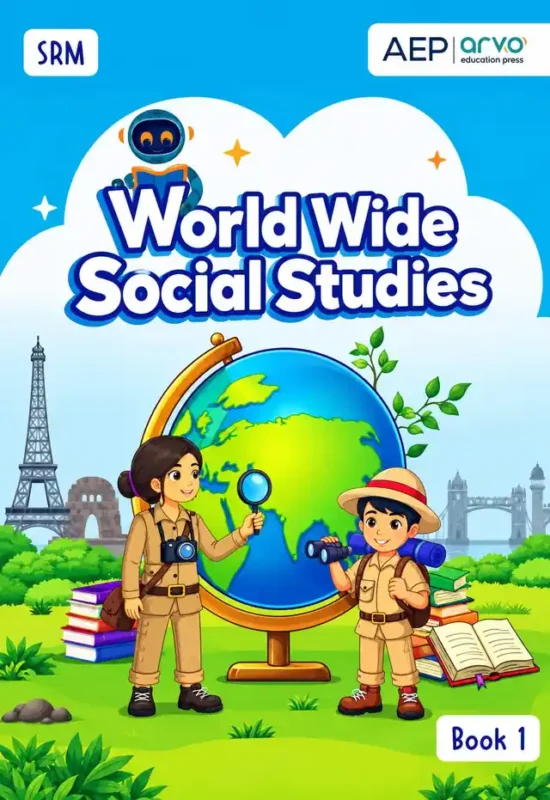
World Wide Social Studies, Book 1 is the Class 1 social studies book of Allied Schools, published by AEP (arvo education press) and marked SRM, available to order now for the 2027-28 session. The cover is a bright blue sky with a white cloud and a little robot reading a book above the title, and a big blue and green globe in the middle with two young explorers: a girl holding a magnifying glass with a camera round her neck, and a boy with binoculars in a safari hat. Behind them are the Eiffel Tower and Tower Bridge, stacks of books and an open atlas, and “Book 1” sits in a white tab at the bottom right.
The title says “World Wide”, but the contents page starts very close to home. The book begins with the child and the family, then moves to school, values, play, the country, transport, the human body, plants and animals, and ends with our Earth, the seasons and the weather. It is a book that teaches a six-year-old to look outward one step at a time. The contents page (headed “Content”) shows 7 units, 13 chapters and well over 100 pages.
SRM on the cover stands for Supplementary Reading Material, the mark Allied School uses for books that sit alongside the main textbooks.
Full table of contents: all 7 units, 13 chapters, every page
The page numbers are as printed on the contents page.
Unit 1: Discovering Self and Immediate Environment
- Chapter 1: Me and My Family (p. 1)
- Chapter 2: My School (p. 11)
Why it helps: The first unit starts with what a Class 1 child knows best: themselves, their family and their classroom. A child who can talk about “my family” and “my school” in words and pictures has taken the first step in social studies, and these two chapters also give new students a friendly way to settle into school life.
Unit 2: Ethics and Values
- Chapter 3: My Values (p. 20)
Why it helps: Habits form early, so the book gives values a chapter of their own right after home and school. This is where parents can reinforce at home what the classroom teaches: honest, kind and respectful behaviour is easier to learn from a story and a picture than from a lecture.
Unit 3: Responsible Citizenship
- Chapter 4: Playtime (p. 27)
Why it helps: Playtime sits under “Responsible Citizenship”, which tells you what the lesson is really about: playing together fairly, taking turns and following rules. For a child this is the first experience of being part of a group, and it is the natural bridge between “me” and “us”.
Unit 4: Patriotism and Knowledge of the Country
- Chapter 5: My Country (p. 37)
Why it helps: One chapter introduces Pakistan to Class 1: who we are and what we call home. It gives parents an easy way to talk about the flag, the national days and local places, and builds pride on top of knowledge.
Unit 5: Goods and Services
- Chapter 6: Means of Transportation (p. 42)
Why it helps: Children see buses, rickshaws, trains and planes every day. This chapter turns that daily sight into a lesson about how people and goods move, which is the first step towards understanding how a community works.
Unit 6: Life Sciences
- Chapter 7: My Body and My Senses (p. 53)
- Chapter 8: Healthy Habits (p. 62)
- Chapter 9: Living and Non-Living Things (p. 72)
- Chapter 10: Plants (p. 80)
- Chapter 11: Animals (p. 88)
Why it helps: The longest unit, five chapters and about 45 pages, moves from the child’s own body and five senses to healthy habits, then outward to the difference between living and non-living things, and to plants and animals. It is the part of the book that most children love, because they can touch, see and name what is being taught. Healthy Habits is a good one to practise at home with hand-washing and sleep routines.
Unit 7: Earth and Space Science
- Chapter 12: Our Earth (p. 99)
- Chapter 13: Seasons and Weather (p. 108)
Why it helps: The book ends by lifting the child’s eyes to the planet and the sky. Our Earth gives the big picture, and Seasons and Weather connect it to something a child feels every week, such as the heat of May and the rain of July. It also closes the circle with the cover’s globe.
What your child gains
- The words and ideas to talk about family, school, values and country.
- Early habits of fairness, teamwork and respect.
- An introduction to the body, health, plants, animals, the Earth and the weather.
- First experience of a textbook with a contents page, chapter titles and page numbers.
Who, what, when, where and how
Whom: Class 1 students of Allied Schools (about six years old). What: the printed Class 1 social studies book, World Wide Social Studies Book 1. When: order before the 2027-28 session starts, or in the first weeks of term. Where: in class, and at home where the chapters on family, health and seasons are easy to talk about. How: read one chapter at a time, ask your child to point to what is in the picture, and connect each chapter to something real: a family photo, a walk, the weather outside.
Frequently asked questions
Is it only social studies, or does it include science?
The contents page shows both: units on the child’s environment, values and country, and also Life Sciences and Earth and Space Science.
What does SRM on the cover mean?
SRM stands for Supplementary Reading Material.
Which publisher is it?
The cover shows AEP | arvo education press. AEP is the publishing arm of the ARVO school platform, which launched its first range of textbooks for Classes 1 to 5 in Lahore in February 2026.
Is there a Class 2 or Class 5 version?
Yes, the same series continues in other classes; each is listed on its own page.
Order World Wide Social Studies Book 1 online with Cash on Delivery across Pakistan, or collect it from our Lahore shop. Message us your child’s class and campus on WhatsApp and we will confirm the edition before we dispatch.