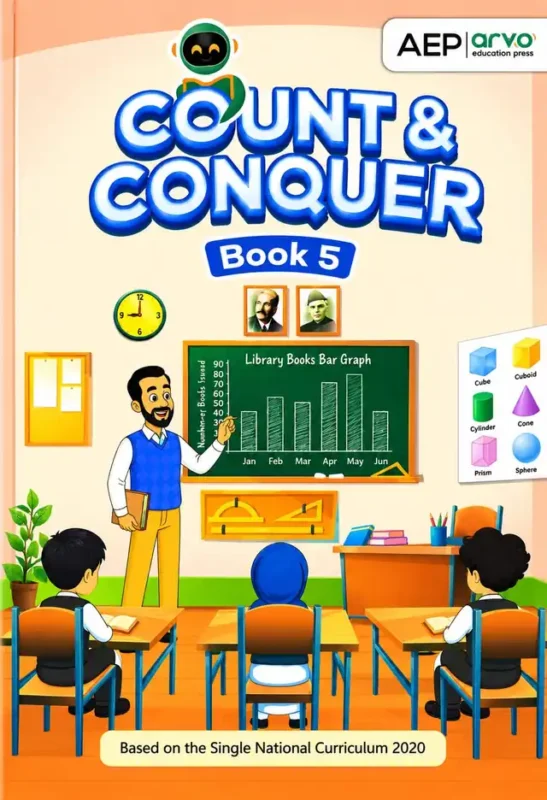
Count & Conquer, Book 5 is the Class 5 mathematics textbook of Allied Schools, published by AEP | arvo education press and, as the orange cover says, ‘Based on the Single National Curriculum 2020’. The cover shows a cheerful teacher with a bar graph titled ‘Library Books Bar Graph’ on the chalkboard, children at their desks, a clock and a set of coloured solids: a classroom that is doing maths for real.
Class 5 maths is the year that decides how comfortable a child will be in secondary school, and in the 2027-28 session this book covers it in ten chapters and about 190 pages: numbers up to 9,999,999, long multiplication and division, HCF and LCM, fractions in all four operations, decimals, percentage, the unitary method, an introduction to algebra and a full chapter of measurement.
Full table of contents: 10 chapters, every topic and page range
The contents are printed over five pages. Every entry is given below exactly as printed (a few lines repeat in the book itself and are shown as printed), with a note on what each chapter builds.
Chapter 1 – Numbers and Place Value (pages 1 to 14)
- 7-digit Numbers up to 9,999,999
- Place Value
Why it helps: Everything starts with place value. Reading and writing numbers into the millions gives children the base for every operation that follows.
Chapter 2 – Addition and Subtraction (pages 15 to 40)
- Addition (Adding Up to 6-Digit Numbers without Regrouping: From 1-Digit to 6-Digit Addends)
- Real-world Word Problems involving Addition
- Subtraction (Subtraction Up to 6-Digit Numbers without Regrouping: From 1-Digit to 6-Digit Numbers)
- Subtraction Up to 6-Digit Numbers with Regrouping: From 1-Digit to 6-Digit Numbers
- Solve real-world word problems involving subtraction
- Estimate the Answer to an Addition and subtraction
- Estimate Subtraction
Why it helps: Large-number addition and subtraction, first without and then with regrouping, followed by word problems and estimation. Estimating teaches children to check whether an answer is reasonable before they write it.
Chapter 3 – Multiplication and Division (pages 41 to 62)
- Multiplication (Multiply 5-digit Numbers by 1-digit Number)
- Multiplication (Multiply 5-digit Numbers by 2-digit Number)
- Multiplication (Multiply 5-digit Numbers by 3-digit Number)
- Real-world word problems involving multiplication
- Division (Divide 5-digit Numbers by 1-digit Number)
- Divide 5-digit Numbers by 1-digit Number
- Real-world word problems involving division
- Solve real-world word problems involving addition, subtraction, multiplication and division
- Divisibility Rules for 7 and 11
Why it helps: This is the arithmetic core of the year: multiplying by one, two and three digits, long division, word problems that mix all four operations, and the divisibility rules for 7 and 11, a shortcut that impresses exam markers.
Chapter 4 – Multiples and Factors (pages 63 to 77)
- 2-digit Prime and Composite Numbers up to 100
- Prime Numbers
- H.C.F and L.C.M
- Real-world word problems involving multiplication
- Highest Common Factor (H.C.F)
- Highest Common Factor (H.C.F) (repeated in the printed list)
Why it helps: Prime and composite numbers, HCF and LCM are the foundation of fractions. Without them, adding unlike fractions is guesswork.
Chapter 5 – Fractions (pages 78 to 101)
- Multiplication
- Ordering Fractions
- Addition of Fractions and Mixed Numbers
- Real-world Word Problems of Addition
- Division (Divide 5-digit Numbers by 1-digit Number) (as printed in this list)
- Subtracting Fractions and Mixed Numbers
- Real-world Word Problems of Subtraction
- Multiplication of Fractions and Mixed Numbers
- Real-world Word Problems of Multiplication
- Division of Fractions and Mixed Numbers
- Real-world Word Problems of Division
Why it helps: The longest chapter of the book: ordering fractions, then all four operations with fractions and mixed numbers, each followed by real-world word problems. Fractions are the hardest topic of Class 5, so the book gives them 24 pages.
Chapter 6 – Decimals (pages 102 to 135)
- Decimals
- Convert fractions to decimals
- Comparing Decimal Numbers
- Ordering Decimal Numbers
- Rounding the Decimal Numbers (with three decimal places)
- Addition of Decimal Numbers
- Subtraction of Decimal Numbers
- Multiply one decimal place numbers by up to 3-digit whole numbers
- Multiply two decimal place numbers by up to 3-digit whole numbers
- Divide two decimal places by up to 2-digit whole numbers
- Divide 2-digit numbers with one decimal place
- Multiply up to two decimal place number by 10
- Multiply up to two decimal place numbers by 100
- Multiply up to two decimal place numbers by 1000
- Divide a number up to two decimal places by 10
- Divide a number up to two decimal places by 100
- Divide a number up to two decimal places by 1000
- Real-world word problems (Addition, Subtraction, Multiplication)
- Order of operations
Why it helps: From converting fractions to decimals, through comparing, ordering and rounding, to all four operations and multiplying and dividing by 10, 100 and 1000. The order of operations ends the chapter, so children learn which part of a long sum to do first.
Chapter 7 – Percentage (pages 136 to 146)
- Percentage
- Convert fraction to percentage
- Convert percentage to fraction
- Convert percentage to decimal
- Convert decimal to percentage
- Real-world word problems
- Percentage and Decimal Equivalent
Why it helps: Percentage links fractions and decimals and appears in discounts, marks and statistics. This chapter gives children all the conversions and the confidence to use them.
Chapter 8 – Unitary Method (pages 147 to 152)
- The value of many objects when the value of one object is given
- The value of one object when the value of many objects is given
- The value of many objects when the value of some objects is given
- Use unitary methods to solve real-world word problems
Why it helps: The unitary method (find the value of one, then of many) is the key to price, speed and recipe problems, and it is among the most tested topics in Class 5.
Chapter 9 – Algebra (pages 153 to 166)
- Square numbers
- Cube numbers
- Number Patterns
- Increasing Pattern
- Decreasing Pattern
Why it helps: Square and cube numbers and increasing and decreasing patterns introduce algebraic thinking: spotting a rule and using it.
Chapter 10 – Measurement (pages 167 to 193)
- Converting Units of Length
- Addition of lengths
- Subtraction of lengths
- Real-world word problems
- Converting units of mass
- Addition of mass
- Subtraction of mass
- Real-world word problems
- Converting Units of Capacity
- Addition of capacities
- Subtraction of capacities
- Real-world word problems
Why it helps: Length, mass and capacity: converting between units, adding and subtracting, and applying all this to real-world problems. These are daily-life skills, from cooking to shopping.
Chapters after page 193
Our photographs of the contents pages show Chapters 1 to 10. The book continues beyond page 193 with further topics, which are not visible on the pages we photographed. If you need the full list before you order, message us on WhatsApp and we will check our copy and reply.
Who, when, where and why
Whom: Class 5 students at Allied Schools (about ten years old). When: through the 2027-28 session. Where: in class and at the homework table. Why: to master the numbers, fractions, decimals and percentages that every secondary maths course assumes.
Frequently asked questions
Is it a textbook or a workbook?
It is the Book 5 mathematics textbook. Check your school list for a separate workbook.
Does it include word problems?
Yes. Most chapters finish with real-world word problems.
Is it based on the Single National Curriculum?
Yes. The cover says ‘Based on the Single National Curriculum 2020’.
Buy Count & Conquer Book 5 from us online and pay when it reaches your door (Cash on Delivery, all over Pakistan). We also ship prepaid orders to Saudi Arabia, UAE, Oman, Qatar, Bahrain and Kuwait.