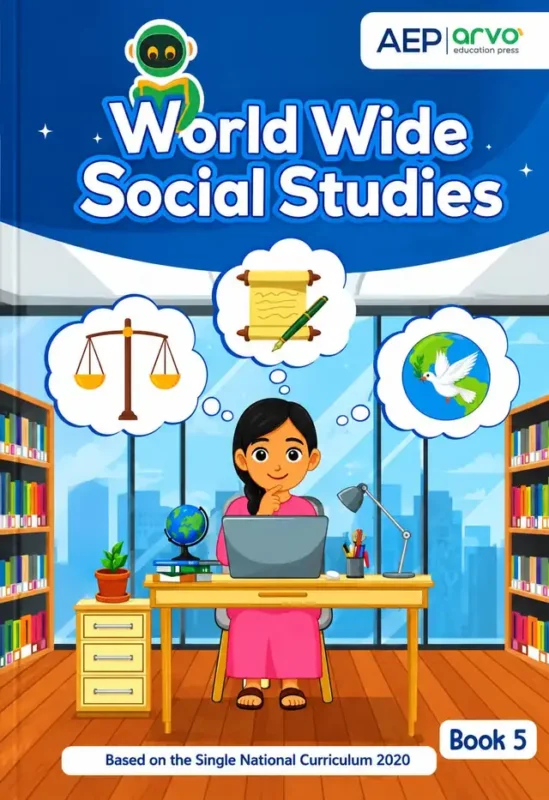
World Wide Social Studies, Book 5 is the Class 5 social studies textbook of Allied Schools, published by AEP | arvo education press and ‘Based on the Single National Curriculum 2020’. The blue cover shows a girl working at a laptop in a library, with thought bubbles above her head: the scales of justice, a scroll, and a globe with a dove. It captures what the book is about: being a thinking citizen of Pakistan and of the world.
The 2020 curriculum is built around learning outcomes, and this book prints them for every chapter. That makes it unusually clear to parents: you can see exactly what your child should be able to do by the end of each chapter. For the 2027-28 session, it covers 15 chapters in six units: citizenship, culture and diversity, state and government, history, geography and economics.
Full table of contents: 6 units, 15 chapters, with learning outcomes
The contents pages list each chapter with its page number and the outcomes the student is expected to reach. They are given below, as printed and condensed only where several lines say the same thing.
Unit 1 – Citizenship: Chapter 1, Building a Peaceful Community (page 1)
- Identify the fundamental human rights as stated by the UN Charter
- Establish that all individuals have equal rights, irrespective of religious and ethnic differences
- Appreciate and respect differences in opinion
- Explain the importance of freedom of speech and demonstrate using it appropriately
- Demonstrate the importance of discussion and negotiation as tools for resolving conflicts at home and school
- Propose ways to create peace and harmony
Why it helps: The first chapter teaches the rights every person has and how to disagree politely. It gives children the tools to settle arguments at home and school, which is where citizenship starts.
Chapter 2 – Digital Citizens in the Age of Media (page 9)
- Recognise the ethics of being digital citizens when connected online, and how to deal with differences of opinion
- Reflect on their own and society’s common etiquette in today’s world
- Describe the concept of mass media and social media
- Investigate their respective advantages and disadvantages
- Recognise the need to verify information received through social media and mass media
Why it helps: A modern chapter on media. Children learn online etiquette and, importantly, to check information before they believe or share it.
Unit 2 – Culture and Diversity: Chapter 3, Building an Inclusive and Multicultural Society (page 15)
- Describe inclusion and explain its benefits for a nation
- List ways in which Pakistan can be made more inclusive for women, religious and ethnic minorities, and mixed-ability groups
- Explain shared values and norms amongst diverse cultures of Pakistan (hospitality, sports, events, resilience)
- Identify the norms and advantages of a multicultural society
- Describe the term ‘Interfaith Harmony’
Why it helps: This chapter builds respect: how a country can include everyone, what Pakistan’s cultures share, and what interfaith harmony means.
Unit 3 – State and Government: Chapter 4, The Constitution and Rule of Law in Pakistan (page 22)
- Distinguish between rules and laws and how they help create a just and healthy political environment in a country
- Describe and analyse the need and importance of a constitution
- Discuss the rights and responsibilities of a Pakistani citizen according to the 1973 Constitution
- Describe the importance of the rule of law against unjust and illegal activities
Why it helps: Rules, laws and the 1973 Constitution explained for a ten-year-old, with an emphasis on both rights and responsibilities.
Chapter 5 – Democracy and the Structure of Government in Pakistan (page 28)
- Describe the concept of democracy and its importance for the people
- Describe the formation and function of political parties in a democratic government, and how they contest elections according to their manifesto
- Describe the components of a government: Legislature, Executive, Judiciary
- Give reasons for the need for a federal government
- Explain the interdependence between federal, provincial, and local governments in Pakistan
Why it helps: How Pakistan is governed: parties, elections, the three branches and the three levels of government.
Unit 4 – History: Chapter 6, Learning from the Past (page 35)
- Illustrate ancient civilisations such as Mesopotamian, Egyptian, Indus Valley, Gandhara on a timeline
- Describe significant aspects of daily life, society and culture of the Egyptian Civilisation
- Describe significant aspects of daily life, society and culture of the following early civilisations: Mesopotamia/Chinese/Gandhara
Why it helps: Ancient civilisations, including the Indus Valley and Gandhara on Pakistani soil, placed on a timeline so that children grasp how long ago they flourished.
Chapter 7 – Our National Heroes (page 42)
- Analyse and discuss the key contributions of the following national heroes: Sir Syed Ahmed Khan, Begum Ra’ana Liaqat Ali Khan, Begum Jahanara (surname cut off in our photograph) and Rehmat Ali
Why it helps: The lives and contributions of national heroes, including women leaders, give children role models from their own history.
Chapter 8 – Role of Regions and Minorities in Pakistan’s Creation (page 48)
- Explain the region’s/province’s contribution to the creation of Pakistan
- Describe the role of minorities in the creation and development of Pakistan
Why it helps: Every province and community played a part in Pakistan’s creation. This chapter makes that clear.
Unit 5 – Geography: Chapter 9, Understanding Maps and Coordinates (page 55)
- Recognise different types of maps, for example road map, tourist map, weather map, political map, and topographical map
- Apply the concept of BOLTSS (Border, Orientation, Legend, Title, Scale and Source) with the help of a political or physical map
- Define ‘scale’ in reading maps and their types with the help of diagrams
- Recognise the characteristics of latitudes, longitudes, and time zone
- Use latitudes and longitudes in determining location through Grid Reference
Why it helps: Real map skills: types of maps, the BOLTSS checklist, scale, latitude, longitude and grid references. These are tested in every geography paper.
Chapter 10 – Living with the Land (page 63)
- Briefly describe the distinctive characteristics/features of each physical region of Pakistan
- Explain how the physical environment affects the lifestyle of people
- Identify different occupations of people (agriculture, mining, and industry)
- Reflect on which occupation appeals the most to them
Why it helps: Pakistan’s regions and how land shapes work and life, with a reflective question about the child’s own future.
Chapter 11 – Global Warming and Climate Change (page 70)
- Describe factors that determine/affect climate
- Explain the concept of global warming
- Analyse the impact of Global Warming on climate change
Why it helps: What decides climate and how global warming is changing it, a topic children hear about at school and in the news.
Chapter 12 – Natural Disasters and Their Impacts (page 76)
- Examine how common natural disasters occur (floods, earthquakes, cyclones, avalanches) and how they affect human life
- Suggest safety measures that can be taken in case of natural disasters such as floods and earthquakes (before, during, and after)
- Investigate how at least one natural disaster in the past affected the affected areas and their population
- Describe the concept of and assess the need for food security in Pakistan
Why it helps: Floods and earthquakes are real events in Pakistan. Children learn safety measures for before, during and after a disaster, plus why food security matters.
Unit 6 – Economics: Chapter 13, Trade (page 83)
- Recall the terms goods and services
- Differentiate between public and private goods and services
- Define ‘trade’, ‘business’, and ‘e-commerce’
- Define ‘export’ and ‘imports’
- State the major imports and exports of Pakistan
- Describe the importance of International Trade for the development of Pakistan
- Identify major means of transportation in trade and business
Why it helps: How goods move and why countries trade, including e-commerce and Pakistan’s main imports and exports.
Chapter 14 – Entrepreneurship and Business Creation (page 91)
- Illustrate examples of entrepreneurial skills and competencies
- Discuss the contribution of at least two Pakistani entrepreneurs (one male and one female)
- Create and present their own hypothetical business/enterprise
Why it helps: Children study Pakistani entrepreneurs and then create and present a business of their own.
Chapter 15 – Money, Banking and Inflation (page 97)
- Narrate with examples the evolution of money, trade via the barter system before money was introduced
- Identify the currencies of different countries
- Identify the role of the State Bank of Pakistan
- Explain the role of commercial banks in the lives of individuals and businesses
- Define the term ‘Inflation’ and evaluate how it affects the purchasing power of people
- List different causes and types of inflation
- Identify the importance of taxes and government loans to pay for goods and services (for example roads, hospitals, schools, electricity)
Why it helps: From barter to the State Bank, inflation and taxes: the economics that adults talk about, explained so a Class 5 child can follow.
Who, when, where and why
Whom: Class 5 students at Allied Schools (about ten years old), and parents who want to see the learning outcomes their child is aiming for. When: through the 2027-28 session. Where: in class and in family conversations about the news. Why: to prepare children to be informed, responsible citizens, as the Single National Curriculum 2020 intends.
Frequently asked questions
Are learning outcomes printed in the book?
Yes. The contents pages print the outcomes for every chapter.
How many units are there?
Six, from Citizenship to Economics.
Is it based on the Single National Curriculum?
Yes. The cover says ‘Based on the Single National Curriculum 2020’.
You can order World Wide Social Studies Book 5 online today. We ship across Pakistan on Cash on Delivery, and families in Lahore can also pick it up from our shop. For overseas delivery (Gulf countries), message us on WhatsApp.