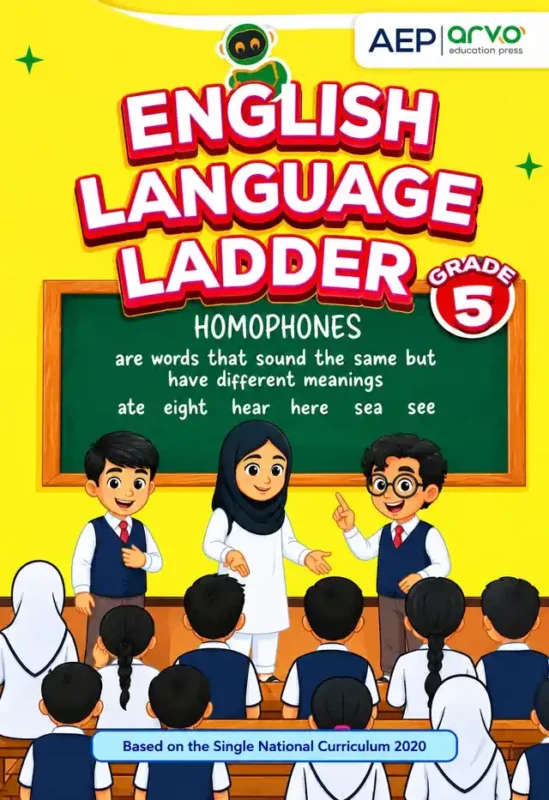
English Language Ladder, Grade 5 is the Class 5 English coursebook used in Allied Schools, a project of the Punjab Group of Colleges. It is published by AEP | arvo education press and, as the yellow cover says, is ‘Based on the Single National Curriculum 2020’. The cover shows a classroom scene: a teacher at a chalkboard that explains homophones (ate and eight, hear and here, sea and see), a robot mascot, and a row of school children, one of them waving.
If your child is in Class 5 for the 2027-28 session, this is the book that carries the English year. It does something clever: every unit starts from a theme that matters (honesty, caring for the planet, equality, courage, friendship) and builds reading, vocabulary, grammar, speaking and writing around it, so English is learned through ideas worth talking about.
Full table of contents: 10 units and 2 reviews, every theme and skill
The contents are printed as two wide tables over two pages (vi and vii). They are rewritten below unit by unit, with every column kept: theme, sub themes, reading and critical thinking, vocabulary and grammar, oral communication and writing.
Unit 1 – The Mercy of Muhammad Rasoolullah (Peace Be Upon Him) (page 1)
- Theme: Hazrat Muhammad Rasoolullah (Peace Be Upon Him); Ethics and Values
- Sub themes: Incidents from the life of Hazrat Muhammad Rasoolullah (Peace Be Upon Him)
- Reading and critical thinking: High-Frequency and Irregular Words; Contractions; Silent Letters and Spelling Patterns; Reading Strategies
- Vocabulary and grammar: Naming, Action, and Describing Words; Words for Feelings and Emotions; Types of Nouns; Using Simple Present Tense
- Oral communication: Listening with Understanding; Non-Verbal Communication; Speaking for Different Listeners
- Writing: Syllables in Long Words; Joined-Up Handwriting; Using Punctuation Correctly
Why it helps: The year opens with the life of the Prophet (peace be upon him), which sets the moral tone. It also revises the basics (nouns, verbs, adjectives, simple present) so every child starts together, and trains careful reading with irregular words and silent letters.
Unit 2 – A Mother’s Love (Poem) (page 21)
- Theme: Ethics and Values
- Sub themes: Regard for Family; Tolerance; Responsibility; Politeness
- Reading and critical thinking: Rhyme, Rhythm, and Repetition; Identifying the Narrator; Summarising the Text; Understanding New Words; Finding and Listing Key Points; Reading for Pleasure
- Vocabulary and grammar: Creating Rhyming Strings; Dictation; Using a Dictionary & Thesaurus; Working with Pronouns & Pronouns (as printed); Using Present Continuous Tense
- Oral communication: Using Context Clues
- Writing: Writing a haiku; Summary Skills; Writing main idea
Why it helps: A poem about a mother lets children feel rhythm before analysing it. They learn to summarise, to use a dictionary and thesaurus, to write a short haiku, and to name the main idea, three skills that matter for every exam.
Unit 3 – A Sustainable Choice (page 39)
- Theme: Environmental education
- Sub themes: Making sustainable lifestyle choices
- Reading and critical thinking: Reading with Understanding and Expression; Phonics and Word Study; Exploring a Variety of Texts; Making Connections across Texts
- Vocabulary and grammar: Suffixes; Forming Nouns and Adjectives; Types of Adjectives and Their Uses; Degrees and Participial Adjectives; Using Present Perfect Tense
- Oral communication: Listening for Main Ideas
- Writing: Understanding Spelling Patterns; Guided Writing Practice; Drafting and Editing; Write a formal letter/email
Why it helps: Caring for the planet is taught with real grammar: adjectives, their degrees, and the present perfect. Children also draft and edit a formal letter or email, a life skill they can use in secondary school.
Unit 4 – The Disappearing Pencil Case (page 58)
- Theme: Life Skills
- Sub themes: Curiosity and Learning
- Reading and critical thinking: Spelling and Sound Awareness; Identifying Viewpoint, Purpose, Themes, and Ideas; Exploring How Texts Are Organised; Understanding and Answering Wh-Questions
- Vocabulary and grammar: Making Anagrams; Using Articles Correctly; Quantifiers and Demonstratives; Verb Forms and Usage
- Oral communication: Listening and Speaking with Respect
- Writing: Writing with Purpose and Process
Why it helps: A mystery about a missing pencil case keeps children curious while they learn articles, quantifiers and verb forms. Wh-questions teach them to find answers in a text, and anagrams make spelling a game.
Unit 5 – Give Lavishly! Live Abundantly! (Poem) (page 76)
- Theme: Peaceful Co-existence / Peace education
- Sub themes: Helping others / generosity; Respecting others and self
- Reading and critical thinking: Inferring Word Meaning; Finding and Listing Key Information
- Vocabulary and grammar: Metaphor & simile; Understanding Verb Types; Using Adverbs Effectively; Using Past Continuous Tense
- Oral communication: Speaking in Turns; Asking and Explaining; Listening for Meaning
- Writing: Spelling Rules and Patterns; Descriptive Writing with Adjectives and Adverbs; Creating Atmosphere and Character Through Imagery
Why it helps: A second poem, this time about generosity, introduces metaphor and simile and the past continuous. Writing with imagery teaches children how writers make a reader see and feel.
Review of Units 1 to 5 (page 90)
- Revision of the first five units
Why it helps: A review after Unit 5 lets the teacher and parent check what has stuck before the second half begins.
Unit 6 – Women’s Leadership and Equality (page 95)
- Theme: Gender Equality and Equity
- Sub themes: Importance of Female Education; Gender-Balanced Roles in Domestic Setup; Equal Access to Basic Needs
- Reading and critical thinking: Reading Fiction and Non-Fiction; Reading for Evidence and Meaning
- Vocabulary and grammar: Phrases and Sentences; Kinds of Sentences; Transitional Words; Direct & indirect Speech
- Oral communication: Phrases and Sentences; Kinds of Sentences; Transitional Words; Direct Speech in Narration (as printed)
- Writing: Enacting Short Plays and Role Plays; Using Dialogue, Gestures, and Movement to Show Emotion
Why it helps: A strong topic for a ten-year-old who is forming views on fairness. Children study kinds of sentences and direct and indirect speech, then act out short plays, which turns grammar into performance.
Unit 7 – Major Shabbir Sharif Shaheed (page 112)
- Theme: Awardees of Nishan-e-Haider
- Sub themes: Awardees of Nishan-e-Haider
- Reading and critical thinking: Point of View in a Story; Understanding Characters and Plot; Exploring Text Types and Purpose; Paragraph Structure and Main Idea
- Vocabulary and grammar: Understanding How Settings and Characters Are Built; Reading Media Texts; Reading for Enjoyment and Insight
- Oral communication: Compound Words; Homophones; Modal Verbs; Using will, shall, and be going to + Infinitive to Show Future Actions
- Writing: Writing Descriptive Paragraphs; Write short texts in speech bubbles and cartoon strips
Why it helps: The life of a national hero teaches courage and pride. Skills include point of view, paragraphs, homophones (the book’s cover theme) and modal verbs, and children practise descriptive writing.
Unit 8 – Who Has Seen the Wind? (Poem) (page 129)
- Theme: Nature
- Sub themes: Hills, rivers, lakes, plains, deserts, mountains etc.
- Reading and critical thinking: Using Pre-Reading Strategies; Enjoying Different Kinds of Texts
- Vocabulary and grammar: Using Pre-Reading Strategies; Enjoying Different Kinds of Texts
- Oral communication: Figurative Language; Working with Abbreviations and Hyphens; Using Punctuation in Sentences
- Writing: Listening and Responding in Group Discussions
Why it helps: A third poem, about the wind, develops figurative language and punctuation. Group discussion gives quieter children a safe way to speak.
Unit 9 – The Friendship Circle (page 143)
- Theme: Self, People, Places & Globe; Patriotism / National Pride
- Sub themes: Knowing children from all provinces, Gilgit-Baltistan and Azad Jammu & Kashmir; Including minority communities, to explore what it means to be a Pakistani
- Reading and critical thinking: Understanding Preferences and Perspectives; Reading and Enjoying Narratives
- Vocabulary and grammar: Synonyms with positive and negative connotations; Using Joining Words in Sentences
- Oral communication: Using Joining Words in Sentences; Capitalisation Rules
- Writing: Writing narratives to develop real or imagined experiences
Why it helps: Children meet friends from every province and community. They learn that words carry positive and negative shades, and they write their own narratives, an essential skill for the Class 5 exam.
Unit 10 – A Tree for the Future (page 156)
- Theme: Introduction to climate change; Plantation of trees
- Sub themes: Taking/handling responsibility; Organizing personal belongings
- Reading and critical thinking: Reading to Follow procedures, labels & captions; Using transitional words and phrases; Sequencing and Linking Ideas
- Vocabulary and grammar: Differentiating between main & subordinate clauses; Forming questions & answers by varying sentence structure
- Oral communication: Engaging in Communication; Prepare and present an argument to persuade others
- Writing: Writing Informative and Explanatory Texts
Why it helps: The year ends with trees and climate change. Children learn main and subordinate clauses, prepare a persuasive argument and write explanatory texts, a fitting close that links English to action.
Review of Units 6 to 10 (page 170) and Glossary (page 175)
- Review Units 6 to 10 (page 170)
- Glossary (page 175)
Why it helps: The final review and a glossary at the back give the child a place to revise and to look up difficult words.
What makes this book useful
Each unit combines the same six strands (reading, vocabulary and grammar, oral work, writing, a theme and a sub-theme), so the book trains all four language skills together. The poems and the national-hero lesson also bring Pakistani and Islamic values into English lessons, which parents tend to appreciate.
Who, when, where and why
Whom: Class 5 students at Allied Schools (about ten years old). When: through the 2027-28 session, roughly one unit every three to four weeks. Where: in class and at home. Why: to build reading, grammar, speaking and writing skills in line with the Single National Curriculum 2020.
Frequently asked questions
Does it include poems?
Yes: A Mother’s Love, Give Lavishly! Live Abundantly! and Who Has Seen the Wind?
Does it have reviews?
Yes, a review after Units 1 to 5 and another after Units 6 to 10, plus a glossary.
Is it based on the Single National Curriculum?
Yes. The cover says ‘Based on the Single National Curriculum 2020’.
We deliver English Language Ladder Grade 5 to every city in Pakistan with Cash on Delivery, and you are welcome to collect it from our Lahore shop. If your school sent a book list, send it to us on WhatsApp and we will put the whole set together.