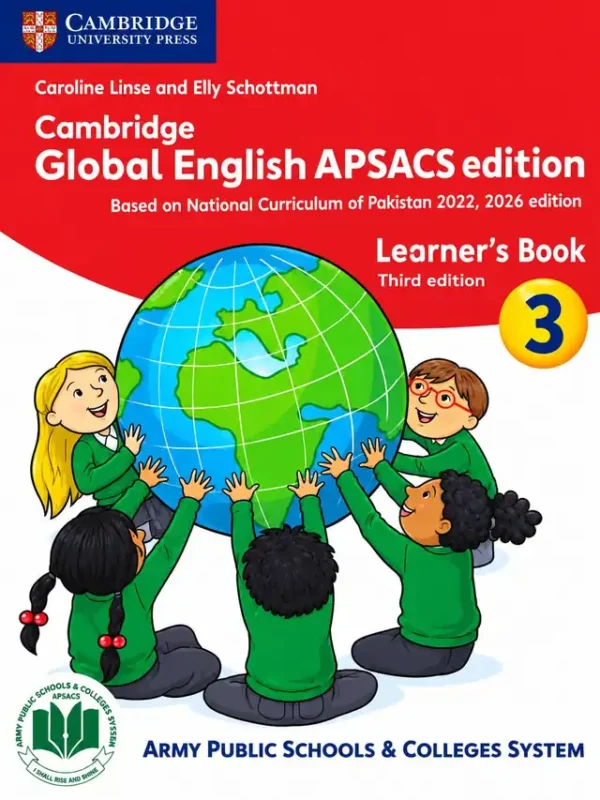
Cambridge Global English APSACS Edition, Learner’s Book 3 (Third edition) is the Class 3 English coursebook of the Army Public Schools & Colleges System. It is published by Cambridge University Press, written by Caroline Linse and Elly Schottman, and the red cover (children in green uniforms holding a globe) carries the line ‘Based on National Curriculum of Pakistan 2022, 2026 edition’. Available to order now for the 2027-28 session.
Class 3 is where English stops being only about words and starts being about ideas. In this book children read about Ramadan and wedding customs, desert animals, optical illusions, young inventors, dinosaurs, secret codes, the human body and robots, and they write letters, autobiographies, poems, riddles and instructions about them.
Why Learner’s Book 3 matters
Class 3 is a hinge year. Children are expected to read information texts, follow multi-step instructions, write short paragraphs with correct punctuation and speak in full sentences. Learner’s Book 3 supports that shift with nine units, each combining grammar, a reading text, a poem, a writing task, listening and speaking practice, a link to another subject and a values lesson. It is the book teachers build the year around, and the book your child will bring home most often.
Full table of contents: Units 1 to 9 and the back-of-book sections
The contents are printed as a wide table over two pages. Below it is rewritten unit by unit, keeping every column: words and expressions, use of English, reading and writing, listening and speaking, school subjects, pronunciation and word study, and critical thinking and values.
Unit 1: Working together (pages 6 to 19)
- Words and expressions: Action verbs; Ways of moving; Sports words: match, win, goal, etc.; Expressions of encouragement; What does … mean?; How about … ?; want to; left/right; easy/difficult.
- Use of English: Present Continuous to describe events; Question words: where, what, how, who; Gerund: be good at + noun/-ing; Subject pronouns; Word order in questions with longer noun phrases.
- Reading and writing: Follow instructions; Information text: Ramadan; Poem: Rope Rhyme; Traditional tale (play script): Whose team are you on?; Write compound sentences using but; Write a letter of apology.
- Listening and speaking: Listen for information; Listen and identify; Give opinions: easy or difficult; Describe what people are doing; Ask and answer questions about a picture; Make suggestions, give encouragement, apologise.
- School subjects: PE: Learn a dance; Maths: Simple bar chart and counting in 5s and 10s; Science: Birds and mammals.
- Phonics and word study: Rhyming words; Common homonyms; Identify action verbs; Spelling rules for words ending in -ing; Paired spelling dictation.
- Critical thinking and values: Classifying; Values: Working as a team; Encouraging others; Discussing rules for fair play.
Why it helps: Teamwork is a strong opening theme for a year of group work. The child learns to encourage, to apologise in writing and to describe what people are doing, and the Ramadan information text connects English to the child’s own culture.
Unit 2: Family and memories (pages 20 to 33)
- Words and expressions: Weddings; Extended family; first, next, then, finally; Months of the year; Dates; Title (Mr, Mrs, Miss, Ms), first name, surname.
- Use of English: Prepositions: next to, in front of; Adverbs of sequence: first, next, then; will for prediction; Statements and questions with was/were; could/couldn’t; be called; to/from (with cards and presents).
- Reading and writing: Follow instructions; Information text: Wedding customs around the world; Poem: The End; Autobiography: Memories of family events; Reading strategy: Scan text for information; Describe people in a photo; Combine sentences with and; Write about a memory.
- Listening and speaking: Listen for information; Listen and discuss an extended narrative (birthday tradition in Korea; Mexican pinata); Talk about family and family celebrations; Describe location; Ask and answer questions about birthday dates and celebrations.
- School subjects: Maths: Ordinal numbers; Geography: Countries around the world; flags.
- Phonics and word study: Rhyming words; Borrowed words; Opposites; Create a picture glossary.
- Critical thinking and values: Comparing and contrasting customs in different countries; Sequencing events; Values: Polite language: How to address adults.
Why it helps: Wedding customs, birthdays and family memories give children a personal, emotional reason to write. They learn to scan a text for information and to address adults politely, both useful life skills.
Unit 3: The desert (pages 34 to 49)
- Words and expressions: Desert: Landscape, weather, animals, plants; Parts of the body (animals); Parts of a plant; Adjectives describing personal qualities.
- Use of English: Comparative and superlative adjectives; all, many, a few; Understanding subject pronouns it and they within texts; Past Simple: regular and irregular forms; Why? Because …
- Reading and writing: Follow instructions; Information texts: Desert animals, desert plants; Poem: Desert; Traditional tales: Two Friends; Rattlesnake and Mouse; Write a chart using given information; Turn notes into full sentences; Draw and label a picture; Write and punctuate dialogue.
- Listening and speaking: Listen for information; Discuss and ask questions about a story; Perform dialogue; Act out a story; Discuss friendship.
- School subjects: Geography: Identify deserts on world map; understand desert weather; Maths/Science: Understand temperature; Science: How living things adapt to their habitat; Maths: Venn diagram.
- Phonics and word study: Spelling rules for comparative and superlative adjectives; Opposites; Use illustrations and context clues to guess the meaning of unfamiliar words.
- Critical thinking and values: Comparing and contrasting; Understanding the difference between fiction and non-fiction; Drawing inferences from a story; Values: Discussing trickery and what is fair; Discussing the qualities of a good friend.
Why it helps: Deserts are a topic children rarely meet at home, which makes the unit a pleasure. Turning notes into full sentences and writing dialogue are exactly the skills Class 3 tests, and the two traditional tales raise the question of what makes a good friend.
Unit 4: Look again (pages 50 to 63)
- Words and expressions: Shapes; Parts of the body: finger, eye, brain; Words to describe people, animals and environments.
- Use of English: Adverbs of frequency; word order with verb to be; Prepositions of location; Object pronouns: him, her, it, them, me.
- Reading and writing: Follow instructions; Information text: Optical illusions, animal camouflage; Poem: Grayish, Greenish; Write a description of a picture; Write sentences using list commas.
- Listening and speaking: Follow aural instructions; Listen to differences between British and American pronunciation; Describe where things and people are; Discuss results of experiments.
- School subjects: Maths: Measure length; Science: How our eyes and brain work together; Science: How/why animals use camouflage; Art/Technology: Make a thaumatrope.
- Phonics and word study: Prefixes un- and im-; Use understanding of rhyme to complete a poem.
- Critical thinking and values: Conducting experiments and discussing results; Solving puzzles; Values: You can’t always believe your eyes.
Why it helps: Optical illusions turn grammar into a game. The unit also gives the child a first scientific method: observe, test and discuss the result, and its thaumatrope craft shows how the eye and brain work together.
Unit 5: Inventors and inventions (pages 64 to 77)
- Words and expressions: Opinions: a good/bad idea, useful, silly, fun; Word families: inventor, invent, invention; Kinds of containers; to be born.
- Use of English: used to to say how things were different; How to say years (e.g. 2014, 1986); have to to express obligation.
- Reading and writing: Information texts: A history of inventions; problems and solutions; Poem: The straw – 1888; Rhyming story: Jack’s dream home; Draw and write about your own invention; Describe a room in a dream house; Revision: Final punctuation marks.
- Listening and speaking: Listen to and understand dialogue; Listen for information; Give opinions; Speculate on how things used to be different.
- School subjects: History: Learn about some important inventions; Art/Technology: Design a room in a dream house.
- Phonics and word study: Word families; Rhyming words; Use context clues to guess meaning of unfamiliar words.
- Critical thinking and values: Understanding that new things are invented to solve a problem.
Why it helps: Children are natural inventors, so asking them to draw and describe their own invention generates real writing. ‘Used to’ and saying years in English are practical grammar points, and the lesson on word families (invent, inventor, invention) builds vocabulary quickly.
Unit 6: Dinosaurs (pages 78 to 91)
- Words and expressions: Language to describe and compare dinosaurs; Long numbers.
- Use of English: Compare things using as (adjective) as …; x years ago; Relative clauses with who and which.
- Reading and writing: Information texts: Dinosaur Q & A; An amazing fossil discovery; Poem: Unfortunately; Create similes with as … as; Describe an imaginary dinosaur; Contrast what scientists used to think and what they think now; Link sentences using but.
- Listening and speaking: Listen for information; Follow aural instructions, including numbers; Talk about prior knowledge of dinosaurs and ask questions; Ask and answer questions about events and dates in your life; Explain supporting evidence for dinosaur facts.
- School subjects: Science: Learn about dinosaurs; Maths: Understand numbers in thousands/millions; History: Understand how a time line works; Maths: Calculate how long ago things happened.
- Phonics and word study: Compound adjectives: plant-eating, meat-eating; Use context clues to guess meaning of unfamiliar words.
- Critical thinking and values: Understanding that scientists are always learning; Discussing qualities of a good scientist; Drawing inferences based on illustrations.
Why it helps: Dinosaurs are the most popular unit with most children. Similes (‘as big as a bus’), relative clauses and time lines are sophisticated tools introduced through an exciting subject, and the lesson that scientists keep learning teaches humility and curiosity.
Unit 7: Puzzles and codes (pages 92 to 105)
- Words and expressions: Colour, pattern and size; Prepositions of location with/without; Crockery and cutlery; to be missing something.
- Use of English: Word order with adjectives (two big yellow stars); Indirect object pronouns; Present perfect for experiences; Irregular past participles.
- Reading and writing: Follow instructions; Information text: Secret codes; Poem: Have you ever done that?; Traditional tale: A fair solution; Solve puzzles and logic problems; Write activity instructions; Link sentences using but.
- Listening and speaking: Follow aural instructions; Describe and compare colour, pattern and size; Roleplay asking for things at lunch; Interview a partner about experiences; Act out a story.
- School subjects: Maths: Use coordinates to make a number code; PSHE: What is fair and unfair.
- Phonics and word study: Synonyms for nice; Use context clues to guess meaning of unfamiliar words.
- Critical thinking and values: Using logic to solve puzzles; Writing and deciphering secret code messages; Drawing inferences about characters’ emotions; Values: Finding fair solutions to problems.
Why it helps: Secret codes make children work hard at grammar without noticing. The present perfect (‘Have you ever…?’) is practised in a partner interview, and writing instructions for an activity prepares them for the kind of writing they will do in science.
Unit 8: Our amazing body (pages 106 to 119)
- Words and expressions: Parts of the body; Healthy habits: Exercise and nutrition; What’s the matter?; Minor injury and illness; go for + noun; Are you doing anything on …?; Would you like to …?
- Use of English: will to express future intention; Offer to help (Shall I …?); Present continuous for future arrangements; Comparative adverbs: more quickly/more slowly than.
- Reading and writing: Follow instructions; Information texts: How can we stay healthy?; Amazing facts quiz; Poem: Miss Polly had a dolly; Make a poster about caring for your teeth; Write a plan for making healthy choices next week.
- Listening and speaking: Follow aural instructions; Listen for information; Role play: Accident/illness; Role play: Making plans; Memorise and recite a poem; Give opinions; Play a vocabulary guessing game.
- School subjects: Science: How exercise affects your heartbeat and breathing; bones and muscles; PSHE: How to stay healthy; Maths: Create and discuss a voting chart.
- Phonics and word study: Synonyms for plenty of; Rhyming words.
- Critical thinking and values: Conducting experiments; discussing findings; Distinguishing fact from opinion; Solving a riddle.
Why it helps: This unit teaches the English a child needs when unwell (‘I have a headache’, ‘Shall I help?’) and links it to healthy habits. A poster on caring for teeth and a plan for healthy choices make the learning practical for home.
Unit 9: Big and little (pages 120 to 133)
- Words and expressions: Robots and what they do; Describing size and weight; x metres/centimetres tall/long; Adjectives to describe character.
- Use of English: Some … Other …; more than and less than with numbers; Revision of comparative and superlative adjectives; the most / the least + noun; Sequence words: first, next, then.
- Reading and writing: Follow instructions; Information text: All kinds of robots; Poem: A pizza the size of the sun; Traditional tall tale: The Tortoise and the Hare; Draw and write about your own robot; Write about a giant pizza, using list commas; Write instructions for an experiment.
- Listening and speaking: Listen to and recognise the speaker’s opinion; Listen to and solve a mathematical puzzle game; Ask and answer questions; Express preference, with reasons; Make predictions; Describe what is happening in a picture.
- School subjects: Science: Advances in technology – robots; Maths: Play a guessing game with numbers more or less than x; number game; Maths: Compare animals’ height and weight; Science: Make predictions about container capacity and conduct an experiment.
- Phonics and word study: Synonyms for big and small; Compound words; Words describing size dimensions: tall, long, short, wide, narrow.
- Critical thinking and values: Comparing and contrasting; Giving opinions and supporting reasons; Conducting an experiment and discussing results; Considering a poet’s choice of words; Values: Considering what qualities make a character a hero.
Why it helps: The year ends with robots, a giant pizza and the Tortoise and the Hare, all fun, all full of comparatives and superlatives. The values question about what makes a hero ends the course on a thoughtful note.
Back of the book: Phonics, Picture dictionary and SNC themes (pages 134 to 156)
- Phonics (pp. 134-143)
- Picture dictionary: Review of vocabulary and themes (pp. 144-154)
- SNC themes: A mapping grid of the SNC themes (pp. 155-156)
Why it helps: The last 23 pages are for revision: phonics practice, a picture dictionary for vocabulary, and a grid mapping each unit to the Single National Curriculum themes.
Who, when and how
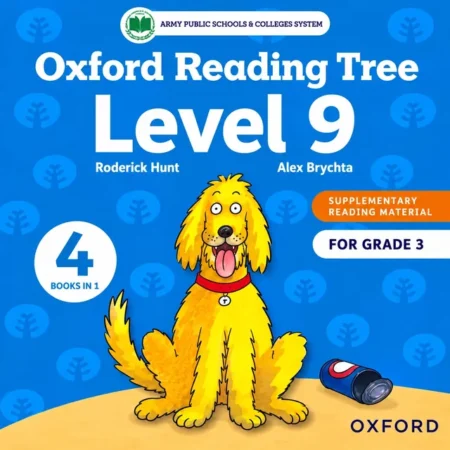
The Learner’s Book is for Class 3 students at Army Public Schools (about eight years old). It is used in the English lesson through the year, roughly one unit per month. Use it with the Activity Book (sold separately) for homework, and with the Class 3 reader (Oxford Reading Tree Level 9) for home reading.
- What: Cambridge University Press, Cambridge Global English APSACS edition, Learner’s Book 3, Third edition.
- Whom: Class 3 students; written by Caroline Linse and Elly Schottman.
- Why: a complete English course aligned to the National Curriculum of Pakistan 2022.
- Where: in class and at home.
Frequently asked questions
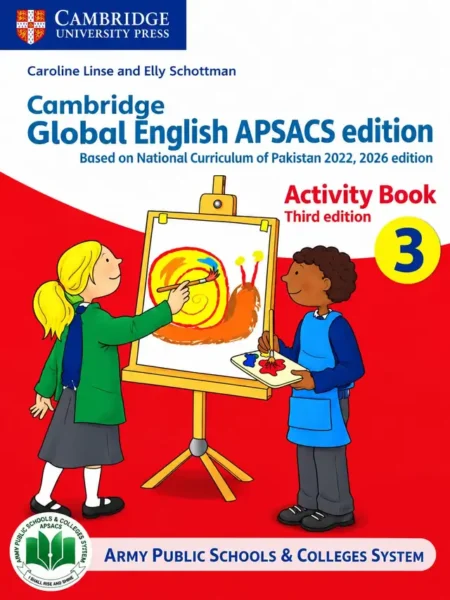
Does Class 3 also need the Activity Book?
The Activity Book follows the same nine units and is used for practice and homework. Most families buy both.
Is this the right edition for Army Public Schools?
It is the APSACS edition: the cover has the Army Public Schools & Colleges System logo and says ‘Based on National Curriculum of Pakistan 2022, 2026 edition’.
What are the units about?
Teamwork, family and memories, the desert, optical illusions, inventions, dinosaurs, puzzles and codes, the human body, and big and little things (robots).
Order the Cambridge Global English Learner’s Book 3 online with Cash on Delivery across Pakistan, or visit our shop in Lahore. Message us the class and campus on WhatsApp and we will confirm the edition before we dispatch.