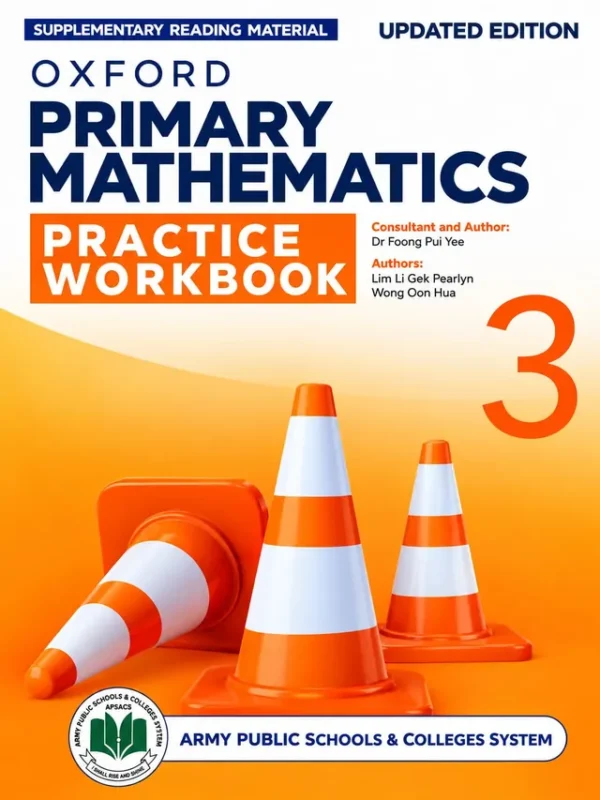
Oxford Primary Mathematics, Practice Workbook 3 (Updated Edition) is the written-practice partner of the Class 3 Students’ Course Book in Army Public Schools. The cover says ‘Supplementary Reading Material’, names Dr Foong Pui Yee as consultant and author, and shows two orange traffic cones. It is published by Oxford University Press Pakistan. Available to order now for the 2027-28 session.
With 12 chapters, a Math Lab Activity and a 140-page glossary reference, this is the most complete workbook of the early series. It gives a child the written practice that makes tables, division and fractions automatic.
Full table of contents: Chapters 1 to 12, Math Lab Activity and Glossary
The contents are printed over two pages. Every lesson is given below with its page number as printed (a few page numbers at the edge of the photograph are not legible, and are left out).
Chapter 1: Numbers to 10 000
- Counting to 10 000 (p. 2)
- Place Value (p. 4)
- Comparing and Ordering Numbers (p. 10)
- Rounding Numbers (p. 14)
- Number Patterns (p. 16)
- Odd and Even Numbers (p. 18)
- Roman Numerals (p. 20)
Why it helps: Written practice on thousands, hundreds, tens and ones is the best way to fix place value.
Chapter 2: Addition and Subtraction Within 10 000
- Addition (p. 22)
- Subtraction (p. 27)
Why it helps: Four-digit sums and differences, with regrouping.
Chapter 3: Multiplication and Division
- Multiplication Tables of 6, 7, 8, and 9 (p. 32)
- Multiplying With Regrouping (p. 48)
- Division (p. 50)
- Dividing Without Regrouping (p. 54)
- Dividing With Regrouping (p. 58)
- Quotient and Remainder (p. 62)
Why it helps: Table practice and long division, the heart of the year.
Chapter 4: Length
- Length in Metres and Centimetres
- Length in Kilometres and Metres
Why it helps: Practice converting and comparing lengths.
Chapter 5: Mass
- Mass in Kilograms and Grams (p. 74)
Why it helps: Reading scales and converting between kilograms and grams.
Chapter 6: Capacity
- Capacity in Millilitres (p. 80)
- Capacity in Litres and Millilitres (p. 82)
Why it helps: Measuring jugs and bottles on paper.
Chapter 7: Fractions
- Proper Fractions, Improper Fractions, and Mixed Numbers (p. 86)
- Equivalent Fractions (p. 90)
- Adding Fractions (p. 96)
- Subtracting Fractions (p. 97)
- More About Fractions (p. 98)
Why it helps: Written fraction work, including equivalent fractions and adding and subtracting.
Chapter 8: Time and Temperature
- Telling Time to the Minute (p. 100)
- Duration of Time (p. 104)
Why it helps: Telling the time to the minute and working out how long something takes.
Chapter 9: Geometry
- Lines (p. 107)
- Circle (p. 108)
- Angles and Polygons (p. 109)
- Right Angles (p. 111)
- Movement (p. 114)
- Prisms and Pyramids (p. 115)
Why it helps: Drawing and naming lines, angles and solid shapes.
Chapter 10: Area and Perimeter
- Perimeter (p. 118)
- Area in Square Units (p. 120)
- Area in cm² and m² (p. 121)
Why it helps: Perimeter and area in real units, a favourite topic for exam questions.
Chapter 11: Symmetrical Figures
- Symmetrical Figures (p. 124)
Why it helps: Drawing lines of symmetry and completing symmetrical figures.
Chapter 12: Data Representation and Probability
Why it helps: Sorting information into a Carroll diagram.
Math Lab Activity and Glossary
- Math Lab Activity (p. 127)
- Glossary (p. 140)
Why it helps: The Math Lab Activity gives a hands-on investigation to finish the year, and the glossary at the back lists the maths words children are expected to know.
Who, when and how
It is for Class 3 students at Army Public Schools, used alongside the Students’ Course Book. A sensible routine is to do the workbook pages for a lesson the same evening it is taught. The glossary at the back helps children check what a word such as ‘quotient’ means.
- What: Practice Workbook 3, Updated Edition.
- Whom: Class 3 students.
- Why: written practice that mirrors the Course Book.
- Where: home and school.
Frequently asked questions
Is this the same as the Course Book?
No. This is the Practice Workbook; the Course Book is a separate title.
Does it have a glossary?
Yes. A glossary begins on page 140.
What is a Math Lab Activity?
It is a hands-on investigation page near the end of the book (page 127).
Ready to order? Send us a WhatsApp message with the class, and we will confirm availability and dispatch the Oxford Primary Mathematics Practice Workbook 3 the same way we send every Army Public School book: carefully packed, with Cash on Delivery across Pakistan.