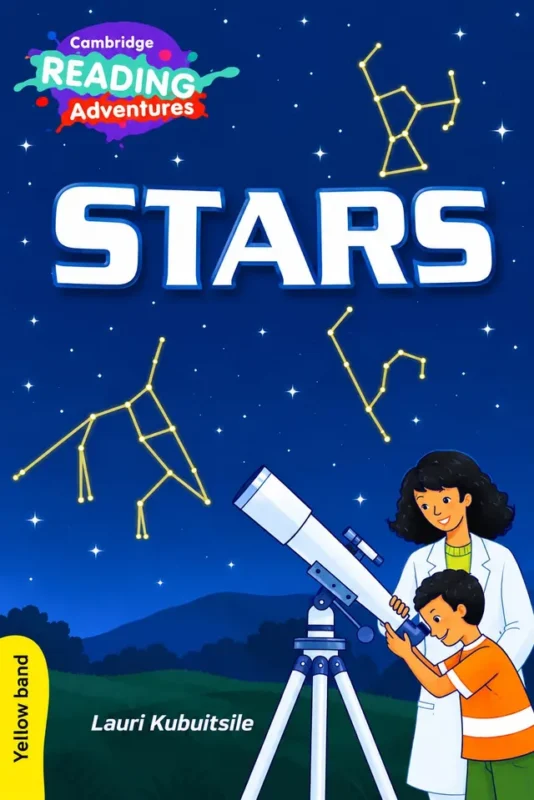
Stars by Lauri Kubuitsile is a non-fiction Yellow band reader in the Cambridge Reading Adventures series, used for Class 1 at Lahore Grammar School (LGS). The deep-blue cover shows a scientist in a white coat and a child looking through a telescope on a tripod, under a night sky with golden constellation lines.
Few topics catch a six-year-old’s imagination like the night sky. For the 2027-28 session, this book gives Class 1 children real facts about stars in a form they can read for themselves, narrated by an ‘expert’ scientist who guides the reader.
What the book is about
According to the teaching notes, this non-chronological report explores facts about stars. It uses the device of an expert scientist to provide information, and this serves as a guide through the book for the reader. Simple non-fiction features such as headings, captions and diagrams are included, and a glossary supports comprehension of the subject-specific vocabulary. There is a contents page, and the notes suggest starting on page 4, which explains what a star is.
The verbs are typical of non-fiction (‘Stars are …’, ‘The sun is …’), and there is simple use of causal connectives, for example ‘It looks big because it is close to the earth.’ Compound words such as ‘supergiants’, ‘outside’ and ‘cannot’ can be broken into chunks for reading, and technical words like ‘dust’ and ‘gas’ can be decoded with phonics and the glossary.
What your child learns from it
The publisher’s teaching notes list these learning outcomes. A child who reads this book can:
- track the print with their eyes, using finger-pointing only at points of difficulty;
- search for information in print to attempt and confirm new words while reading;
- make links between this text and other non-fiction texts they have read.
How to read it together at home
The guided reading lesson printed in the book gives a simple routine you can follow:
- Begin by discussing what your child already knows about stars. Give them the book and read the title.
- Establish that this is a non-fiction text by looking at the features and layout.
- Look at the contents page together and turn to page 4: it will tell us what a star is.
- On page 4, ask: are stars really small? Look for the section that explains they are far away. Check the technical words ‘dust’ and ‘gas’ using the glossary.
- On page 6, show how things look smaller when they are far away, by looking at trees or buildings from a window.
Fun learning links beyond the book
For science, the text supports work on space and space travel, and children could explore the use of simple telescopes. Exploring perspective (objects look smaller when they are further away) makes a good activity. For language development, the book is narrated by a scientific expert, so children can take the role of the expert and explain what they found out about stars, perhaps as a short video presentation on a phone or tablet.
About the Yellow band
Yellow band books ask a young reader to track print mostly with their eyes, to use punctuation and to meet short non-fiction and fiction texts with a little more variety in sentence structure.
Who, when, where and why
Whom: Class 1 children (about six years old). When: during the 2027-28 session, and best on a clear evening. Where: at school and at home, with a window or roof. Why: to feed a child’s curiosity while practising how information books work. Lahore Grammar School campuses follow almost the same book list, but a few campuses use their own list for some subjects. Send us your child’s campus on WhatsApp and we confirm the title before we dispatch.
Frequently asked questions
Is it fiction?
No. It is a non-fiction report narrated by an expert scientist.
Does it have a glossary?
Yes, according to the teaching notes.
What band is it?
Yellow band.
Ready to order? Send us a WhatsApp message with the class and school, and we will confirm availability and dispatch Stars carefully packed, with Cash on Delivery across Pakistan. Prefer to see it first? Our Lahore shop is open to visitors.