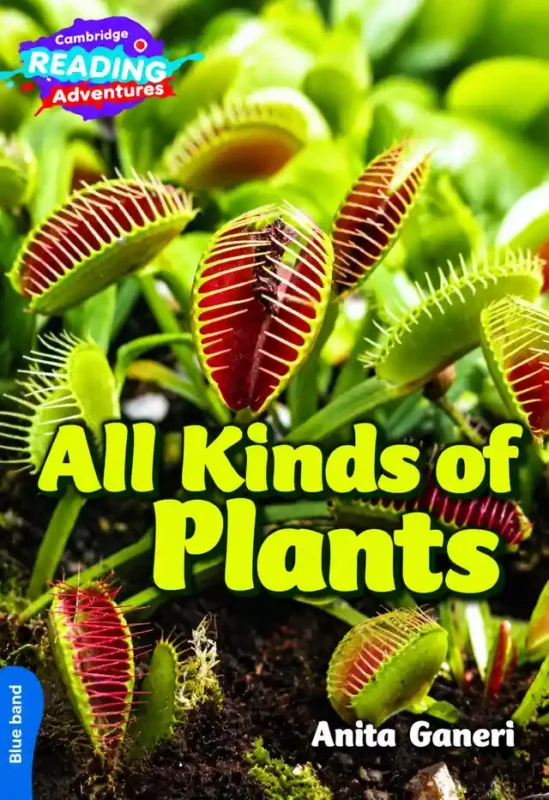
All Kinds of Plants by Anita Ganeri is a non-fiction Blue band reader from Cambridge Reading Adventures, used for Class 1 at Lahore Grammar School (LGS). The cover is a close-up photograph of Venus flytraps, the plants that snap shut on insects, with the title in lime green. For a six-year-old it is a little bit scary and a lot of fun.
In the 2027-28 session, many Class 1 children meet their first proper information book here. Instead of following a story from page 1 to the end, they learn to dip into a book, find the section they want and read facts about the world, which is a skill they will use for the rest of school.
What the book is about
According to the teaching notes, this is a non-chronological report that explores different types of plants from all around the world. A range of non-fiction features supports the text: labels and captions give extra information, and the book includes a contents page, an index and a glossary. It is a useful starting point for science work on growth and living things, and the notes suggest reading it alongside two other Cambridge Reading Adventures titles, ‘Water’ (Pink A band) and ‘Where Do They Grow?’ (Pink B band).
Grammar follows the pattern of a non-chronological report: the continuous present tense, an impersonal sentence structure and a focus on general groups of plants. Sentence length changes for effect; on the Venus flytrap page the sentences are short and sharp, like the plant itself (‘A fly lands on the leaves. The leaves snap shut.’). Two- and three-syllable words such as ‘redwood’, ‘flytrap’ and ‘rainforest’ can be read in chunks, and the glossary explains technical words.
What your child learns from it
The publisher’s teaching notes list these learning outcomes. A child who reads this book can:
- reread to clarify the precise meaning after problem-solving novel or less well-known words;
- understand the features of non-chronological reports;
- attend to changes in sentence structure, considering the author’s impact.
How to read it together at home
The guided reading lesson printed in the book gives a simple routine you can follow:
- First talk about growing things: have you helped a parent or grandparent plant something?
- Read the title and the blurb. Ask: what kind of book is this, and how do you know? What plants might we find inside?
- Explain that a report like this is not usually read from beginning to end; children choose what to find and use the contents and index to find it.
- Practise finding the Venus flytrap section on pages 10 and 11, and break ‘flytrap’ into ‘fly’ and ‘trap’ with your fingers.
- Notice the short sentences on page 11 and discuss why the author wrote like that.
Fun learning links beyond the book
For science, link the book to plants that grow in your own area. Visit a field, a garden or a nursery, or grow a fast sunflower in a pot and measure it every few days. For literacy, the notes suggest using a traditional tale such as ‘The Enormous Turnip’ as a framework for a story of your own about one of the plants in the book; ‘The Gigantic Cactus’ is their example.
About the Blue band
By Blue band a child is expected to read longer lines, cope with speech marks and recognise many common words without sounding them out, which is why this level suits a confident Class 1 reader.
Who, when, where and why
Whom: Class 1 children (about six years old). When: during the 2027-28 session, a section at a time. Where: at school, in the garden and anywhere there is a plant. Why: to learn how an information book works. Lahore Grammar School campuses follow almost the same book list, but a few campuses use their own list for some subjects. Send us your child’s campus on WhatsApp and we confirm the title before we dispatch.
Frequently asked questions
Is it fiction?
No. It is a non-fiction report with labels, captions, an index and a glossary.
Who is the author?
Anita Ganeri.
Does it have a contents page?
Yes, according to the teaching notes.
Order All Kinds of Plants online with Cash on Delivery across Pakistan, or visit our shop in Lahore. Message us the class and campus on WhatsApp and we will confirm the edition before we dispatch.