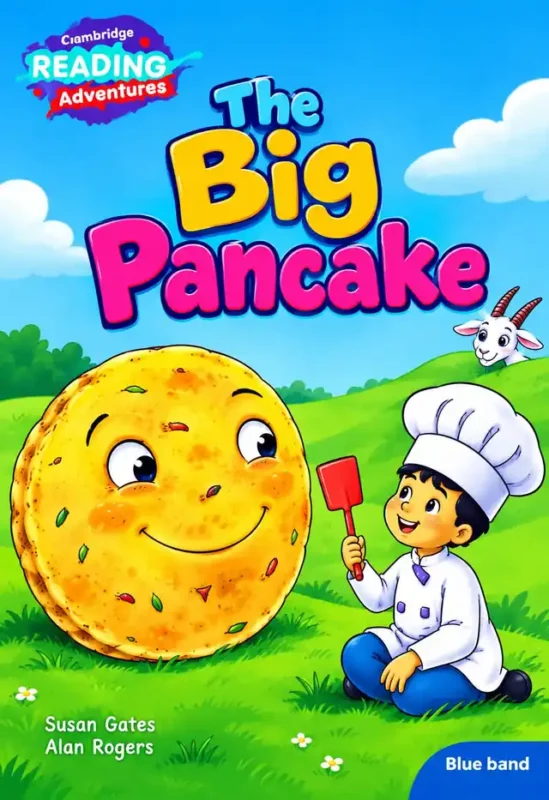
The Big Pancake by Susan Gates (illustrated by Alan Rogers, as credited on the cover) is a Blue band reader in Cambridge Reading Adventures for Class 1 at Lahore Grammar School (LGS). On the cover a giant smiling pancake rolls across a green hill, while a young chef in a tall white hat sits beside it with a spatula.
Everyone loves a chase. In the 2027-28 session, this book gives Class 1 readers a funny, rhythmic story with a repeating chorus and a twist at the end that makes them smile.
What happens in the book
According to the teaching notes, this reworking of a traditional tale focuses on a cook who gives chase to his pancake. Along the way, the pancake helps a series of characters, and they all give chase too. The tale takes a change of direction as it becomes clear that they do not want to eat it, but say thank you.
The sentences get longer as new characters join the chase, and speech is sustained over more than one utterance. The notes point out the comparatives ‘faster’ and ‘biggest’, the phrase ‘faster and faster’, and the repeated pattern ‘The cook wants to eat me’. Children also meet new words which can be decoded with the help of context. The cook made a big pancake, but it jumped out of the pan and ran away: where will it go, and will the cook catch it?
What your child learns from it
The publisher’s teaching notes list these learning outcomes. A child who reads this book can:
- solve unfamiliar words using print information and understanding of the text;
- sustain accurate reading over a greater number of lines of text on a page;
- comment on events, characters and ideas, making imaginative links to their own experience.
How to read it together at home
The guided reading lesson printed in the book gives a simple routine you can follow:
- Give each child a copy and read the title and the blurb. Say: the cook made the big pancake. Ask why lots of people might run after the pancake.
- Ask: do you know any other stories where lots of people join in to chase something? If your child knows the Gingerbread Man, retell the plot briefly.
- On pages 2 and 3, say: wow, that pancake is big; it is much bigger than the cook’s usual frying pan. Ask how it moved, and lead them to the word ‘rolled’.
- On pages 4 and 5, point out ‘faster and faster’ and ask why the pancake is getting faster.
- Notice the repeated sentence ‘The cook wants to eat me’ and ask what will happen next.
Fun learning links beyond the book
For science, the pancake uses its material properties to help people: it breaks a lady’s fall, it floats and it can stick over a hole. Explore household materials to see which would be useful in those situations. For food technology, follow a simple recipe to make pancakes at home and decide which you prefer. That is an easy and delicious follow-up!
About the Blue band
By Blue band a child is expected to read longer lines, cope with speech marks and recognise many common words without sounding them out, which is why this level suits a confident Class 1 reader.
Who, when, where and why
Whom: Class 1 children (about six years old). When: during the 2027-28 session. Where: at school and at home, ideally before a pancake breakfast. Why: to practise reading longer lines with rhythm, and to enjoy a story that ends with kindness. Most LGS campuses use the same books, though a few follow their own list in some subjects. Tell us your child’s campus on WhatsApp and we will check before the parcel leaves.
Frequently asked questions
Is it like the Gingerbread Man?
It is a reworking of a similar kind of chase tale, with a twist: nobody wants to eat the pancake, they want to say thank you.
Who wrote it?
Susan Gates, illustrated by Alan Rogers.
What band is it?
Blue band.
The Big Pancake is available now. Order online, pay on delivery anywhere in Pakistan, or collect it in Lahore. Buying the whole class list? WhatsApp us the list and we will confirm every title in one go.