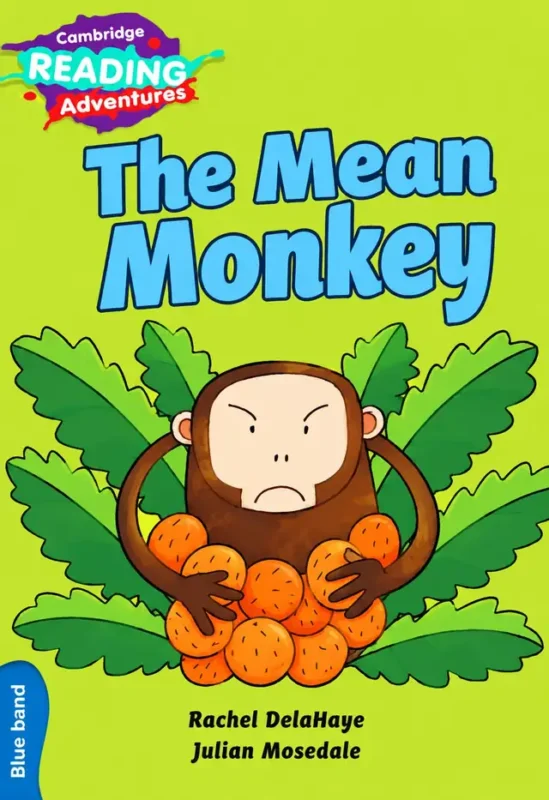
The Mean Monkey by Rachel DelaHaye (illustrated by Julian Mosedale, as credited on the cover) is a Blue band story in the Cambridge Reading Adventures series, used for Class 1 at Lahore Grammar School (LGS). On the cover a grumpy brown monkey hugs a pile of orange coconuts among big green leaves, with the title in bright blue.
Every child knows what it feels like when someone will not share. For the 2027-28 session, this book gives Class 1 children a funny, well-plotted story about exactly that, and teaches reading expression at the same time.
What happens in the book
According to the teaching notes, Babbo has found a tree full of coconuts and he does not want to share them. Even Kamal’s offer of help to pick the coconuts does not move Babbo from his mean attitude. Then Kamal’s cunning plan results in a much fairer approach to sharing the coconuts, but does Babbo realise that he has been tricked? Attending to punctuation is key to gaining the full meaning of the text and reading with appropriate expression.
The conversation between Babbo and Kamal on page 3 uses speech punctuation, and sentence lengths vary for effect: short sentences in dialogue such as ‘Look at me’ (page 2) and ‘This is my tree’ (page 5). Multi-syllable words like ‘himself’ and ‘coconut’ can be read by identifying parts of words, and there is plenty of practice with common words.
What your child learns from it
The publisher’s teaching notes list these learning outcomes. A child who reads this book can:
- monitor their own errors and show a greater degree of independent self-correction, rereading to check that meaning is conveyed through phrasing and expression;
- discuss the story to demonstrate understanding.
How to read it together at home
The guided reading lesson printed in the book gives a simple routine you can follow:
- Ask: do you know what it is to be mean? Has anyone ever been mean to you?
- Read the title and the blurb together. Look at Babbo clutching the coconuts with a mean expression on his face.
- Say: in this story Babbo the monkey is mean; he will not share the coconuts, even though he cannot eat them all himself. Let’s read what happens.
- On pages 2 and 3, discuss how Babbo calls out to Kamal to show off, and break ‘coconut’ into co-co-nut, then find it on the page and read it a few times.
- On page 3, explore the speech punctuation: an exclamation mark does not always mean shouting.
Fun learning links beyond the book
For science and nature, monkeys are mostly leaf eaters but many are omnivores; use books or a safe website to find what monkeys in different habitats eat. For literacy, Babbo has behaved badly, so ask your child to write a letter from Babbo to the other monkeys, apologising for being mean and promising to share the coconuts in future. It is a lovely way to practise writing with a purpose.
About the Blue band
Blue band is where reading starts to feel like reading: longer sentences, dialogue with speech punctuation and a growing bank of words the child knows by sight.
Who, when, where and why
Whom: Class 1 children (about six years old). When: during the 2027-28 session. Where: at school and at home. Why: to practise reading with expression and to talk about fairness and sharing. Book lists at LGS are almost the same from campus to campus, with a few campuses following their own for some subjects, so message us your campus name first and we will confirm this exact book with you.
Frequently asked questions
What is the lesson of the story?
That sharing is fairer and kinder, and that cleverness can help solve a problem.
Who illustrated it?
Julian Mosedale is credited on the cover.
What band is it?
Blue band.
We deliver The Mean Monkey to every city in Pakistan with Cash on Delivery, and you are welcome to collect it from our Lahore shop. If your school sent a book list, send it to us on WhatsApp and we will put the whole set together.