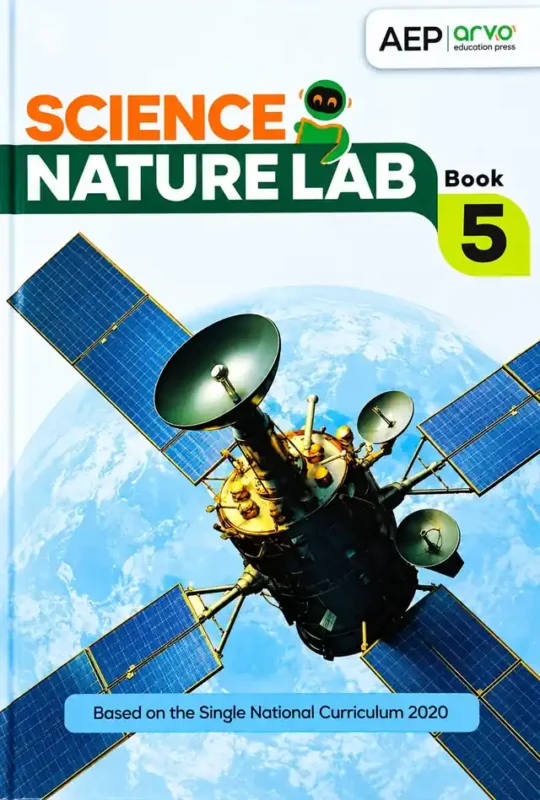
Science Nature Lab, Book 5 is the Class 5 science textbook of Allied Schools, published by AEP | arvo education press and ‘Based on the Single National Curriculum 2020’. The cover shows a satellite orbiting above the blue Earth, with the title in orange and white and the book number in a lime-green badge.
Class 5 science is where a child stops asking ‘what is it?’ and starts asking ‘how does it work?’. For the 2027-28 session, this book covers ten chapters: the human body’s organ systems, ecosystems, microorganisms, changes in matter, friction and simple machines, light and sound, electricity and magnetism, earth and soil, space and satellites, and technology in everyday life.
Full table of contents: 10 chapters, page by page
The contents page lists ten chapters. Each is given below as printed, with a note on what it builds for the student.
Chapter 1 – Humans and The Organ Systems (page 1)
- Humans and The Organ Systems (p. 1)
Why it helps: The year begins with the child’s own body: how the digestive, respiratory, circulatory and other systems work together. It makes science personal and gives the base for health lessons.
Chapter 2 – Ecosystems and Energy Flow (page 24)
- Ecosystems and Energy Flow (p. 24)
Why it helps: Food chains, habitats and how energy passes from the Sun to plants to animals. This explains why every living thing depends on others.
Chapter 3 – Microorganisms (page 46)
Why it helps: Bacteria, viruses and fungi: how some cause illness and how others help us. It supports handwashing and hygiene with reasons.
Chapter 4 – Changes in Matter (page 75)
- Changes in Matter (p. 75)
Why it helps: Physical and chemical changes: melting, burning, rusting. It teaches children to tell a change that can be reversed from one that cannot.
Chapter 5 – Friction and Simple Machines (page 94)
- Friction and Simple Machines (p. 94)
Why it helps: Why surfaces grip, and how levers, pulleys and ramps make work easier. A hands-on chapter for home experiments.
Chapter 6 – Light and Sound (page 119)
Why it helps: How light travels, reflects and makes shadows, and how sound is made by vibrations. Easy to explore with a torch and a ruler.
Chapter 7 – Electricity and Magnetism (page 143)
- Electricity and Magnetism (p. 143)
Why it helps: Circuits, conductors and insulators, and the way magnets attract and repel. It is the foundation of secondary physics.
Chapter 8 – Earth and Soil (page 166)
Why it helps: The layers of the Earth and what soil is made of. It has particular value in an agricultural country like Pakistan.
Chapter 9 – Space and Satellites (page 192)
- Space and Satellites (p. 192)
Why it helps: The Sun, planets, the Moon and artificial satellites, and what satellites do for us, from weather forecasts to phone signals. It matches the cover.
Chapter 10 – Technology in Everyday Life (page 215)
- Technology in Everyday Life (p. 215)
Why it helps: The book closes by showing how technology has changed daily life, a natural bridge to the computer book.
How the chapters fit together
The sequence moves from the small (the human body, microorganisms) to the physical world (matter, forces, light, sound, electricity) and then to the very large (Earth, space). That is how a science mind grows. It also means your child can link chapters: the circulatory system and electricity both involve circuits and flow, and satellites depend on both light and electricity.
Who, when, where and why
Whom: Class 5 students at Allied Schools (about ten years old). When: through the 2027-28 session. Where: in class and at home, where a torch, a magnet and a battery make a great kit. Why: to build understanding of the science that the Single National Curriculum 2020 expects.
Frequently asked questions
How many chapters are there?
Ten, from Humans and The Organ Systems to Technology in Everyday Life.
Is it for Class 5?
Yes. The cover says Book 5 and Allied Schools use it in Class 5.
Is it based on the Single National Curriculum?
Yes, according to the cover.
Ready to order? Send us a WhatsApp message with the class and school, and we will confirm availability and dispatch Science Nature Lab Book 5 carefully packed, with Cash on Delivery across Pakistan. Prefer to see it first? Our Lahore shop is open to visitors.