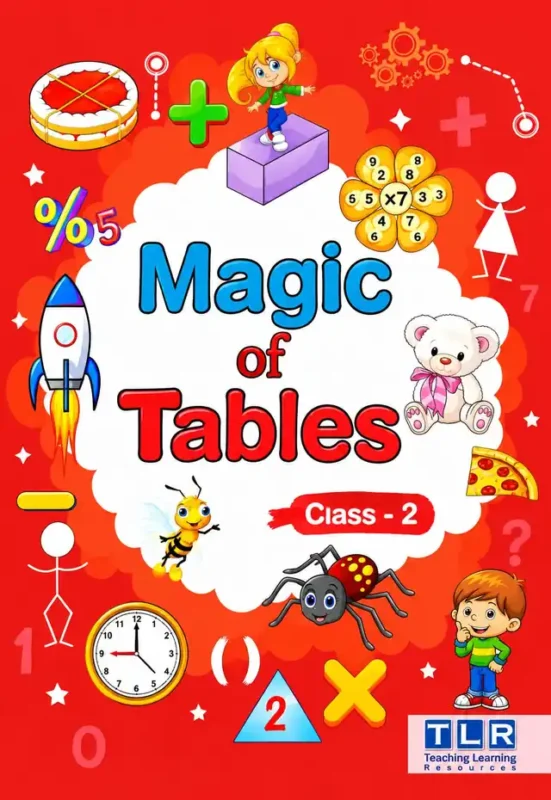
Magic of Tables, Class 2 is the Class 2 mathematics book on the Allied School list for the 2027-28 session, from TLR (Teaching Learning Resources). The cover is a bright red page with a white cloud holding the title, around it a pizza, a clock, a rocket, a spider, a teddy bear and the signs +, -, x and %, and a child with an open book.
The title is a promise: tables should feel like magic, not punishment. In Class 2 children begin to memorise times tables, and this book is built around that, in eleven short chapters. Table practice takes up eight pages of the book (pages 3 to 10), and the rest of the book uses those tables for the multiplication, division and money problems that follow.
Full table of contents: 11 chapters, page by page
All eleven chapters are listed with their pages as printed, followed by a note on what each chapter does for the child.
01. Numbers in Words
Why it helps: Writing numbers as words is a spelling and maths skill together, and is tested in most Class 2 exams.
02. Place Value
Why it helps: Hundreds, tens and ones. A child who sees why 47 is four tens and seven ones can learn tables and carry out sums with understanding.
03. Times Tables 0-10
- Times Tables 0 – 10 (pp. 03-10)
Why it helps: The core of the book: tables from 0 to 10 over eight pages. Short, repeated practice helps memory far more than one long session.
04. Multiplication: Window Method
- Multiplication: Window Method (pp. 11-14)
Why it helps: The window method lays a multiplication sum out in a grid, so that children can see each step. It is a friendly way to move from tables to two-digit multiplication.
05. Division
Why it helps: Division is introduced as the reverse of multiplication, so the tables just learned do double duty.
06. Money
Why it helps: Adding and subtracting rupees is the most practical use of arithmetic a child can try, whether at the school shop or at home.
07. Symmetry
Why it helps: A short chapter on mirror images and lines of symmetry, which connects maths to patterns and art.
08. Fractions
Why it helps: Halves, quarters and the idea of equal parts, the first step to the fractions of the upper classes.
09. Time
Why it helps: Reading a clock and understanding hours and minutes.
10. Shapes 2-D & 3-D
Why it helps: Flat and solid shapes: names, faces, edges and everyday examples.
11. Metric Conversion Measurement
- Metric Conversion Measurement (p. 22)
Why it helps: A first look at converting between metric units, such as metres and centimetres.
How to help your child learn the tables
Short, daily practice works best. Chant one table a day, in order, then out of order. Use real objects: groups of three biscuits for the table of 3. Ask one table fact at breakfast and another at dinner. When a table is solid, move to the next, and keep returning to the earlier ones.
Games to practise the tables
Play ‘skip counting’ on the stairs, saying the multiples of the table of the day on each step. Use a deck of number cards for quick recall. Ask a table fact while setting the table for dinner. Keep a small chart of the tables learned and tick each one off; seeing progress keeps children motivated.
Who, when, where and how
Whom: Class 2 students at Allied Schools (about seven years old). When: through the 2027-28 session. Where: at school and at the dinner table. How: five minutes a day, using the book alongside the main maths textbook.
Frequently asked questions
Which tables does it cover?
Times tables 0 to 10, on pages 3 to 10.
What is the window method?
A grid method for multiplication, taught in Chapter 4, pages 11 to 14.
Who publishes it?
The TLR (Teaching Learning Resources) mark is on the cover.
You can order Magic of Tables, Class 2 online today. We ship across Pakistan on Cash on Delivery, and families in Lahore can also pick it up from our shop. For overseas delivery (Gulf countries), message us on WhatsApp.