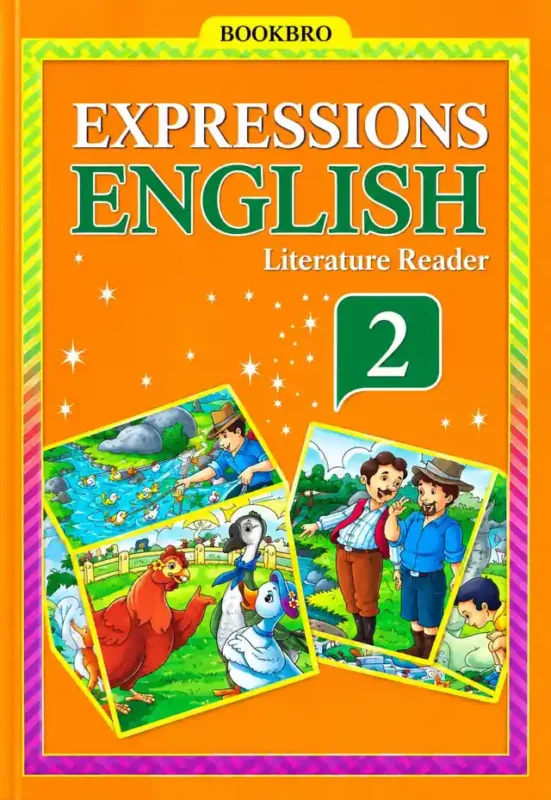
Expressions English, Literature Reader 2 is the Class 2 English reader on the Allied School list for the 2027-28 session. It is published under the Bookbro name and has an orange cover with a farmyard scene on the front: birds and animals in a yard and two people in old-fashioned clothes.
A reader is where a child’s English stops being a school subject and becomes stories. This one collects ten short pieces, seven in prose and three poems, chosen to be read aloud: fables about greed and foolishness, a mother’s devotion, a tea party in verse. The pieces are followed by two projects and two language quizzes that let the teacher check what the child has understood.
Full table of contents: 10 lessons, 2 projects and 2 quizzes
Every lesson is listed with its page, exactly as printed, and whether it is prose or a poem. Each carries a note on what a child gets from it.
Lessons 1 to 3: three stories
- 1. The Snowdrop (prose), Hans Christian Andersen, adapted (p. 5)
- 2. The Fox and the Crow (prose) (p. 10)
- 3. The Wise Lark (prose) (p. 13)
Why it helps: The reader opens with a story adapted from Hans Christian Andersen, so a seven-year-old meets a famous author in the first lesson. The Fox and the Crow and The Wise Lark are animal tales of the kind that teach a lesson, which makes retelling and discussion easy.
Lesson 4: a poem
- 4. The Tea Party (poem) (p. 18)
Why it helps: A poem early in the book introduces rhythm and rhyme, and gives children something to recite from memory.
Lessons 5 and 6: two more tales
- 5. The Greedy Mouse (prose) (p. 21)
- 6. The Red Hen (prose) (p. 24)
Why it helps: Greed is the theme of Lesson 5, and the title tells you so, which is useful for a class discussion on sharing. The Red Hen is a classic folk-tale title that children often know in a different form, so they can compare versions.
Lesson 7: a poem by Jane Taylor
- 7. Little Pussy (poem), Jane Taylor (p. 30)
Why it helps: A short poem about a kitten, credited to Jane Taylor. It is easy to memorise and ideal for pronunciation practice.
Lessons 8 and 9: a story and a poem
- 8. The Foolish Fish (prose) (p. 32)
- 9. The Little Bird (poem), Paul King (p. 36)
Why it helps: The Foolish Fish gives another lesson through an animal, and The Little Bird, credited to Paul King, is a gentle poem to read slowly and aloud.
Lesson 10: the closing story
- 10. The Devoted Mother (prose) (p. 40)
Why it helps: The book ends with a story about a mother’s devotion, a theme that children and parents both understand.
Projects and quizzes
- Project 1 (p. 44)
- Project 2 (p. 46)
- Language Quiz 1 (p. 48)
- Language Quiz 2 (p. 52)
Why it helps: Two projects let children do something with what they have read, and two language quizzes check vocabulary and understanding. They give parents a clear way to see progress before term exams.
Why a literature reader in Class 2
At seven, children can decode words but still need practice with rhythm, meaning and expression. A literature reader gives them that practice with real stories and poems rather than exercises. Reading a fable and talking about the lesson builds comprehension, and learning a poem by heart builds memory and confidence. This reader is designed to sit beside the English course book.
Who, when, where and how
Whom: Class 2 students at Allied Schools (about seven years old). When: through the 2027-28 session, one lesson every week or so. Where: in class and at home at bedtime. How: take turns reading a paragraph, then ask what the lesson of the story was.
Frequently asked questions
How many stories and poems are there?
Ten: seven prose pieces and three poems.
Does it have exercises?
It has two projects and two language quizzes.
Is there a Class 6 version?
Yes, there is a separate Expressions English Literature Reader for Class 6, listed on its own page.
We deliver Expressions English Literature Reader 2 to every city in Pakistan with Cash on Delivery, and you are welcome to collect it from our Lahore shop. If your school sent a book list, send it to us on WhatsApp and we will put the whole set together.