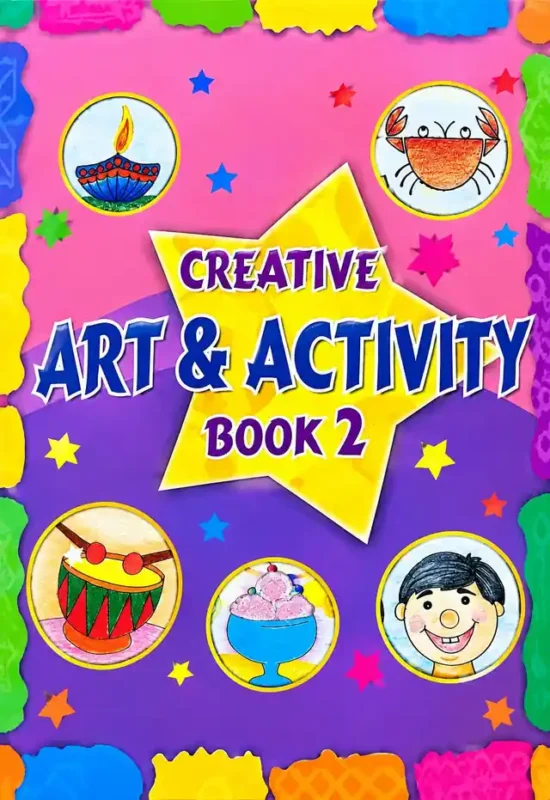
Creative Art & Activity, Book 2 is the Class 2 art and craft book on the Allied School list for the 2027-28 session. The cover is as colourful as the book: a pink and purple background with a big yellow star carrying the title, and five round pictures of finished work (a diya lamp, a crab, a drum, an ice-cream cup and a smiling boy’s face) to show what a child can make.
Art at this age is not about talent; it is about learning to use hands, materials and ideas. This book is built around that. Its contents page lists 37 activities between pages 3 and 40, and almost every one uses a different technique or a different material, many of them things you already have at home: dal, cotton, ice-cream sticks, a toothbrush, a coin, an onion.
Full table of contents: all 37 activities, in book order
Each activity is named by technique, then by what the child makes. They are given exactly as printed, with page numbers, in four groups of about ten pages, each followed by a note on what it teaches.
Pages 3 to 12: first impressions and pasting
- Broomstick, Glitter & Pencil Shave Pasting: Colour Palette (p. 3)
- Thumb Impression: Caterpillar (p. 4)
- Gift Paper & Ribbon Pasting: Gift Pack (p. 5)
- Glue Painting: Ghost (pp. 6-7)
- Air Blowing Technique: Egg (p. 8)
- Draw & Colour: Faces (p. 9)
- Cotton & Themocol Ball Pasting: Ice cream (p. 10)
- Cotton, Ice cream Stick & Sand Paper Pasting: Hut (p. 11)
- Draw & Colour: Cake (p. 12)
Why it helps: The book opens with materials the child can feel: broomstick pieces, glitter, ribbon, cotton and sand paper. Pasting teaches how much glue to use and where to press, and the thumb impression and air-blowing activities show that a finger or a breath can be an art tool. Drawing faces and a cake fits in the first drawing practice.
Pages 13 to 20: kitchen and craft materials
- Dal Pasting: Pot (p. 13)
- Colouring: Drum (p. 14)
- Wash Technique: Tree (p. 15)
- Paper Craft: Snake (p. 16)
- Draw & Colour: Crab (p. 17)
- Coin Tracing: Peacock (p. 18)
- Onion, Leaf Impression & Glitter Pasting: Flower (p. 19)
- Pattern Making: Frock (p. 20)
Why it helps: Pasting dal into a pot shape and printing with an onion and a leaf turn kitchen items into craft supplies. Tracing a coin to make a peacock’s body trains the hand to follow an outline, the wash technique introduces water-colour thinking, and pattern making begins to teach repeat and rhythm in design.
Pages 21 to 30: nature, impressions and collage
- Draw & Colour: Railway Track (p. 21)
- Coconut Hair Pasting: Coconut (p. 22)
- Draw & Colour: Parrot (p. 23)
- Ladyfinger Impression: Flower Pot (p. 24)
- Rubber Band & Glitter Pasting: Ball (p. 25)
- Pattern Making: Squirrel (p. 26)
- Cotton Bud Impression: Butterfly (p. 27)
- Ice cream Stick Pasting: Flower (p. 28)
- Colouring: Hidden Picture (p. 29)
- Paper Collage: Fire (p. 30)
Why it helps: Impression printing continues with a ladyfinger and a cotton bud, and pasting moves to coconut hair and rubber bands, which give each picture a texture. A hidden-picture page asks a child to look closely, and the paper collage of a fire teaches tearing, layering and colour choice.
Pages 31 to 40: techniques for a finished look
- Glitter & Rubber Band Pasting: Shell (p. 31)
- Draw & Colour: Boats (p. 32)
- Toothbrush Spray: Apple (p. 33)
- Paper Folding: Parrot (p. 34)
- Pencil Shave Pasting: Flowers (p. 35)
- Design: Pillars (p. 36)
- Tile Effect: Clown (p. 37)
- Wash Technique: Design (p. 38)
- Abstract Art: Painting (p. 39)
- Mehandi Design (p. 40)
Why it helps: The last group uses more advanced ideas: spraying paint with a toothbrush, folding paper, a tile effect, abstract painting and a mehandi design. Abstract art and mehandi show a child that art is also about pattern and feeling, and the final page connects the book to something many Pakistani families do at Eid and weddings.
What your child learns from it
The activities build four things at once. Fine motor control: pasting, tearing, tracing and printing exercise the same small muscles used for handwriting. Creative thinking: each page turns an ordinary object into something new. Following instructions: every activity has a technique to try. Confidence: the child ends the year with 37 finished pieces to show family. It also supports patience, because glue and paint need time to dry.
Materials to keep at hand
Many activities use household items, so a small craft box helps: glue, glitter, cotton, ice-cream sticks, ribbon, coloured paper, a toothbrush, a coin, dal, rubber bands, an onion and a few leaves. Ask your child’s teacher which materials the school supplies.
Who, when, where and how
Whom: Class 2 students at Allied Schools (about seven years old). When: through the 2027-28 session, one activity a week fits well. Where: in art class and at the kitchen table. How: let your child choose the colours, and only help with the tricky steps.
Frequently asked questions
How many activities are there?
Thirty-seven, between pages 3 and 40, according to the contents page.
Do we need special materials?
Mostly household items such as cotton, dal, ice-cream sticks and a toothbrush.
Is it a drawing book or a craft book?
Both: some pages are draw and colour, others are pasting, printing, folding or painting.
Order Creative Art & Activity Book 2 online with Cash on Delivery across Pakistan, or visit our shop in Lahore. Message us the class and campus on WhatsApp and we will confirm the edition before we dispatch.