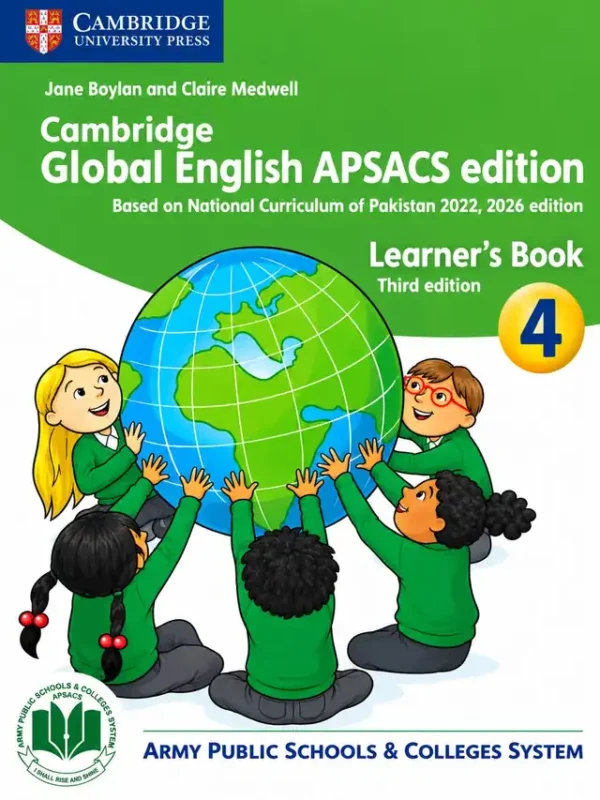
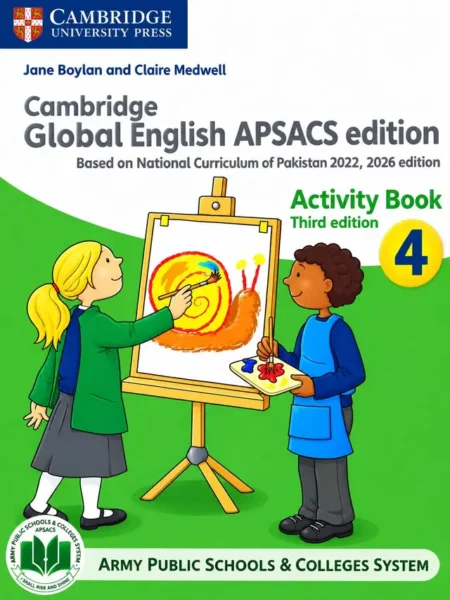
Cambridge Global English APSACS Edition, Learner’s Book 4 (Third edition) is the Class 4 English coursebook of the Army Public Schools & Colleges System. It is published by Cambridge University Press and written by Jane Boylan and Claire Medwell. The green cover (children in green uniforms lifting a globe) says ‘Based on National Curriculum of Pakistan 2022, 2026 edition’. Available to order now for the 2027-28 session.
From Class 4, the course becomes more literary. Alongside nine themed units, each ends with an extract from real children’s literature: The Treasure, The Seekers, Hey Ma, Something’s Under My Bed, The Hobbit, Lost in the Desert, Charlie and the Chocolate Factory, Why emus can’t fly, The Mona Lisa and Back to school. Five review units, placed after every one or two units, let teachers and parents check progress as the year goes on.
Why Learner’s Book 4 matters
Class 4 is the year English moves from ‘learning to read’ to ‘reading to learn’. This book asks the child to scan a text for information, to read for gist, to make notes, to organise paragraphs and to write letters, blogs, quizzes, fact files and newspaper articles. The result is a student who can read and write for different purposes, which is exactly the skill that Class 5 and beyond assume.
Full table of contents: Units 1 to 9, five Reviews and the SNC themes
The contents are printed as a wide table over two pages. Below it is rewritten unit by unit, keeping every column: words and expressions, use of English, reading and writing, listening and speaking, school subjects, pronunciation and word study, and critical thinking and values. Pages are shown with each unit.
Unit 1: Family circles (pages 6 to 19)
- Words and expressions: Families, sports and hobbies; Adjectives; Similarities and differences; Relationships.
- Use of English: Present simple; Adverbs of frequency; play/go/do; Verb + infinitive/-ing; Phrasal verbs; both/too/whereas.
- Reading and writing: Families; Table completion; Young athletes; Sentence correction; Write a letter; Scan; Make connections; Help in the house; Literature: The treasure.
- Listening and speaking: Strategy: Prediction; Talk about families and activities; Ask about relationships.
- School subjects: Geography: Kenya, Patagonia.
- Phonics and word study: Present simple 3rd person s; Capital letters.
- Critical thinking and values: Values: Being kind and helpful; Venn diagrams; Comparing and contrasting lives of children.
Why it helps: The first unit uses family, sport and hobbies to review the present simple. Writing a letter and scanning a text introduce two skills the child will use all year, and the Venn diagram gives them a tool for comparing.
Unit 2: Stories (pages 20 to 33)
- Words and expressions: Describe people; Sequence; Describe likes and dislikes.
- Use of English: Pronouns: who, where and that; Instructions; Past simple: Regular/irregular verbs; Sequencing words.
- Reading and writing: Statements about different types of books; Task: Table completion; How to draw a cartoon; Read for gist; Write about a superhero; write a story; Make a story plan; Literature: The Seekers.
- Listening and speaking: Strategy: Prediction; Table completion; Listen to: The Seekers; Comprehension questions; Talk about people.
- School subjects: Art: Drawing.
- Phonics and word study: Word stress; Punctuation in speech.
- Critical thinking and values: Values: Being brave; Identifying different types of stories; Forming opinions about stories; Classifying characters.
Why it helps: Making a story plan before writing a story is one of the most useful habits a ten-year-old can learn. The unit also teaches the past simple in a natural setting, storytelling, and discusses bravery.
Review 1 (pages 34 to 35)
Why it helps: A two-page review after Units 1 and 2 lets the child and the teacher see what has stuck before the harder grammar of Unit 3 begins.
Unit 3: Day and night (pages 36 to 49)
- Words and expressions: Adjectives to describe landscapes; Parts of animals; The solar system; Nocturnal animals; Time.
- Use of English: Expressing time; Comparatives; Superlatives; Adjective order.
- Reading and writing: Life in Norway; Our solar system; Task: Complete a table; Write a quiz; Create your own planet; Write an animal fact file; Writing tip: Adjective order; Literature: Hey Ma, Something’s Under My Bed.
- Listening and speaking: The Earth’s landscape; Complete an animal fact file; Multiple choice; Listen for specific information.
- School subjects: Geography: Landscapes Norway; Science: Planets, animal fact files.
- Phonics and word study: Rhyming words.
- Critical thinking and values: Expressing opinions about poetry; Comparing natural landscapes; Identifying planets in solar system; Understanding a story described in poetic form.
Why it helps: Planets and nocturnal animals are science topics the child enjoys. Creating a planet of their own, with correct adjective order, is a playful way to practise comparatives and superlatives, and the unit connects English with science and geography.
Unit 4: Homes (pages 50 to 63)
- Words and expressions: Types of houses; Materials: Wood/stone …; Places in town; Tourism; Adjectives.
- Use of English: Modals of probability; Question tags; Present perfect for life experience.
- Reading and writing: Eco-house; Adverts; A famous landmark; Read for information; Organise information; Write about a strange building; write about a landmark; Paragraphs; Literature: The Hobbit.
- Listening and speaking: Descriptions of homes; Match conversations; Descriptions of strange buildings; Talk about where they’d like to live; Check facts; Listen to The Hobbit.
- School subjects: Ecology; Geography: Peru, famous landmarks in many countries.
- Phonics and word study: Intonation: Question tags.
- Critical thinking and values: Values: Being a responsible person; Organising information; Identifying materials; Expressing opinions about unusual types of houses; Expressing preferences.
Why it helps: Homes and landmarks lead naturally into paragraph writing. The Hobbit extract is a child’s first taste of fantasy literature in this course, and question tags (‘It’s big, isn’t it?’) are practised through listening.
Review 2 (pages 64 to 65)
Why it helps: A review of Units 3 and 4 before the middle of the book.
Unit 5: Getting around (pages 66 to 79)
- Words and expressions: Road safety; Travel; Space travel; Strong adjectives; Reference words.
- Use of English: Zero conditional; Past continuous; Preposition of direction; get (travel) / get + adj / get + to + verb.
- Reading and writing: A journey to school in Colombia; Road safety (note completion); Neil Armstrong’s first trip to the Moon; Write about a famous person in history; Literature: Lost in the Desert.
- Listening and speaking: Different ways of travelling to school; Note completion; Tourist office; Listen for specific information; Directions.
- School subjects: Geography: Map interpretation; Space travel.
- Phonics and word study: -ed endings.
- Critical thinking and values: Value: Taking advice; Understanding road safety issues.
Why it helps: Road safety is one of the most important practical topics for a ten-year-old, and Neil Armstrong’s first trip to the Moon gives the past continuous a real story to attach to. Writing about a famous person in history is a first mini-biography.
Unit 6: School lunch (pages 80 to 93)
- Words and expressions: Food and food groups; Quantities.
- Use of English: some and any; made of / made from; Quantifiers; Linkers of purpose: so that, so as not to, in order to.
- Reading and writing: Lunches around the world; Recycled art; How chocolate is made; Read for details (scan); Plan a birthday party; Write about how a food item is produced; Linkers of purpose; Literature: Charlie and the Chocolate Factory.
- Listening and speaking: Jamie Oliver school lunches (comprehension); Organise a party; Talk about what people around the world eat.
- School subjects: Geography: Food in other countries; Science: How food is made.
- Phonics and word study: Connected speech.
- Critical thinking and values: Values: Being generous; Distinguishing between healthy and unhealthy meals; Classify food types; Understanding basic food preparation.
Why it helps: Food is a theme everyone knows, so the unit gets a lot of speaking out of the class. Writing how a food item is produced is a process-writing task, and the Charlie and the Chocolate Factory extract rounds it off with a famous story.
Review 3 (pages 94 to 95)
Why it helps: A review after the middle three units.
Unit 7: Australia (pages 96 to 109)
- Words and expressions: Extreme weather; Geographical features.
- Use of English: Infinitives of purpose; Past and present actions.
- Reading and writing: Australia fact file; A blog; Notice numbers; Make notes; Literature: Why emus can’t fly.
- Listening and speaking: A weather report; Australian endangered animals; Talk about maps; Follow the topic.
- School subjects: Geography: Australia, climate; Maths: High numbers; Science: Animals.
- Phonics and word study: Pronunciation of numbers.
- Critical thinking and values: Values: Not being jealous; Comparing countries; Giving factual examples; Giving explanations about endangered animals; Understanding traditional stories.
Why it helps: Australia makes geography, science and maths part of the English lesson, with a weather report, a fact file and endangered animals. Note-making is a study skill every student needs, and the traditional story ‘Why emus can’t fly’ adds a cultural dimension.
Unit 8: The human race (pages 110 to 123)
- Words and expressions: Facial characteristics.
- Use of English: Verbs of movement; Quantative pronouns (as printed); Phrasal verbs: crime.
- Reading and writing: Traditional dances; A museum theft; Read and write a newspaper article; Identify difficult words; Write a blog about a trip; write a description of a thief; Literature: The Mona Lisa.
- Listening and speaking: Descriptions of people; A description of a thief; Follow instructions; Talk about traditional dances.
- School subjects: Geography: New Zealand, Spain; Arts: Dance, sports; History/Art: Da Vinci.
- Phonics and word study: Homophones; Speech marks.
Why it helps: A museum theft and a newspaper article are the most exciting writing tasks of the year. The child learns to describe a person precisely, to write in news style and to recognise homophones, and The Mona Lisa extract links with art history.
Review 4 (pages 124 to 125)
Why it helps: A review after Unit 8.
Unit 9: Looking backwards and forwards (pages 126 to 139)
- Words and expressions: Holiday activities; Agree/disagree; Pack for a trip; Respond.
- Use of English: Future predictions with will; Going to for future plans.
- Reading and writing: Adverts for holiday courses; What I enjoyed this year; An email invitation; Look at pictures and text types; Read questions first; Write an email invitation to a friend; Informal writing; Literature: Back to school.
- Listening and speaking: What you enjoy doing in the holidays; Interviews; Talk about school; Survey.
- School subjects: Arts and crafts; Maths: Make a bar chart.
- Phonics and word study: Pronunciation in questions; Exclamation marks.
- Critical thinking and values: Values: Being sympathetic; Interpreting advertisements; Making predictions about trips; Surveying and classifying information.
Why it helps: The last unit looks back over the year and forward to the next. Writing an informal email invitation is a modern, practical writing task, and the survey and bar chart link English to maths.
Review 5 and SNC themes (pages 140 to 143)
- Review 5 (pp. 140-141)
- SNC themes: A mapping grid of the SNC themes (pp. 142-143)
Why it helps: The year ends with a final review, and a grid mapping every unit to the Single National Curriculum themes, which teachers and parents can use to check coverage.
Who, when and how
The Learner’s Book is for Class 4 students at Army Public Schools (about nine years old). It is used in the English lesson through the year, roughly three to four weeks per unit. Pair it with the Activity Book (sold separately) and with the Class 4 reader, The Railway Children.
- What: Cambridge University Press, Cambridge Global English APSACS edition, Learner’s Book 4, Third edition.
- Whom: Class 4 students; written by Jane Boylan and Claire Medwell.
- Why: a complete English course aligned to the National Curriculum of Pakistan 2022.
- Where: in class and at home.
Frequently asked questions
Does the Learner’s Book include literature?
Yes. Each unit ends with a literature extract, including The Hobbit, Charlie and the Chocolate Factory and The Mona Lisa.
What are the Reviews?
Five two-page reviews are placed after Units 2, 4, 6, 8 and 9 so the child can check progress.
Do I need the Activity Book as well?
The Activity Book follows the same nine units and is used for practice and homework. Most families buy both.
Order the Cambridge Global English Learner’s Book 4 online with Cash on Delivery across Pakistan, or visit our shop in Lahore. Message us the class and campus on WhatsApp and we will confirm the edition before we dispatch.