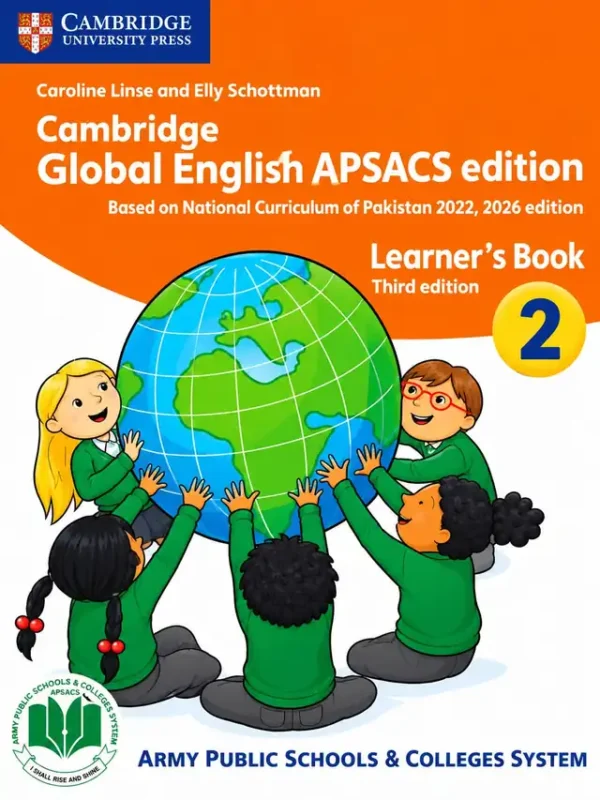
Cambridge Global English APSACS Edition, Learner’s Book 2 (Third edition) is the Class 2 English coursebook of the Army Public Schools & Colleges System. It is published by Cambridge University Press, written by Caroline Linse and Elly Schottman, and the cover says it is ‘Based on National Curriculum of Pakistan 2022, 2026 edition’. The orange cover shows children in green uniforms holding up a globe. Available to order now for the 2027-28 session.
If your child finished Learner’s Book 1 last year, this is the natural next step. Class 2 English moves from naming things to telling stories: the book introduces the past tense, the present perfect, the first fables and traditional stories from other countries, and it asks children to write their own poems, letters and short autobiographies.
What makes this book worth buying?
The Learner’s Book is the one book a Class 2 student cannot do without in English lessons. It sets out the vocabulary, grammar, reading, writing, listening and speaking work for the year in nine units, and connects each unit to another school subject (social studies, science, geography, maths or physical education), so English is learned through content the child cares about. Each unit ends with a thinking question and a values statement, such as ‘taking care of books’ or ‘homes offer shelter and safety’.
Full table of contents: Units 1 to 9 and the back-of-book sections
The contents are printed as a wide table over two pages. Below it is rewritten unit by unit, keeping every column: words and expressions, use of English, reading and writing, listening and speaking, school subjects, phonics and word study, and critical thinking and values.
Unit 1: Look in a book (pages 6 to 21)
- Words and expressions: Books and parts of a book; Classroom objects; Numbers 1-15; Clothes and personal possessions; What is it about?; How do you spell …?; How do you say __ in English?
- Use of English: Singular/plural nouns; There is/are …; Present simple; Possessive pronouns (mine, yours); Genitive ‘s; have got + noun; like + -ing; Which one? / the __ one.
- Reading and writing: Poems/songs; Information text; Write personal information; Write about your school; Write an original song verse; Use a capital letter and full stop.
- Listening and speaking: Listen for information; Follow instructions; Ask and answer questions; Collaborative problem solving; Memory games; Ask about an unknown word.
- School subjects: Using a contents page; Using a dictionary.
- Phonics and word study: Letter names and sounds; Vowels and consonants; Sounds: sh, ch, th; Short vowel sounds in initial and middle position; Spelling dictation; Compound words.
- Critical thinking and values: What can you find in a book?; Classifying; Main ideas and details; Values: Taking care of books and school supplies (responsibility, respect).
Why it helps: A book about books is a clever place to start. The child learns the parts of a book, how to use a contents page and a dictionary, and how to ask ‘How do you spell …?’, skills that are used in every other subject for the rest of school life.
Unit 2: Good neighbours (pages 22 to 35)
- Words and expressions: People and places in the community; Extended family; Places in the world; Jobs, Shops; Ordinal numbers; Left, right, A lot of.
- Use of English: Present continuous; Question forms; Present simple 3rd person endings: -s, -es; Irregular plurals; Prepositions of location.
- Reading and writing: Poems/songs; Information text; Write a friendly letter; Report information from an interview; Write instructions collaboratively.
- Listening and speaking: Listen for information; Ask for, give and follow directions; Roleplay + guessing game; Interviews.
- School subjects: Social studies: Communities; Geography: Reading maps, using a map grid.
- Phonics and word study: Occupation words ending with -er: singer, writer, etc.; Prefix un-.
- Critical thinking and values: Who lives in your neighbourhood?; Asking interview questions; Interpreting maps; Values: In a caring community, people help each other.
Why it helps: Writing a friendly letter and interviewing a neighbour are real-world tasks. Map reading and giving directions give a child the English to say where something is, and the values message (people in a community help each other) fits Army Public School life well.
Unit 3: Ready, steady, go! (pages 36 to 51)
- Words and expressions: Action verbs; Parts of the body; Numbers 1-20; Feelings (adjectives).
- Use of English: Imperatives; Can/can’t for ability; Adverbs: slowly, quickly; Conjunctions: and, but, or; Determiners: all, most, some; I like/don’t like + verb + -ing.
- Reading and writing: Poems/songs; Information text; Play: Native American tale; Write information about birds; Write an original song verse; Write a riddle.
- Listening and speaking: Listen to and give instructions; Discuss likes and dislikes; Discuss and act out poems, song and play.
- School subjects: Science: Different bird species; interpreting a chart; Maths: Counting; Physical education: Moving different parts of the body.
- Phonics and word study: Long vowel sounds and spellings: ai, ay, silent e.
- Critical thinking and values: How can we move in different ways?; Comparing and contrasting; Classifying; Values: Teamwork; an active life style keeps us healthy and happy.
Why it helps: Movement verbs and adverbs (slowly, quickly) make descriptions livelier. Writing a riddle teaches a child to describe without naming, which is a good exercise in vocabulary, and the unit links English to P.E. and to the idea that being active keeps us healthy.
Unit 4: The big sky (pages 52 to 65)
- Words and expressions: Weather; Shadows; Day and night: Sun, Moon, stars, planets; Time phrases: Yesterday, in the morning, at night; Movement verbs.
- Use of English: Past simple regular (-ed) and irregular forms; Past simple of be; Past simple question forms; Time expressions: in the morning/afternoon/evening; at night.
- Reading and writing: Poems/songs; Information text; Read and follow instructions; Write informational sentences; Report interview information (past tense).
- Listening and speaking: Listen for information; Ask/answer questions; Partner interviews; Discuss and act out poems and song.
- School subjects: Science: Shadows; weather; day and night; Earth, Moon, Sun and planets.
- Phonics and word study: Long i spellings: i, igh; Rhyming words; Spelling dictation; Compound words.
- Critical thinking and values: What is the sky like?; Making and using a sundial; Comparing and contrasting; Values: Appreciating and learning about the natural world.
Why it helps: The past simple is the grammar milestone of Class 2. Telling what happened yesterday is a natural way to practise it, and building a sundial turns the science of shadows into a hands-on project.
Unit 5: Let’s count and measure (pages 66 to 81)
- Words and expressions: Numbers 1-100; How many? How far? How long?; Metres, centimetres; Shapes; Tell time to the hour.
- Use of English: Past simple regular and irregular forms; Countable and uncountable nouns with some, a/an; What (a) + adj. + noun!; When clause.
- Reading and writing: Poems and song; Information text; Traditional stories from Africa; Write personal information; Write a new verse.
- Listening and speaking: Listen for information; Ask/answer questions; Memory games; Discuss and act out poems, songs and stories.
- School subjects: Maths: Counting in 2s; measuring, completing chart, telling the time (to the hour); shapes.
- Phonics and word study: Homophones.
- Critical thinking and values: How do we use numbers?; Problem solving; Sequencing; Estimating; Values: We can work together to help ourselves learn.
Why it helps: English and maths meet here. Children use numbers up to 100, metres and centimetres and telling the time in English, which helps them in the maths lesson too, and they meet traditional stories from Africa, a first taste of world literature.
Unit 6: Bugs: fact and fiction (pages 82 to 95)
- Words and expressions: Insects and spiders; Parts of insects (wings, legs, antennae); Action verbs.
- Use of English: Prepositions: above, under, near, on; Determiners: all, some, most; Subject/verb agreement; Regular and irregular past tense; How, What, How many, Do/Does?
- Reading and writing: Poems/songs; Information text; Traditional story from Mexico; Story elements: Plot (story map); Describe insects and what they do; Write questions.
- Listening and speaking: Listen for information; Ask/answer questions; Discuss and act out poems, songs and stories; Insect game.
- School subjects: Science: Insects and spiders.
- Phonics and word study: Long e spellings (ee, ea, me, s/he); Rhyming words.
- Critical thinking and values: How are bugs special?; Classifying; Comparing; Study skills; Graphic organisers; Values: Appreciating and learning about the natural world.
Why it helps: ‘Fact and fiction’ means the child reads an information text about insects and a traditional story from Mexico, and learns how the two differ. Story maps (plot) are the first step to planning a story of one’s own.
Unit 7: Our green Earth (pages 96 to 109)
- Words and expressions: Parks, leisure time; Parts of a tree; Fruits and vegetables; Environmental issues; Would you like …? I’d/We’d like …; How about …?; What does __ mean?
- Use of English: -ing forms as nouns (no + -ing form); Must/mustn’t with rules/instructions; Can for permission; Will for future intentions/promises; Determiners: this, these, that, those.
- Reading and writing: Poems/songs; Information text; Write promises/intentions; Write a poem; Write your autobiography.
- Listening and speaking: Listen for information; Give/follow instructions; Ask/answer questions; Discuss and apply information; Discuss and act out poems and song.
- School subjects: Science and Social studies: Environmental issues; uses of trees; Social studies: International signs; Science: Plants; growing food.
- Phonics and word study: Long o spellings (ou and ow); Variant sounds of ow.
- Critical thinking and values: How can we care for the Earth?; Problem solving; Sequencing; Study skills; Values: We are responsible for taking care of the Earth.
Why it helps: Environmental care is a value that parents want to see taught early. Rules (‘you mustn’t litter’), promises (‘I will plant a tree’) and a short autobiography allow children to write about themselves and their responsibility to the planet.
Unit 8: Home, sweet home (pages 110 to 123)
- Words and expressions: Parts of a building; Kinds of homes; Climates (hot, cold, warm, cool, wet, dry); Rooms and furnishings; Animal homes; Construction materials; What is it made of?
- Use of English: Present perfect; have + object + infinitive; Have you ever…?; Let’s and How about + -ing for suggestions; Would you like __ or __? I’d like…; Too to add information; Will for future intention.
- Reading and writing: Poems; Narrative song; Information text; Information from diagrams; Write descriptions of things; Narrative writing (retell story).
- Listening and speaking: Listen for information; Ask/answer questions; Share information; Make decisions and choices; Recite and discuss poems and song.
- School subjects: Social studies: Homes around the world; Geography: World places and climates; Science: Homes built by animals; building materials.
- Phonics and word study: Long u spellings: Variant sounds of oo; Rhyming words.
- Critical thinking and values: What kinds of homes do people and animals build?; Collaborative learning; Values: Homes offer shelter and safety; Values: Homes around the world are both similar and unique.
Why it helps: The present perfect (‘Have you ever…?’) is introduced through a topic that every child knows, their own home. The unit also retells a story in the child’s own words, which is the core skill tested in many Class 2 exams.
Unit 9: Inside and outside cities (pages 124 to 137)
- Words and expressions: Buildings and other city words; Holiday places and leisure activities; Food and drink; Opposites.
- Use of English: Where/what would you like to …?; Comparative adjectives: -er and more + adjective; better; Expressing agreement/disagreement: So do I! I don’t.
- Reading and writing: Poems/songs; Information text; Fable from Aesop (contemporary retelling); Write a poem (haiku); Write a picture caption (stating and explaining a preference).
- Listening and speaking: Listen for information; Recognise speaker’s opinion; Problem solving; Discuss preferences; Roleplay: Ask for food and drink; Discuss and act out poem, song and story.
- School subjects: Geography: Mountains, beach, desert, etc.; Social studies: Community places in a city.
- Phonics and word study: Identify opposites; Count syllables; Variant sounds of c.
- Critical thinking and values: What can we do in the town and countryside?; Comparing; Supporting an opinion with reasons; Values: Respecting different opinions and preferences.
Why it helps: The last unit finishes with opinion: stating a preference and giving a reason. A haiku and an Aesop fable give children two very different forms to read and write, and the roleplay of ordering food and drink is the most practical English of the year.
Back of the book: Phonics practice, Picture dictionary and SNC themes (pages 138 to 166)
- Phonics practice: Practice of phonics and handwriting (pp. 138-153)
- Picture dictionary: Review of vocabulary and themes (pp. 154-164)
- SNC Themes: A mapping grid of the SNC themes (pp. 165-166)
Why it helps: The last 29 pages are for revision. The phonics section drills sounds and handwriting, the picture dictionary reviews vocabulary by theme, and the SNC themes grid lets teachers and parents match each unit to the national curriculum.
Who, when, where and how
The Learner’s Book is for Class 2 students at Army Public Schools (about seven years old). It is used through the school year, about two weeks per unit. Pair it with the Activity Book for homework, and with the Class 2 reader (Oxford Reading Tree Level 8) for home reading.
- What: Cambridge University Press, Cambridge Global English APSACS edition, Learner’s Book 2, Third edition.
- Whom: Class 2 students; written by Caroline Linse and Elly Schottman.
- Why: a complete English course aligned to the National Curriculum of Pakistan 2022.
- Where: in class and at home.
Frequently asked questions
Is this for Class 2 in all Army Public Schools?
It is the APSACS edition for Class 2, with the Army Public Schools & Colleges System logo on the cover.
What is the difference between this and the Activity Book?
The Learner’s Book teaches the lessons; the Activity Book (sold separately) gives practice and homework for the same nine units.
How many units does it have?
Nine units, then phonics practice, a picture dictionary and a page of SNC themes.
Order the Cambridge Global English Learner’s Book 2 online with Cash on Delivery across Pakistan, or visit our shop in Lahore. Message us the class and campus on WhatsApp and we will confirm the edition before we dispatch.