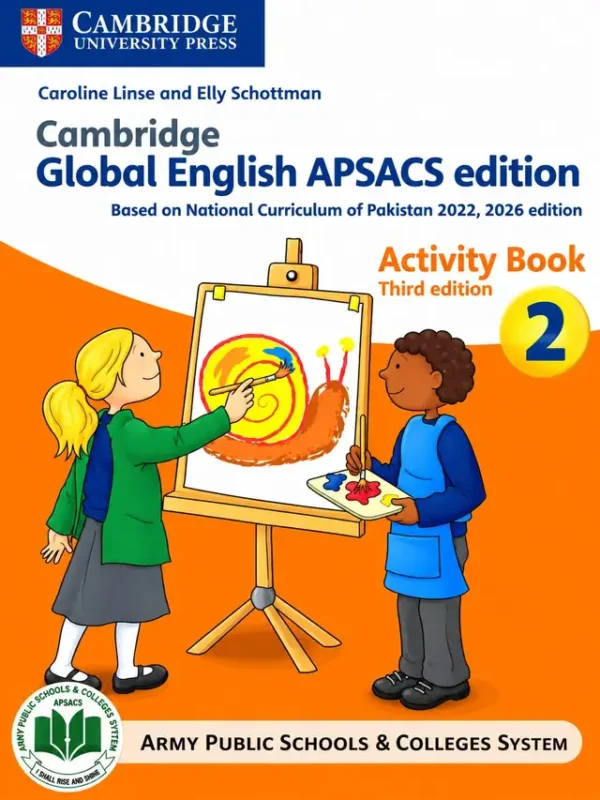
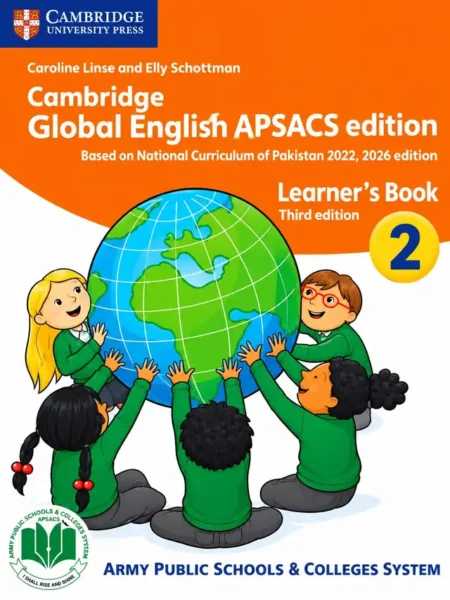
The Activity Book of Cambridge Global English, APSACS Edition (Third edition), Level 2 is the practice partner of Learner’s Book 2 for Class 2 in Army Public Schools. It is published by Cambridge University Press and ‘Based on National Curriculum of Pakistan 2022, 2026 edition’. The orange cover shows two children painting a snail on an easel. Available to order now for the 2027-28 session.
Each of its nine units has six lessons of two pages each, in the same order as the Learner’s Book. That repeating structure is the secret of the book: a seven-year-old knows what to expect, so they can work with less supervision.
Full table of contents: Units 1 to 9, six lessons each, every page
‘Words and sounds’ is the phonics and spelling lesson; ‘Use of English’ is the grammar lesson; ‘Read and respond’ is a reading page with questions; and each unit ends with a Quiz.
Unit 1: Look in a book
- 1. Think about it: What can you find in a book? (p. 4)
- 2. Find out more: Inside a book (p. 6)
- 3. Words and sounds: Review of short vowels (p. 8)
- 4. Use of English: Talking about possessions (p. 10)
- 5. Read and respond (p. 12)
- 6. Quiz (p. 14)
Why it helps: The opening unit reviews short vowel sounds, which is the right place to find any gaps from Class 1 before new work begins.
Unit 2: Good neighbours
- 1. Think about it: Who lives in your neighbourhood? (p. 16)
- 2. Find out more: Where do you live? (p. 18)
- 3. Words and sounds: Jobs that end in -er (p. 20)
- 4. Use of English: Saying where things are (p. 22)
- 5. Read and respond (p. 24)
- 6. Quiz (p. 26)
Why it helps: Jobs ending in -er (teacher, baker, driver) teach a spelling rule, and saying where things are practises prepositions.
Unit 3: Ready, steady, go!
- 1. Think about it: How can we move in different ways? (p. 28)
- 2. Find out more: What can birds do? (p. 30)
- 3. Words and sounds: Long vowel sounds (p. 32)
- 4. Use of English: Revision of -ing forms (p. 34)
- 5. Read and respond (p. 36)
- 6. Quiz (p. 38)
Why it helps: Long vowel sounds and -ing forms are two of the biggest spelling topics of Class 2, practised here with bird and movement themes.
Unit 4: The big sky
- 1. Think about it: What is the sky like? (p. 40)
- 2. Find out more: The sky by day and night (p. 42)
- 3. Words and sounds: Long i (p. 44)
- 4. Use of English: Using the past simple (p. 46)
- 5. Read and respond (p. 48)
- 6. Quiz (p. 50)
Why it helps: The past simple gets a full lesson of its own. Written practice helps children remember irregular forms such as went, saw and ate.
Unit 5: Let’s count and measure
- 1. Think about it: How do we use numbers? (p. 52)
- 2. Find out more: How did people measure long ago? (p. 54)
- 3. Words and sounds: Homophones (p. 56)
- 4. Use of English: Past Simple Verbs (p. 58)
- 5. Read and respond (p. 60)
- 6. Quiz (p. 62)
Why it helps: Homophones (to, two and too) are a classic spelling trap. Meeting them in Class 2, with numbers and measuring as a theme, makes them easier to remember.
Unit 6: Bugs: Fact and fiction
- 1. Think about it: How are bugs special? (p. 64)
- 2. Find out more: Ants and spiders (p. 66)
- 3. Words and sounds: Rhyming words, long e (p. 68)
- 4. Use of English: Writing questions (p. 70)
- 5. Read and respond (p. 72)
- 6. Quiz (p. 74)
Why it helps: Writing questions is a skill that improves reading comprehension, because a child who can write a question knows what to look for in a text.
Unit 7: Our green Earth
- 1. Think about it: How can we care for the Earth? (p. 76)
- 2. Find out more: Why are trees important? (p. 78)
- 3. Words and sounds: Long o (p. 80)
- 4. Use of English: At the market (p. 82)
- 5. Read and respond (p. 84)
- 6. Quiz (p. 86)
Why it helps: Trees and the market give the child plenty to write about, and the long o lesson ties the spelling of ou and ow words together.
Unit 8: Home, sweet home
- 1. Think about it: What kinds of homes do people and animals build? (p. 88)
- 2. Find out more: Homes around the world (p. 90)
- 3. Words and sounds: Long u (p. 92)
- 4. Use of English: Making choices (p. 94)
- 5. Read and respond (p. 96)
- 6. Quiz (p. 98)
Why it helps: Making choices (‘Would you like tea or juice?’) is polite, practical English, and the long u lesson completes the set of long vowels.
Unit 9: Inside and outside cities
- 1. Think about it: What can we do in the town and the countryside? (p. 100)
- 2. Find out more: Cafés in different places (p. 102)
- 3. Words and sounds: Opposites and syllables (p. 104)
- 4. Use of English: Choosing and comparing (p. 106)
- 5. Read and respond (p. 108)
- 6. Quiz (p. 110)
Why it helps: Opposites, syllables and comparing give the child the tools to describe and contrast, which is exactly what Class 3 will ask of them.
Who is it for, why, and how to use it
It is for Class 2 children at Army Public Schools. Do one lesson (two pages) at a time; ask the child to read the question aloud first. Use the quiz page at the end of each unit as a mini-test, and keep a note of the scores to see progress.
- What: a 110-page practice book, 9 units x 6 lessons.
- Why: daily written practice of the Learner’s Book.
- When: alongside the Learner’s Book, unit by unit.
- Whom: Class 2 students.
Frequently asked questions
Do I need the Learner’s Book too?
The Activity Book follows the Learner’s Book unit by unit, so most children use both.
What is a ‘Words and sounds’ lesson?
It is the phonics and spelling lesson of the unit.
Is it based on the new curriculum?
Yes. The cover says ‘Based on National Curriculum of Pakistan 2022, 2026 edition’.
We deliver the Cambridge Global English Activity Book 2 to every city in Pakistan with Cash on Delivery, and you are welcome to collect it from our Lahore shop. If your school sent a book list, send it to us on WhatsApp and we will put the whole set together.