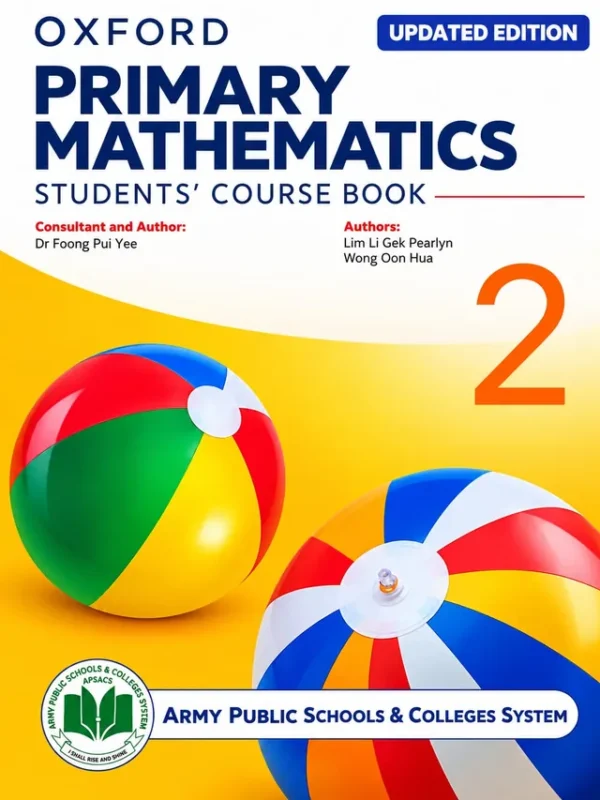
Oxford Primary Mathematics, Students’ Course Book 2 (Updated Edition) is the Class 2 maths textbook of the Army Public Schools & Colleges System. It is published by Oxford University Press Pakistan, with Dr Foong Pui Yee as consultant and author and Lim Li Gek Pearlyn and Wong Oon Hua as authors. The cover shows two colourful beach balls. Available to order now for the 2027-28 session.
Class 2 is the year in which maths becomes ‘real’: three-digit numbers, regrouping (carrying and borrowing), the first multiplication tables and the first measurements in metres, kilograms and litres. The Course Book takes the child through each of these with the same pattern as Class 1: a chapter opener, ‘In Focus’ discussion, ‘Let’s Learn’ pages (objects, then pictures, then numbers), ‘Activity Time’ and ‘Practice’.
Table of contents (Chapters 1 to 8, as photographed)
The Course Book’s contents are printed on two pages. Every lesson is listed below with its page number, followed by what it gives the child.
Chapter 1: Numbers to 1000
- 1. Counting in Hundreds, Tens, and Ones (p. 2)
- 2. Place Value (p. 5)
- 3. Comparing and Ordering Numbers (p. 8)
- 4. Ordinal Numbers (p. 13)
- 5. Number Patterns (p. 15)
- 6. Odd and Even Numbers (p. 19)
- 7. Rounding Numbers (p. 21)
- 8. Roman Numerals (p. 23)
Why it helps: The whole year rests on this chapter: a child who understands hundreds, tens and ones can add, subtract and round with confidence. Odd and even numbers, rounding and Roman numerals widen the picture.
Chapter 2: Addition and Subtraction Within 1000
- 1. Addition and Subtraction (p. 25)
- 2. Addition without Regrouping (p. 26)
- 3. Addition with Regrouping (p. 30)
- 4. Subtraction without Regrouping (p. 34)
- 5. Subtraction with Regrouping (p. 38)
- 6. Estimation (p. 40)
Why it helps: Each operation is taught first without regrouping, then with it, which lets the child master the easy case before the hard case. Estimation teaches them to check whether an answer is sensible.
Chapter 3: Multiplication
- 1. Multiplication Table of 3 (p. 44)
- 2. Multiplication Table of 4 (p. 45)
- 3. Multiplication (p. 47)
Why it helps: The tables of 3 and 4 follow the tables of 2, 5 and 10 from Class 1. The third lesson pulls multiplication together with real examples.
Chapter 4: Dividing by 3 and 4
- 1. Dividing by 3 and 4 (p. 51)
- 2. Multiplication and Division (p. 53)
- 3. Solving Real-Life Stories (p. 54)
Why it helps: Division is taught as the opposite of multiplication, and ‘real-life stories’ (word problems) apply it to everyday situations.
Chapter 5: Length
- 1. Measuring Length in Metres (p. 58)
- 2. Measuring Length in Centimetres (p. 60)
- 3. Comparing Lengths (p. 62)
- 4. Solving Real-Life Stories (p. 65)
Why it helps: Metres and centimetres are introduced separately, then compared, which is a sound progression for a seven-year-old.
Chapter 6: Mass
- 1. Measuring Mass in Kilograms (p. 68)
- 2. Measuring Mass in Grams (p. 71)
- 3. Comparing Masses (p. 74)
- 4. Solving Real-Life Stories (p. 76)
Why it helps: Kilograms and grams are everyday units (flour, rice, sugar), so the child can practise at home in the kitchen.
Chapter 7: Capacity
- 1. Measuring Capacity in Litres (p. 79)
- 2. Comparing Capacities (p. 81)
- 3. Solving Real-Life Stories (p. 82)
Why it helps: Measuring how much a container holds in litres links maths to water bottles and milk cartons.
Chapter 8: Two-Dimensional Shapes
- 1. Straight Lines and Curves (p. 85)
- 2. Parallel Lines (p. 87)
- 3. Perpendicular Lines (p. 89)
- 4. Semicircle and Quarter Circle (p. 90)
- 5. Making Figures from Shapes (p. 92)
- 6. Making Patterns (p. 94)
- 7. Area and Perimeter (p. 96)
Why it helps: Parallel and perpendicular lines are the vocabulary of geometry, and area and perimeter are introduced early, in Class 2, through simple shapes.
Later chapters
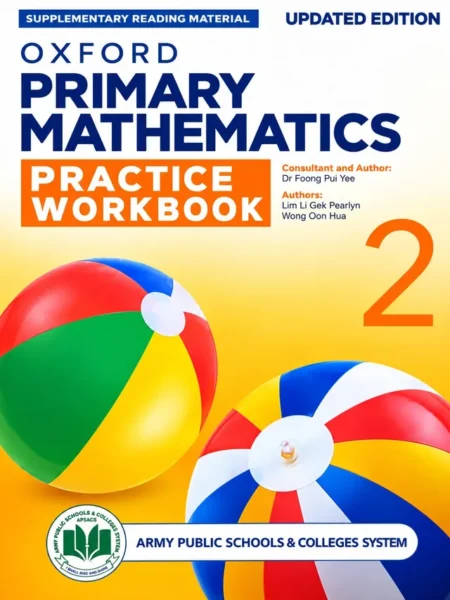
Our photographs show Chapters 1 to 8. The companion Practice Workbook for Class 2 lists three more chapters: Chapter 9, Three-Dimensional Shapes; Chapter 10, Fractions (understanding fractions, more fractions, comparing and ordering fractions, adding and subtracting like fractions); and Chapter 11, Time and Temperature (telling and writing time to 5 minutes, using a.m. and p.m., telling time after, and the lunar and solar calendars). If you want the Course Book page numbers for those chapters, message us before you order and we will confirm them.
Who, when and how
The book is for Class 2 children at Army Public Schools and is the main maths textbook for the year. Parents can help by turning each new idea into a kitchen or shop activity: weighing rice, pouring water, counting coins. Pair it with the Practice Workbook for written practice.
- What: Oxford University Press Pakistan, Updated Edition, Students’ Course Book 2.
- Whom: Class 2 students; authors: Dr Foong Pui Yee, Lim Li Gek Pearlyn, Wong Oon Hua.
- Why: a step-by-step course that builds understanding of regrouping, tables and measures.
- Where: Army Public Schools; for sale in Pakistan only.
Frequently asked questions
Is this the Course Book or the Workbook?
This is the Students’ Course Book. The Practice Workbook is a separate book.
Does it teach multiplication tables?
Yes. Chapter 3 covers the tables of 3 and 4, and Chapter 4 covers division by 3 and 4.
Which edition is it?
The cover says ‘Updated Edition’ and shows the Army Public Schools & Colleges System logo.
Buy Oxford Primary Mathematics Students’ Course Book 2 from us online and pay when it reaches your door (Cash on Delivery, all over Pakistan). We also ship prepaid orders to Saudi Arabia, UAE, Oman, Qatar, Bahrain and Kuwait.