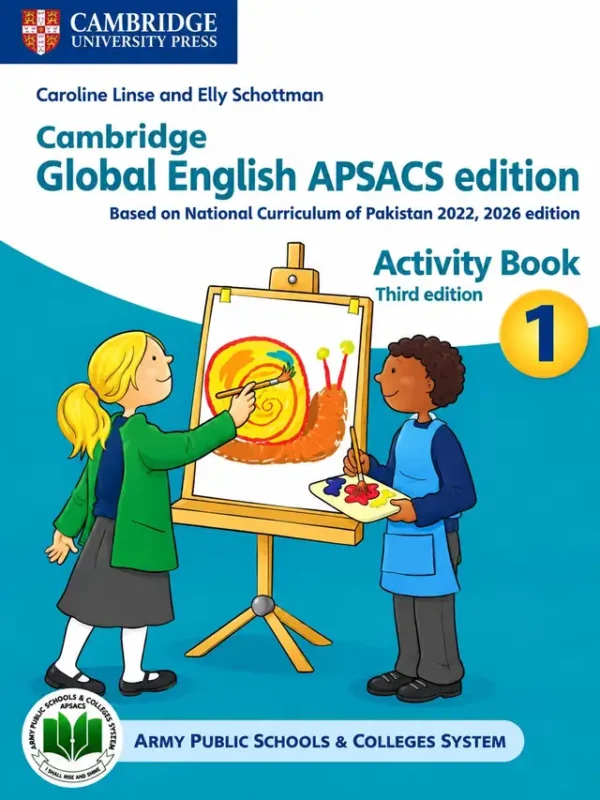
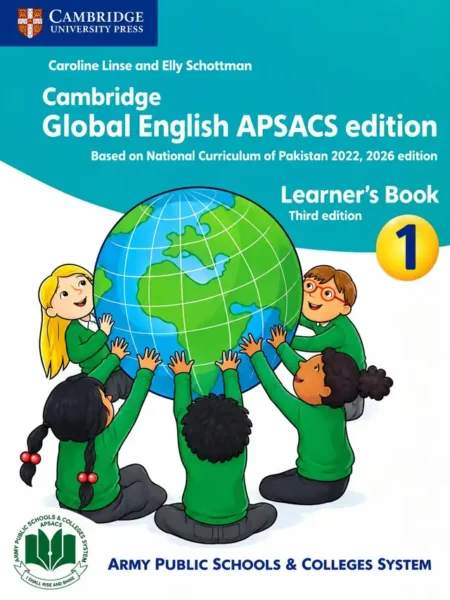
The Activity Book of Cambridge Global English, APSACS Edition (Third edition), Level 1 is the practice partner of the Class 1 Learner’s Book in Army Public Schools. It is published by Cambridge University Press, written by Caroline Linse and Elly Schottman, and ‘Based on National Curriculum of Pakistan 2022, 2026 edition’. Its cover shows a girl and a boy in school uniform painting a snail on an easel, and that is the spirit of the book: do something, then learn from doing it. Available to order now for the 2027-28 session.
Where the Learner’s Book introduces language, the Activity Book makes the child use it. Every one of the nine units has the same six pages, so a six-year-old (and a busy parent) always knows what to do next.
Full table of contents: Units 1 to 9, six lessons each, every page
Each unit has six lessons, and each lesson is two pages. The contents list below is exactly as printed. ‘Letters and sounds’ is the phonics lesson, ‘Use of English’ is the grammar lesson, and ‘Read and respond’ is a short reading with questions.
Unit 1: Welcome to school
- 1. Think about it: What do we do at school? (p. 4)
- 2. Find out more: Children around the world (p. 6)
- 3. Letters and sounds: The alphabet (p. 8)
- 4. Use of English: Favourite colours (p. 10)
- 5. Read and respond (p. 12)
- 6. Quiz (p. 14)
Why it helps: The first unit gets the child to talk about what they do at school, then practises the alphabet and the words for colours. The quiz at the end is a first, low-pressure test.
Unit 2: Family time
- 1. Think about it: What do families do together? (p. 16)
- 2. Find out more: Breakfast time (p. 18)
- 3. Letters and sounds: Short a (p. 20)
- 4. Use of English: Let’s count! (p. 22)
- 5. Read and respond (p. 24)
- 6. Quiz (p. 26)
Why it helps: Family and breakfast are topics a child can write about from life, and counting in English joins language with maths.
Unit 3: Fun and games
- 1. Think about it: What games can we play? (p. 28)
- 2. Find out more: Learning new games (p. 30)
- 3. Letters and sounds: Short u (p. 32)
- 4. Use of English: Giving instructions (p. 34)
- 5. Read and respond (p. 36)
- 6. Quiz (p. 38)
Why it helps: Giving instructions is a real skill: the child learns to say what to do, step by step, which is the foundation of clear speaking and writing.
Unit 4: Making things
- 1. Think about it: What can we make with shapes? (p. 40)
- 2. Find out more: Colourful quilts (p. 42)
- 3. Letters and sounds: Short e (p. 44)
- 4. Use of English: Painting a mural (p. 46)
- 5. Read and respond (p. 48)
- 6. Quiz (p. 50)
Why it helps: Shapes, quilts and a mural turn grammar into craft. Children describe what they are making, which is the present continuous in action.
Unit 5: On the farm
- 1. Think about it: What can you find on a farm? (p. 52)
- 2. Find out more: Life cycles (p. 54)
- 3. Letters and sounds: Short i (p. 56)
- 4. Use of English: Farm activities (p. 58)
- 5. Read and respond (p. 60)
- 6. Quiz (p. 62)
Why it helps: Life cycles are the child’s first science idea in English. Short i completes the run of short vowel sounds that started with short a in Unit 2.
Unit 6: My five senses
- 1. Think about it: How do we use our five senses? (p. 64)
- 2. Find out more: Using your five senses (p. 66)
- 3. Letters and sounds: Short o (p. 68)
- 4. Use of English: Comparing things (p. 70)
- 5. Read and respond (p. 72)
- 6. Quiz (p. 74)
Why it helps: Comparing things (bigger, louder, softer) is a key grammar step, and the senses give children plenty to compare.
Unit 7: Let’s go
- 1. Think about it: How do we travel around? (p. 76)
- 2. Find out more: Make a plane and race it (p. 78)
- 3. Letters and sounds: Long e spelling ee (p. 80)
- 4. Use of English: Describing things (p. 82)
- 5. Read and respond (p. 84)
- 6. Quiz (p. 86)
Why it helps: Making a plane and racing it is the most hands-on activity of the book. Long e with the spelling ‘ee’ brings in the first vowel-pair spelling.
Unit 8: Wonderful water
- 1. Think about it: Why is water important? (p. 88)
- 2. Find out more: Facts about water (p. 90)
- 3. Letters and sounds: Long a spellings ai and ay (p. 92)
- 4. Use of English: Things that float (p. 94)
- 5. Read and respond (p. 96)
- 6. Quiz (p. 98)
Why it helps: Facts about water introduce factual reading, and the ai/ay spelling lesson is one that children revisit throughout primary school.
Unit 9: City places
- 1. Think about it: What can you see, hear and do in a city? (p. 100)
- 2. Find out more: City living (p. 102)
- 3. Letters and sounds: -y endings (p. 104)
- 4. Use of English: This or that? (p. 106)
- 5. Read and respond (p. 108)
- 6. Quiz (p. 110)
Why it helps: The final unit pairs the this/that distinction with -y endings, and its closing quiz is a good check of the year before exams.
Who is it for, why, and how to use it
It is for Class 1 children at Army Public Schools, and for parents who want homework that matches the Learner’s Book. Do one lesson (two pages) per sitting, ask the child to tell you what they learned in their own words, and keep the ‘Read and respond’ page for reading aloud. Because the book has 110 pages and 54 lessons, one lesson every school day finishes it in a school term.
- What: a 110-page practice book, 9 units x 6 lessons.
- Why: to make English a daily habit with short, focused tasks.
- When: alongside the Learner’s Book, unit by unit.
- Whom: Class 1 students at Army Public Schools.
Frequently asked questions
Can I use the Activity Book without the Learner’s Book?
It is designed to go with the Learner’s Book, whose units it follows. Most families buy both.
What is a ‘Quiz’ page?
It is the sixth lesson of every unit and gives the child a short check of the unit’s words and grammar.
Is it only for Army Public Schools?
This is the APSACS edition, and it carries the Army Public Schools & Colleges System logo.
We deliver the Cambridge Global English Activity Book 1 to every city in Pakistan with Cash on Delivery, and you are welcome to collect it from our Lahore shop. If your school sent a book list, send it to us on WhatsApp and we will put the whole set together.