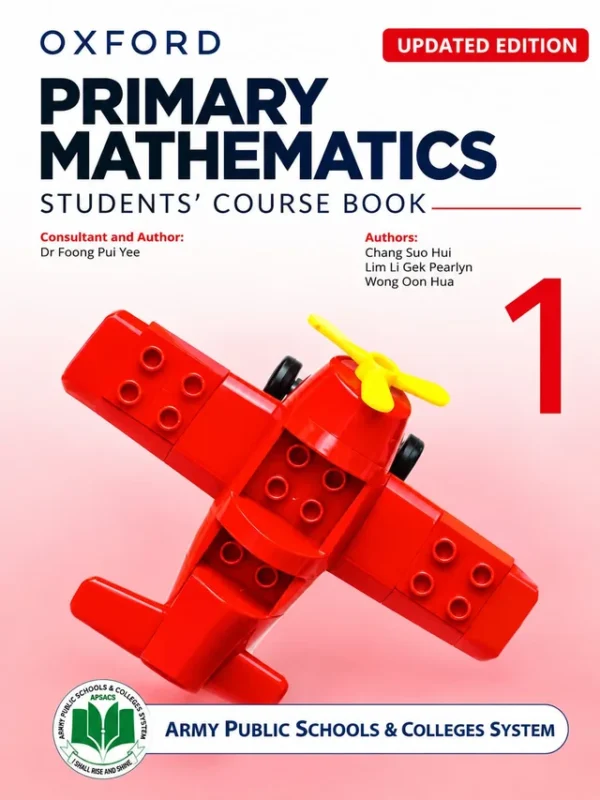
Oxford Primary Mathematics, Students’ Course Book 1 (Updated Edition) is the Class 1 maths textbook of the Army Public Schools & Colleges System. It is published by Oxford University Press Pakistan, with Dr Foong Pui Yee as consultant and author and Chang Suo Hui, Lim Li Gek Pearlyn and Wong Oon Hua as authors, and the cover shows a red toy aeroplane built from building bricks. The series is sold in Pakistan only and, according to its publisher, is built around a student-centred approach. Available to order now for the 2027-28 session.
Each chapter is designed in the same way: a chapter opener to start discussion, ‘In Focus’ questions, ‘Let’s Learn’ pages that introduce ideas through the concrete-pictorial-abstract method (objects first, then pictures, then numbers), ‘Activity Time’ pages for games and group work, and ‘Practice’ pages for immediate checking. For a six-year-old, that means the new idea is always shown with something they can hold or see before it is written as a sum.
Table of contents (Chapters 1 to 10, as photographed)
The contents list is printed over two pages. All topics are given exactly as printed, with page numbers.
Chapter 1: Numbers to 20
- 1. Counting to 20 (p. 2)
- 2. Comparing and Ordering Numbers (p. 8)
- 3. Number Patterns (p. 15)
Why it helps: Everything in Class 1 maths depends on a secure feel for the numbers up to 20. Counting, comparing which is more or less, and spotting patterns (such as counting in twos) give the child that feel.
Chapter 2: Addition Within 20
Why it helps: A single, long lesson where the child discovers that addition can be done by counting on, by using a number line or by making ten, so they choose a method that suits them.
Chapter 3: Subtraction Within 20
- 1. Ways to Subtract (p. 27)
- 2. Addition and Subtraction (p. 31)
Why it helps: Subtraction is introduced through take-away and counting back, and the second lesson shows that addition and subtraction are linked, a connection that makes later checking of answers easy.
Chapter 4: Positions
- 1. Naming Positions (p. 33)
- 2. Naming Left and Right Positions (p. 36)
Why it helps: Words such as above, below, next to, left and right are maths vocabulary as much as English vocabulary, and they also help a child follow directions.
Chapter 5: Shapes and Patterns
- 1. Recognising and Grouping Shapes (p. 40)
- 2. Recognising Patterns (p. 45)
- 3. Recognising Three-Dimensional Shapes (p. 47)
Why it helps: Sorting shapes, continuing patterns and meeting solid shapes such as cubes and cones give the child their first geometry and algebra thinking.
Chapter 6: Measurements
- 1. Finding the Lengths of Objects (p. 51)
- 2. Comparing Masses (p. 54)
- 3. Comparing Capacities (p. 56)
- 4. Temperature (p. 59)
Why it helps: Length, mass, capacity and temperature are the four real-life measures. Here they are compared, not yet calculated, which is right for this age.
Chapter 7: Numbers to 40
- 1. Counting to 40 (p. 62)
- 2. Place Value (p. 64)
- 3. Comparing and Ordering Numbers (p. 66)
- 4. Number Patterns (p. 70)
Why it helps: Place value (tens and ones) is the key idea of the whole book. Once a child sees 27 as 2 tens and 7 ones, larger numbers make sense.
Chapter 8: Addition and Subtraction Within 40
- 1. Addition (p. 74)
- 2. Subtraction (p. 76)
- 3. Adding Three Numbers (p. 78)
Why it helps: The methods learned within 20 are stretched to 40, and adding three numbers is a first step toward mental arithmetic.
Chapter 9: Numbers to 100
- 1. Counting to 100 (p. 80)
- 2. Place Value (p. 83)
- 3. Comparing and Ordering Numbers (p. 85)
- 4. Number Patterns (p. 88)
Why it helps: Counting to 100 is a milestone that most children are proud of. Place value, comparing and patterns are repeated at the new size, which makes the idea stick.
Chapter 10: Addition and Subtraction Within 100
- 1. Addition (p. 92)
- 2. Subtraction (p. 94)
Why it helps: Adding and subtracting within 100 is the end-point of the Class 1 number work and the springboard for Class 2.
Chapters 11 to 14: what the companion Practice Workbook shows
The contents pages we photographed for the Course Book stop at Chapter 10. The companion Practice Workbook for Class 1, which follows the same chapters, lists four more: Chapter 11, Multiplication Tables of 2, 5 and 10; Chapter 12, Division; Chapter 13, Halves and Quarters; and Chapter 14, Time (telling time to the hour and half hour, and the Islamic calendar). If you want the Course Book page numbers for these later chapters, message us on WhatsApp and we will confirm them before you order.
Who is it for, when and how
It is for Class 1 children at Army Public Schools. It is the class textbook, so it is used in lessons and for reference at home; the Practice Workbook (sold separately) is for written practice. At home, use real objects (buttons, coins, bangles) for every new idea before turning to the page.
- What: Oxford University Press Pakistan, Updated Edition, Students’ Course Book 1.
- Whom: Class 1 students; maths teachers; parents who help with homework.
- Why: a concrete-pictorial-abstract course that builds understanding, not just answers.
- Where: Army Public Schools & Colleges, for sale in Pakistan only.
Frequently asked questions
Is this the Course Book or the Workbook?
This is the Students’ Course Book. The Practice Workbook is a separate book.
Which edition is it?
The cover says ‘Updated Edition’ and carries the Army Public Schools & Colleges System logo.
Does it cover multiplication?
Multiplication tables (2, 5 and 10), division, halves and quarters and time are Chapters 11 to 14 of the series; our photographs show the first ten chapters.
Buy Oxford Primary Mathematics Students’ Course Book 1 from us online and pay when it reaches your door (Cash on Delivery, all over Pakistan). We also ship prepaid orders to Saudi Arabia, UAE, Oman, Qatar, Bahrain and Kuwait.