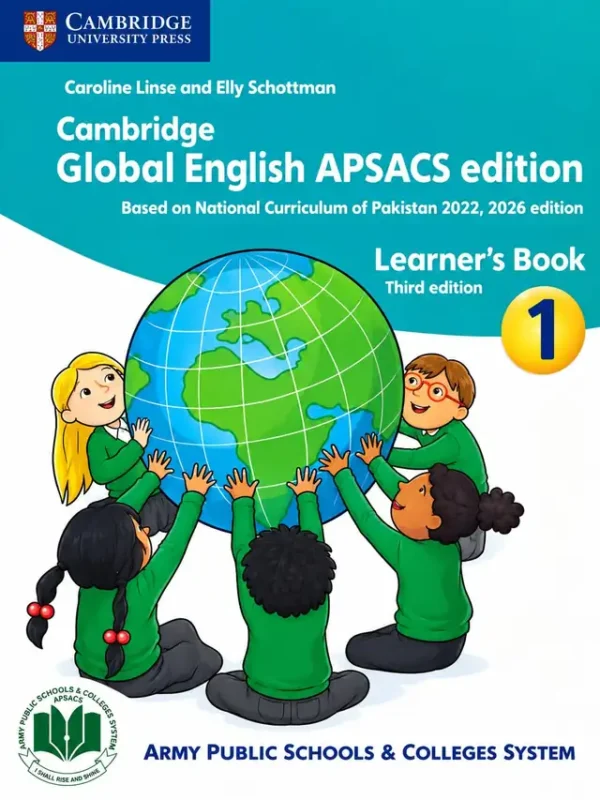
Cambridge Global English APSACS Edition, Learner’s Book 1 (Third edition) is the main English coursebook for Class 1 in the Army Public Schools & Colleges System. It is published by Cambridge University Press, written by Caroline Linse and Elly Schottman, and the cover states that it is ‘Based on National Curriculum of Pakistan 2022, 2026 edition’. If your child is moving up from Pre 1 into Class 1 at an Army Public School, this is the English book they will open on the first day. Available to order now for the 2027-28 session.
Cambridge Global English is a six-stage primary English course for children who learn English as a second language, and the APSACS edition adapts it to the Pakistani curriculum: it adds a page of Single National Curriculum (SNC) themes at the back, and its units are built around everyday topics such as school, family, farms, water and cities. The cover shows a group of children in green school uniforms lifting a big globe, a fair picture of the course: English as a language for the whole world.
Why this book, and why now?
Class 1 is the year a child begins to read and write in English with real purpose. The Learner’s Book does this in a structured way: each unit combines new vocabulary, a grammar point, a reading or writing task, listening and speaking activities, a link to another school subject, phonics, and a thinking or values question. Because every unit follows the same pattern, a six-year-old quickly learns what is expected, and a parent can see exactly what is being taught. It works best alongside the Activity Book (sold separately), which gives the extra practice.
Full table of contents: Starter, Units 1 to 9 and the back-of-book sections
The contents of this book are printed as a wide table that runs over two pages. Here it is rewritten unit by unit, with every column of the table kept: the words children learn, the English structure, reading and writing, listening and speaking, links to other school subjects, phonics, and critical thinking and values.
Starter (pages 6 to 9)
- Words and expressions: Numbers, colours and alphabet objects.
- Listening and speaking: Listen to letters, numbers and colours.
Why it helps: The Starter is a gentle bridge from Pre 1. It revisits numbers, colours and the alphabet so that every child, whatever school they came from, begins Class 1 on the same footing, and the teacher can see who needs extra help.
Unit 1: Welcome to school (pages 10 to 23)
- Words and expressions: School objects, people, activities, vehicles; Greetings; Transport; Colours.
- Use of English: Singular and plural nouns; Present simple with I, we, you; Possessive adjectives; by; Adjective order.
- Reading and writing: Poems/songs; Read for information; Guided writing.
- Listening and speaking: Listen for information; Interviews; Discuss, act out poems and songs.
- Critical thinking and values: Understanding and conducting interviews; Organising and making charts; Values: Making friends, working, playing and learning together.
Why it helps: The first unit is about the child’s new surroundings, so the vocabulary is immediately useful: pencil, teacher, bus, hello. Learning to greet, ask and answer in the first fortnight builds confidence to speak in class, and the values strand (making friends) helps a shy child settle in.
Unit 2: Family time (pages 24 to 37)
- Words and expressions: Families, routines; Feeling words; Likes and dislikes; Favourite foods, recipes and activities; Numbers 1-10.
- Use of English: Present simple; Negatives; Questions and short answers; How many are there?; There is/are.
- Reading and writing: Non-fiction; Poems/songs; Read for information; Guided writing: Cards, labels; Picture captions.
- Listening and speaking: Listen for information; Ask and answer; Talk about families; Discuss, act out poems and songs.
- School subjects: Maths: 1-10, simple problem solving; Geography; Social studies.
- Phonics and word study: th; Short a; Rhyming words.
- Critical thinking and values: Families in different parts of the world; Asking survey questions, creating and discussing graphs; Classification; Values: How families work and play together.
Why it helps: Children love talking about their own family, which is why this unit gets so much spoken English out of them. Asking and answering questions, making a simple graph and writing a card or a caption give practice in all four skills, and the short ‘a’ phonics lesson turns the topic into early reading.
Unit 3: Fun and games (pages 38 to 51)
- Words and expressions: Activities/games; Body; House and objects; Animals; Left/right; Point to/put.
- Use of English: Imperatives/present tense; can for ability; on, under, next to.
- Reading and writing: A play; Guided writing: Game; Read instructions; Read and act out story/play.
- Listening and speaking: Listen to/give instructions; Make a new song verse; Discuss and act out poems, songs, stories.
- School subjects: Physical education.
- Phonics and word study: Short u; Rhyming words; Question marks; Read and act out decodable story.
- Critical thinking and values: What games can we play?; Creative problem solving; Compare and contrast; Values: Taking turns, speaking politely, being a good sport.
Why it helps: Games make instructions meaningful: a child who can say ‘put it under the table’ or ‘I can jump’ is using English for a purpose. Acting out a play brings reading to life, and the values of taking turns and being a good sport matter in every playground.
Unit 4: Making things (pages 52 to 65)
- Words and expressions: Clothes; Colours and shapes; Celebrations; Characters; Describe clothes.
- Use of English: Present continuous (statements, questions, word order); Subject pronouns.
- Reading and writing: Traditional story and song; Information texts; Write about clothes; Poem; Write a song verse.
- Listening and speaking: Listen for information; Ask and talk about pictures; Discuss and act out poems, songs, stories.
- School subjects: Arts and crafts; Shapes and colours; Make puppets.
- Phonics and word study: Short e; I’m (contractions); Rhyming words.
- Critical thinking and values: What can we make with colours and shapes?; Recognising and reproducing word patterns; Planning and making a quilt; Values: Helping others; Values: Cleaning up after ourselves.
Why it helps: This is the first unit where the child describes what is happening right now (she is painting, they are cutting), the present continuous. Arts and crafts make the grammar visible, and cleaning up after ourselves is a habit worth practising at home as well as in class.
Unit 5: On the farm (pages 66 to 79)
- Words and expressions: Farms and animals, seeds, vegetables; Describe animals and their actions; Polite language.
- Use of English: Present continuous: questions and short answers; Subject pronouns; can; above/under.
- Reading and writing: Guided writing; Labelling; Picture captions; Class story writing.
- Listening and speaking: Interviews; Guided speaking; Discuss and act out stories, poems, songs; New verses; Ask and answer information questions.
- School subjects: Science: Life cycles; Growing vegetables.
- Phonics and word study: Short i, ch, sh; Tongue twisters; Identify rhyming words; I’m/we’re (contractions).
- Critical thinking and values: What can you find on a farm?; Document growth of seeds; Interpreting diagrams; Story maps; Values: Taking care of plants and animals is important.
Why it helps: Farm animals and growing seeds give a first science lesson in English. Children learn to label a diagram and to follow a life cycle, which are exactly the skills later science books assume. Tongue twisters make the ch and sh sounds fun.
Unit 6: My five senses (pages 80 to 93)
- Words and expressions: Senses; Music; Talk about favourites; Compare; Ordinal numbers; Describe and discuss tastes, likes and dislikes; Make predictions.
- Use of English: Comparatives with -er; can; Ask and answer questions beginning: Which? Can you? What’s? Do you?
- Reading and writing: Story from Asia; Factual texts; Write full sentence captions, shared writing, short vowel words.
- Listening and speaking: Talk about ability; Talk about senses; Act out a story.
- School subjects: Music; Science: Senses; Arts and crafts: Making instruments.
- Phonics and word study: Short o; -er forms; Compare minimal pairs; Rhyming sounds.
- Critical thinking and values: How do we use our five senses?; Making lists; Comparing things; Understanding high and low sounds; Values: Inclusion/awareness of disability; Values: Respecting differences.
Why it helps: A child who can say ‘my drum is louder’ is comparing in English. The unit uses sight, sound, taste, smell and touch to teach describing words, and its values lessons on inclusion and respecting differences prepare children to treat every classmate fairly.
Unit 7: Let’s go! (pages 94 to 107)
- Words and expressions: Transportation; Movement; Descriptions: Colours and size; Adjective order.
- Use of English: Imperatives; What’s this?; Prepositions.
- Reading and writing: Factual text; Read and follow instructions; Write about activities/experiments; Make a chart; Write about favourite vehicles.
- Listening and speaking: Listen for information; Talk about transportation and movement; Listen to stories, poems; Song.
- School subjects: Arts and crafts: Making a helicopter; Science: Hands-on exploration, shapes.
- Phonics and word study: Long e sound; Listen for sounds.
- Critical thinking and values: How do we travel around?; Classifying and identifying difference between vehicles and movement; Values: Keeping safe while using transportation.
Why it helps: Buses, boats and planes are favourite topics. Following instructions to make a helicopter teaches children to read for a purpose, and the safe-travel values lesson is useful for a child who now travels to school every day.
Unit 8: Wonderful water (pages 108 to 121)
- Words and expressions: Weather; Water and nature; Days of the week; Ask about and describe weather.
- Use of English: Present simple consolidation; yes/no questions; Don’t forget to…
- Reading and writing: Play from Vietnam; Poetry, story, song; Write a poem based on model; Write about animals; Write captions, speech bubbles, create lists, organise writing; Make a class book.
- Listening and speaking: Listening comprehension; Guided speaking; Dialogues; Emphatic expression; Discuss and act out stories, poems, songs.
- School subjects: Science and the environment; Weather patterns; Experiment: Things that float.
- Phonics and word study: Long a spellings ai and ay; Punctuation and capitals.
- Critical thinking and values: Why is water important?; Providing examples to support ideas; Predicting outcomes; Values: Understanding nature and survival; Values: Understanding the importance of water.
Why it helps: Water is a subject every child can relate to, and the unit pulls together everything learned so far: present simple, yes/no questions, a poem to write and a class book to make. The ‘things that float’ experiment teaches prediction, a science skill that begins with a guess and a test.
Unit 9: City places (pages 122 to 135)
- Words and expressions: City places and sounds; Traffic and roads; Household objects; Ordinal numbers; Identify opposites; Describe and compare objects; Express opinions.
- Use of English: Determiners: this/that; Pronouns: these/those; Plurals.
- Reading and writing: Poem about cities; Guided writing about cities; Write: Complete sentence frames, new version of poem, draw and label places.
- Listening and speaking: Listening comprehension: Routes; Talk about where you live; Act out conversation; Play games; Perform poems; Ask for and give things.
- School subjects: Social studies: Living in cities.
- Phonics and word study: -y endings; Awareness of syllables; Rhyming words.
- Critical thinking and values: What can you see, hear and do in a city?; Interpreting maps; Interpreting poems; Values: We can appreciate where we live; Values: We can respect different opinions.
Why it helps: The last unit looks outward, to the child’s neighbourhood. Directions, maps and ‘this/that, these/those’ are the English a child needs to describe where they live, and respecting different opinions is a good note on which to end the year.
Back of the book: Phonics practice, Picture dictionary and SNC themes (pages 136 to 163)
- Phonics practice: Practice of phonics and handwriting (pp. 136-153)
- Picture dictionary: Review of vocabulary and themes (pp. 154-161)
- SNC themes: A mapping grid of the SNC themes (pp. 162-163)
Why it helps: These 28 pages are the part parents use most. The phonics and handwriting practice reinforces letter sounds and letter formation, the picture dictionary is a quick vocabulary check, and the SNC themes grid shows how each unit matches the Single National Curriculum.
Who is it for, when is it used, and how should you use it?
The Learner’s Book is for Class 1 students at Army Public Schools (about six years old), and it is used through the school year, usually one unit every few weeks. Read the ‘Think about it’ question together before the unit starts, say the new words aloud, then let the child do the activities. Keep the Activity Book for homework: it follows the same nine units.
- What: Cambridge University Press, Cambridge Global English APSACS edition, Learner’s Book 1, Third edition.
- Whom: Class 1 students; written by Caroline Linse and Elly Schottman.
- Why: a structured, skills-based English course that matches the National Curriculum of Pakistan 2022.
- Where: in class at Army Public Schools, and at home.
Frequently asked questions
Do I need the Activity Book too?
Most Class 1 students use both. The Learner’s Book is for lessons and the Activity Book (sold separately) is for practice and homework.
Is this the right edition for Army Public Schools?
It is the APSACS edition: the cover shows the Army Public Schools & Colleges System logo and the line ‘Based on National Curriculum of Pakistan 2022, 2026 edition’.
How many units does it have?
Nine units after a Starter, then phonics practice, a picture dictionary and a page of SNC themes.
Order the Cambridge Global English Learner’s Book 1 online with Cash on Delivery across Pakistan, or visit our shop in Lahore. Message us the class and campus on WhatsApp and we will confirm the edition before we dispatch.