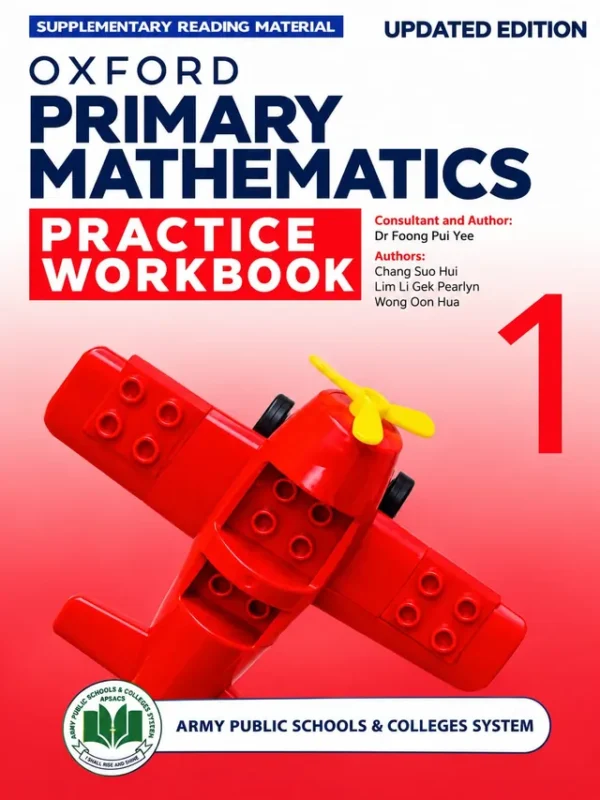
Oxford Primary Mathematics, Practice Workbook 1 (Updated Edition) is the written-practice book that goes with the Class 1 Students’ Course Book in Army Public Schools. It is marked ‘Supplementary Reading Material’, written by Dr Foong Pui Yee (consultant and author) with Chang Suo Hui, Lim Li Gek Pearlyn and Wong Oon Hua, and published by Oxford University Press Pakistan. Available to order now for the 2027-28 session.
A Course Book explains; a Workbook makes the child do. This workbook gives the child space to write answers for every lesson of the Course Book, so the school’s chapter and the home practice always match. Its 14 chapters take a six-year-old from counting to 20 all the way to telling the time and using the Islamic calendar.
Full table of contents: Chapters 1 to 14, every lesson and page
This workbook’s contents are printed on two pages. Here is every chapter and lesson, in order, with the page number, followed by a note on what the practice builds.
Chapter 1: Numbers to 20
- Counting to 20 (p. 1)
- Comparing and Ordering Numbers (p. 10)
- Number Patterns (p. 18)
Why it helps: Plenty of room to write numbers, circle the bigger one and fill in missing numbers makes the first chapter a confidence-builder.
Chapter 2: Addition Within 20
Why it helps: Practice on every method of adding, so the child does not depend on one trick.
Chapter 3: Subtraction Within 20
- Ways to Subtract (p. 23)
- Addition and Subtraction (p. 28)
Why it helps: Take-away sums and mixed addition and subtraction questions, which teach the child to read the sign before answering.
Chapter 4: Positions
- Naming Positions (p. 30)
- Naming Left and Right (p. 34)
Why it helps: Colouring and circling tasks that fix the words left, right, above and below.
Chapter 5: Shapes and Patterns
- Recognising and Grouping Shapes (p. 37)
- Recognising Patterns (p. 42)
- Recognising Three-Dimensional Shapes (p. 44)
Why it helps: Sorting and continuing patterns trains logical thinking.
Chapter 6: Measurements
- Finding the Lengths of Objects (p. 46)
- Comparing Masses (p. 51)
- Comparing Capacities (p. 53)
- Temperature (p. 56)
Why it helps: Comparing length, mass and capacity on paper prepares a child for real-life measuring.
Chapter 7: Numbers to 40
- Counting to 40 (p. 57)
- Place Value (p. 61)
- Comparing and Ordering Numbers (p. 64)
- Number Patterns (p. 67)
Why it helps: Place value drills, tens and ones, are the most important practice in the book.
Chapter 8: Addition and Subtraction Within 40
- Addition (p. 68)
- Subtraction (p. 70)
- Adding Three Numbers (p. 72)
Why it helps: Larger sums, and the first adding-three-numbers questions.
Chapter 9: Numbers to 100
- Counting to 100 (p. 74)
- Place Value (p. 77)
- Comparing and Ordering Numbers (p. 80)
- Number Patterns (p. 83)
Why it helps: Counting, place value and ordering up to 100.
Chapter 10: Addition and Subtraction Within 100
- Addition (p. 85)
- Subtraction (p. 87)
Why it helps: Two-digit sums, the end of the number work for Class 1.
Chapter 11: Multiplication Tables of 2, 5, and 10
- Multiplication as Repetitive Addition (p. 89)
- Multiplication Table of 2 (p. 91)
- Multiplication Table of 5 (p. 94)
- Multiplication Table of 10 (p. 97)
Why it helps: The tables of 2, 5 and 10 are the easiest to learn and the most useful, because they link to counting by twos, fives and tens.
Chapter 12: Division
- Division as Successive Subtraction (p. 100)
- Grouping and Sharing (p. 102)
- Dividing by 2, 5, and 10 (p. 104)
- Multiplication and Division (p. 107)
Why it helps: Division is shown as sharing and grouping, then linked back to the tables just learned.
Chapter 13: Halves and Quarters
- Halves and Quarters (p. 109)
Why it helps: A first look at fractions, through folding and sharing.
Chapter 14: Time
- Telling Time to the Hour (p. 111)
- Telling Time to the Half Hour (p. 114)
- Islamic Calendar (p. 117)
Why it helps: Telling the time and using the Islamic calendar, so that the year ends with practical skills a child uses every day.
Who is it for, when and how
It is for Class 1 students in Army Public Schools, used alongside the Students’ Course Book. A good rhythm is to learn a topic in class and then do the matching workbook pages the same evening while the lesson is fresh. Parents can check answers quickly because the chapters are short.
- What: Practice Workbook 1, Updated Edition, Oxford University Press Pakistan.
- Whom: Class 1 children at Army Public Schools.
- Why: written practice that mirrors the Course Book chapter by chapter.
- Where: home and school.
Frequently asked questions
Is this the same as the Course Book?
No. This is the Practice Workbook; the Course Book is a separate title.
Does it have more chapters than the Course Book?
The workbook’s contents list 14 chapters, the last four being multiplication tables, division, halves and quarters, and time.
Do I need both?
Most families buy both: the Course Book for lessons and the Workbook for practice.
Ready to order? Send us a WhatsApp message with the class, and we will confirm availability and dispatch the Oxford Primary Mathematics Practice Workbook 1 the same way we send every Army Public School book: carefully packed, with Cash on Delivery across Pakistan.