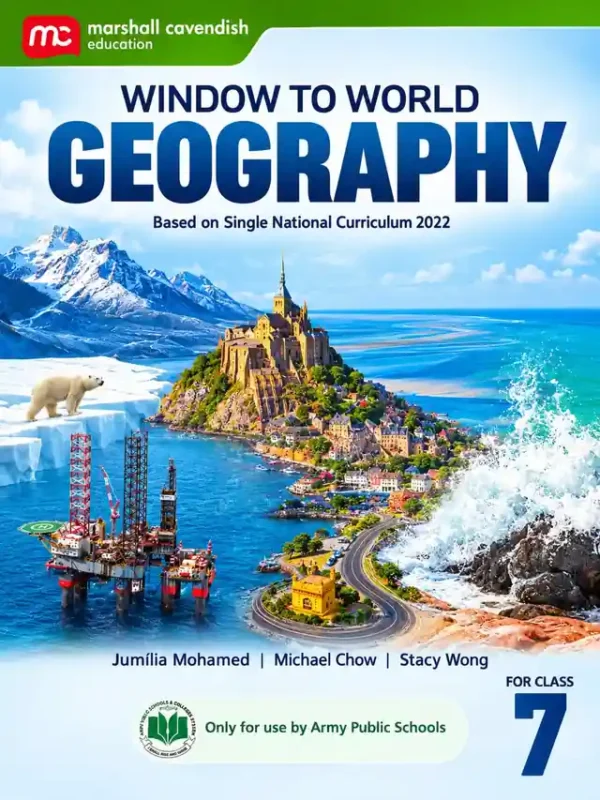
Window to World Geography, Class 7 is the Class 7 geography textbook of the Army Public Schools & Colleges System. It is published by Marshall Cavendish Education, written by Jumilia Mohamed, Michael Chow and Stacy Wong, and the cover (a picture of a coastal castle, an oil rig, a polar bear and a sunny coast) says ‘Based on Single National Curriculum 2022’, ‘For Class 7’ and ‘Only for use by Army Public Schools’. Available to order now for the 2027-28 session.
The Class 7 book uses the same three-part structure as the Class 6 book: physical, human and environmental geography. It moves from plains and rivers, through water, farming, settlements and the minerals that power the modern world, to climate change.
Full table of contents: six chapters, glossary and maps
Every entry is given as printed, with a note on what each chapter gives the student.
Physical Geography
- Chapter 1: Plains and Rivers (p. 2)
Why it helps: Plains and rivers are central to Pakistan’s geography and history. The chapter explains how rivers shape the land and why most people live along them.
Human Geography
- Chapter 2: Water Sources and Management (p. 32)
- Chapter 3: Agriculture (p. 46)
- Chapter 4: Settlements and Land Use (p. 60)
- Chapter 5: Minerals and Power (p. 78)
Why it helps: Four chapters on how people use the Earth. Water management and agriculture are key issues in Pakistan; settlements and land use explain how cities and villages grow; and minerals and power cover the resources behind industry and energy.
Environmental Geography
- Chapter 6: Climate Change (p. 94)
Why it helps: Climate change is the most important environmental topic of our time. The final chapter helps Class 7 students understand causes and effects and think about solutions.
Back of the book: Glossary and maps
- Glossary (p. 104)
- World Map (p. 107)
- Outline World Map (p. 108)
- Outline Map of Pakistan (p. 109)
Why it helps: A glossary of key terms and three maps (world, outline world and outline Pakistan) for practice.
How to use the book with an atlas
For Class 7, keep a map of Pakistan on the table:
- Chapter 1, plains and rivers: trace the Indus and its tributaries (the Jhelum, Chenab, Ravi and Sutlej) on the outline map.
- Chapter 2, water sources: ask your family how water reaches your home: from a well, a canal, a tank or a pipe?
- Chapter 3, agriculture: make a list of the crops grown near your city and the season for each.
- Chapter 4, settlements: compare a village and a city you know, using the words in the chapter.
- Chapter 5, minerals and power: find where coal, salt and natural gas are found in Pakistan.
- Chapter 6, climate change: write down three changes in weather your grandparents notice that they did not see as children.
Who, when and how
The book is for Class 7 students at Army Public Schools and is the main geography textbook of the year. Keep an atlas next to the book and use the outline maps to practise labelling rivers, plains and mineral areas of Pakistan.
- What: Window to World Geography, Class 7, Marshall Cavendish Education.
- Whom: Class 7 students.
- Why: to cover physical, human and environmental geography under the Single National Curriculum 2022.
- Where: Army Public Schools only.
Frequently asked questions
Who publishes this book?
Marshall Cavendish Education.
Is it the same as the Class 6 book?
No. Class 6 covers rocks, mountains, climate, forests and natural disasters; Class 7 covers plains and rivers, water, agriculture, settlements, minerals and climate change.
Does it include outline maps?
Yes. The back of the book has a world map, an outline world map and an outline map of Pakistan.
We deliver Window to World Geography Class 7 to every city in Pakistan with Cash on Delivery, and you are welcome to collect it from our Lahore shop. If your school sent a book list, send it to us on WhatsApp and we will put the whole set together.