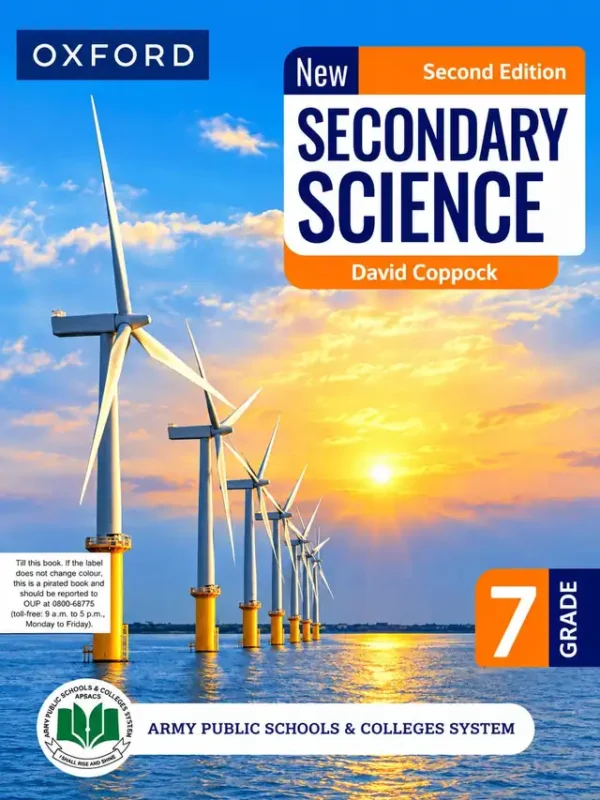
Oxford New Secondary Science, Grade 7 (Second Edition) is the Class 7 science textbook of the Army Public Schools & Colleges System. It is written by David Coppock and published by Oxford University Press; the cover shows wind turbines at sea against a sunset, with a large orange 7. According to the publisher, it covers physics, chemistry and biology topics according to the curriculum of Pakistan 2022, with full-colour illustrations, ‘Did you know?’ segments, ‘Test yourself’ sections at the end of units and exercises after each unit. Available to order now for the 2027-28 session.
The three chapters photographed on the contents page are all biology and are substantial: plant systems (including photosynthesis and respiration), the human respiratory and circulatory system, and immunity and diseases. Each is 14 to 18 pages and comes with a page of learning outcomes.
Full table of contents: Chapters 1 to 3, with learning outcomes
The contents are printed as a table of chapters, page ranges and titles, with bullet points under each. Each chapter is listed below as printed, followed by what the book’s own learning-outcomes page says the student should be able to do (paraphrased).
Chapter 1: Plant systems (pages 2 to 15)
- Transport in plants
- Transpiration
- Photosynthesis
- The process of photosynthesis
- Plants need minerals
- What happens to the glucose?
- Respiration in plants
- Anaerobic respiration in plants
- Gas exchange in plants
Why it helps: Learning outcomes: students explain the root and shoot systems and label the parts of a leaf, stem and root; predict the roles of xylem and phloem by observing a cross section of a stem; define photosynthesis and write word equations for it; know that plants need minerals (magnesium for chlorophyll, nitrates for protein); explain how a leaf is adapted for photosynthesis; describe respiration with word equations and compare it with photosynthesis; investigate transpiration and how wind, temperature, light and humidity affect it; and explore how water rises naturally in plants. This chapter turns an everyday plant into a working machine.
Chapter 2: Human respiratory and circulatory system (pages 16 to 33)
- The respiratory system
- Breathing
- Difference between respiration and breathing
- Energy without oxygen in animals
- The circulatory system
- The human heart
- Blood
- The pumping cycle
- Why do living organisms have such a complex transport system?
Why it helps: Learning outcomes: students differentiate respiration from breathing and aerobic from anaerobic respiration; trace the path of air in and out of the body; sketch and label the circulatory system; hypothesise how exercise of varying intensity affects pulse rate, then test and record it; describe the trachea, lungs and alveoli; explain why living organisms need a complex transport system; describe the heart, arteries, veins and capillaries and compare them; and describe the composition of blood and the functions of red cells, white cells, platelets and plasma. A pulse-rate experiment makes this a very hands-on chapter.
Chapter 3: Immunity and diseases (pages 34 to 47)
- Pathogens
- Pathogens and diseases
- Defences against diseases – the immune system
- How to avoid catching a disease
- Strategies for strengthening the immune system
Why it helps: Learning outcomes: students identify the types of pathogens that cause infectious diseases; explain the body’s defences and the parts of the immune system; describe the three types of immunity (innate, adaptive and passive); show how adaptive immunity develops over time; visualise extra layers of defence (such as wearing masks and using sanitisers); propose strategies for strengthening the immune system; explain how diseases such as Hepatitis, COVID-19, Typhoid, Whooping Cough, Measles and Dengue are contracted, tested, diagnosed and prevented; and suggest ways a community can protect itself. It is a timely, practical chapter for Class 7.
How the book helps students study
According to the publisher, the book has a clear, student-friendly layout with full-colour illustrations; step-by-step explanations of complex concepts; a comprehensive contents section giving the teaching objectives and learning outcomes for each unit; ‘Did you know?’ segments with extra facts; ‘Test yourself’ questions at the end of each section; and exercises after each unit. A separate Workbook for Grade 7 is available for further practice.
Who, when and how
The book is for Class 7 students at Army Public Schools and is the main science textbook of the year. At home, check your own pulse before and after exercise, grow a plant in light and dark, and talk about how handwashing stops pathogens spreading.
- What: New Secondary Science, Second Edition, Grade 7, by David Coppock (Oxford).
- Whom: Class 7 students.
- Why: to cover the science curriculum of Pakistan 2022 for Class 7.
- Where: Army Public Schools & Colleges.
Frequently asked questions
Who wrote this book?
David Coppock, published by Oxford University Press.
Is there a workbook?
Yes. The New Secondary Science Workbook for Grade 7 is a separate title (listed separately in our shop).
What are the chapters?
Plant systems, Human respiratory and circulatory system, and Immunity and diseases.
Ready to order? Send us a WhatsApp message with the class, and we will confirm availability and dispatch New Secondary Science Grade 7 the same way we send every Army Public School book: carefully packed, with Cash on Delivery across Pakistan.