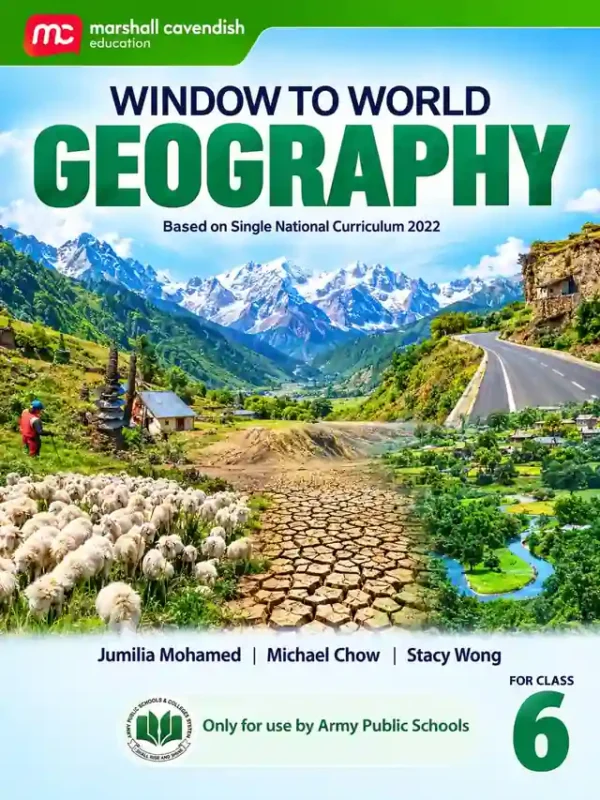
Window to World Geography, Class 6 is the Class 6 geography textbook of the Army Public Schools & Colleges System. It is published by Marshall Cavendish Education, written by Jumilia Mohamed, Michael Chow and Stacy Wong, and the cover says ‘Based on Single National Curriculum 2022’, ‘For Class 6’ and ‘Only for use by Army Public Schools’. The cover shows snow-capped mountains above a green valley, a cracked dry riverbed and a flock of sheep, a picture of what the book is about: the Earth in all its variety. Available to order now for the 2027-28 session.
Class 6 is the first year in which geography is taught as a separate subject, and the book is organised into three branches: physical geography, human geography and environmental geography. Six chapters cover Earth’s structure, mountains, climates, forests, natural disasters and the way human activity changes the planet.
Full table of contents: Introduction, six chapters, glossary and maps
The contents list an introduction, six chapters grouped under three headings, and a glossary and three maps. Every entry is given as printed.
Introducing Geography (page 1)
- Introducing Geography (p. 1)
Why it helps: Before the chapters begin, the book explains what geography is and how to work with it. A student who understands what a geographer does will read the later chapters with purpose.
Physical Geography
- Chapter 1: Structure of Earth and Types of Rocks (p. 10)
- Chapter 2: Mountains, Plateaus and Valleys (p. 35)
- Chapter 3: Climatic Regions of the World (p. 53)
Why it helps: Three chapters on the natural Earth. Chapter 1 digs into the planet’s layers and the three kinds of rock; Chapter 2 covers the landforms Pakistan is famous for (mountains, plateaus and valleys); and Chapter 3 travels the world’s climate zones.
Human Geography
- Chapter 4: Forests of the World (p. 71)
- Chapter 5: Natural Disasters (p. 101)
Why it helps: Forests and natural disasters link the natural world to human life. Natural disasters, floods and earthquakes especially, are directly relevant to Pakistan, and the chapter helps students understand why they happen and how to prepare.
Environmental Geography
- Chapter 6: Changing Earth and Human Activity (p. 137)
Why it helps: The final chapter looks at how human activity changes the Earth, and prepares students to think about their own responsibility for the environment.
Back of the book: Glossary and maps
- Glossary (p. 154)
- World Map (p. 157)
- Outline World Map (p. 158)
- Outline Map of Pakistan (p. 159)
Why it helps: The glossary explains key geographical terms, and the world map and two outline maps (the world and Pakistan) give students blank maps to practise labelling, a skill that is tested in most geography exams.
How to use the book with an atlas
Geography becomes much easier when the page and the map are open together. For Class 6:
- Chapter 1, rocks: collect three small rocks (or look at pictures) and decide whether they are igneous, sedimentary or metamorphic.
- Chapter 2, mountains, plateaus and valleys: find the Himalayas, Karakoram and Hindu Kush on the outline map of Pakistan, and the Potohar Plateau and the Swat Valley.
- Chapter 3, climatic regions: on the world outline map, colour the hot, temperate and cold zones in three colours.
- Chapter 4, forests: note which forests are in tropical, temperate and cold regions and what lives in each.
- Chapter 5, natural disasters: read about the 2005 earthquake and the floods in Pakistan in the news archive, and discuss how to prepare.
- Chapter 6, changing Earth: list three ways your family can reduce waste.
Who, when and how
The book is for Class 6 students at Army Public Schools and is the main geography textbook of the year. At home, an atlas or a globe beside the book makes the chapters concrete: find the mountains, trace the climate zones, mark the outline map of Pakistan.
- What: Window to World Geography, Class 6, Marshall Cavendish Education.
- Whom: Class 6 students; authors Jumilia Mohamed, Michael Chow and Stacy Wong.
- Why: to teach physical, human and environmental geography.
- Where: Army Public Schools only.
Frequently asked questions
Who publishes this book?
Marshall Cavendish Education.
Is it based on the new curriculum?
Yes. The cover says ‘Based on Single National Curriculum 2022’.
Does it include maps to fill in?
Yes. The back of the book has a world map, an outline world map and an outline map of Pakistan.
Order Window to World Geography Class 6 online with Cash on Delivery across Pakistan, or visit our shop in Lahore. Message us the class and campus on WhatsApp and we will confirm the edition before we dispatch.