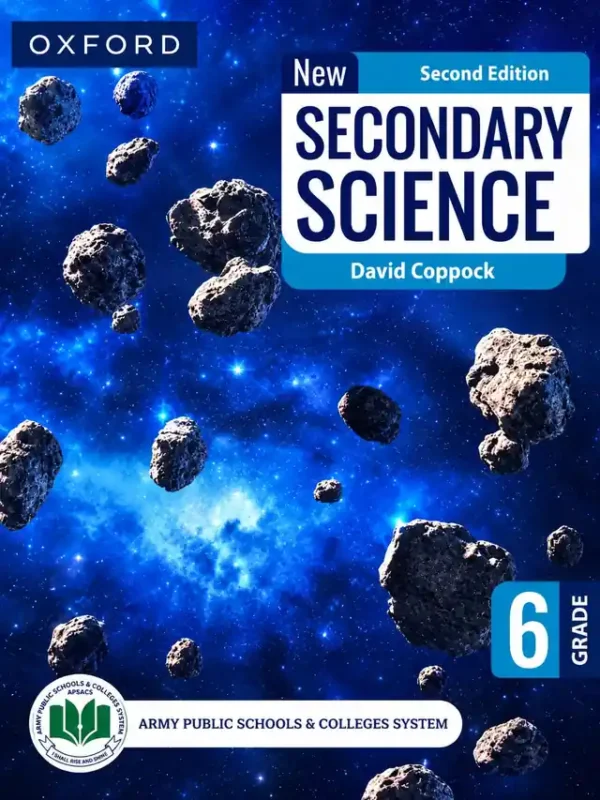
Oxford New Secondary Science, Grade 6 (Second Edition) is the Class 6 science textbook of the Army Public Schools & Colleges System. It is written by David Coppock and published by Oxford University Press; the dark-blue cover shows asteroids drifting in space. According to the publisher, the book covers physics, chemistry and biology topics according to the curriculum of Pakistan 2022 and relates scientific facts to the everyday world. Available to order now for the 2027-28 session.
In Class 6 the photographed contents show four biology chapters: cellular organisation, reproduction in plants, balanced diet and the human digestive system. The book gives full details of teaching objectives and learning outcomes for each chapter, and the publisher describes ‘Test yourself’ questions at the end of each section and exercises after each unit.
Full table of contents: Chapters 1 to 4, with learning outcomes
The contents are printed as a table of chapters, page ranges and titles, with bullet points under each title. Each chapter is listed below exactly as printed, followed by what the book’s own learning-outcomes page says the student should be able to do (paraphrased).
Chapter 1: Cellular Organization (pages 2 to 9)
- Cells
- Special cells for special jobs
- Cells, tissues, and organs
Why it helps: Learning outcomes: students recognise cells as the basic unit of life, organised into tissues, organs, systems and organisms; arrange the levels of cellular organisation; relate the structures of common cells (nerve, muscle, epithelial and blood cells) to their functions; identify the parts of animal and plant cells seen under a simple microscope (cell membrane, cytoplasm, nucleus, cell wall, chloroplast, mitochondria and sap vacuole); compare plant and animal cells; and sketch and label them, including by preparing slides of onion peel and cheek cells. This is where a student first uses a microscope and learns to see living things as made of cells.
Chapter 2: Reproduction in Plants (pages 10 to 19)
- Reproduction in plants
- Sexual reproduction in plants
- Asexual reproduction in plants
- Micropropagation and tissue culture
- Vegetative propagation and agriculture
Why it helps: Learning outcomes: students describe the types of plant reproduction, compare sexual and asexual reproduction, distinguish natural from artificial asexual reproduction (budding, grafting, bulbs, tubers, runners, cutting and layering), and explore how artificial propagation can give better yields in agriculture. It is a very relevant chapter for a farming country.
Chapter 3: Balanced Diet (pages 20 to 29)
- Food types
- Nutrition disorders
- Keeping fit and healthy
Why it helps: Learning outcomes: students identify the parts of a balanced diet (protein, carbohydrates, fats and oils, water, minerals, limited to calcium and iron, and vitamins, limited to A, C and D) and the functions of these nutrients; identify deficiency disorders; recognise that a healthy diet is balanced; and relate diet to fitness. Students and parents will find this chapter applicable to everyday meals.
Chapter 4: Human Digestive System (pages 30 to 39)
- Digestion
- Physical digestion
- Chemical digestion
- Enzymes
- Digestive disorders
Why it helps: Learning outcomes: students state why digestion matters and describe physical and chemical digestion; sequence the main regions of the alimentary canal and describe their functions; describe the role of enzymes and some major digestive disorders; and conclude that blood carries the products of digestion around the body while undigested material is egested. A clear picture of the digestive system also helps children make sense of nutrition.
How the book helps students study
According to the publisher, the book has a full-colour, student-friendly layout; a comprehensive contents section giving the teaching objectives and learning outcomes for each unit; ‘Test yourself’ questions at the end of each section; and exercises after each unit to check learning. A separate Workbook for Grade 6 (also by David Coppock) is available for extra practice.
Who, when and how
The book is for Class 6 students at Army Public Schools and is the main science textbook of the year. At home, try the experiments the book suggests: look at onion peel under a microscope, grow a plant from a cutting, plan a balanced meal.
- What: New Secondary Science, Second Edition, Grade 6, by David Coppock (Oxford).
- Whom: Class 6 students.
- Why: to cover the science curriculum of Pakistan 2022 for Class 6.
- Where: Army Public Schools & Colleges.
Frequently asked questions
Who wrote this book?
David Coppock, published by Oxford University Press.
Is there a workbook?
Yes. A separate New Secondary Science Workbook for Grade 6 is available; this listing is the textbook.
Which subjects does it cover?
The photographed chapters are biology: cells, plant reproduction, diet and digestion. The publisher says the series covers physics, chemistry and biology.
Buy New Secondary Science Grade 6 from us online and pay when it reaches your door (Cash on Delivery, all over Pakistan). We also ship prepaid orders to Saudi Arabia, UAE, Oman, Qatar, Bahrain and Kuwait.