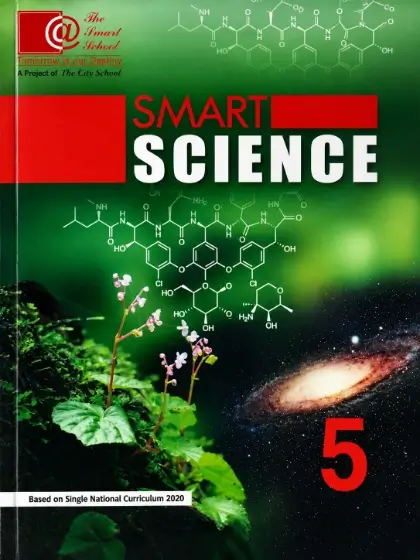
The Smart School’s Class 5 Smart Science textbook, based on the Single National Curriculum 2020, covers ten units of life science, environmental science, chemistry and physics for Grade 5 students, plus a full glossary.
Unit 1: Classification of Living Things (Page 8) — classifying animals into vertebrates (mammals, birds, reptiles, amphibians, fish) and invertebrates (insects, worms, mollusks), and plants into flowering/non-flowering, monocots and dicots. A good starting point for anyone looking for class 5 living things classification notes.
Unit 2: Microorganisms (Page 28) — bacteria, viruses and fungi, their useful roles in decomposition, food production and digestion, harmful microorganisms and disease, plus hygiene and immunization. Useful for class 5 microorganisms notes or a school project on germs and hygiene.
Unit 3: Flowers and Seeds (Page 44) — the parts of a flower (sepals, petals, stamen, carpel), self- and cross-pollination, fertilization, and how a seed germinates. Matches searches like parts of a flower class 5 or seed germination for kids.
Unit 4: Environmental Pollution (Page 58) — air, water and soil pollution, their causes and effects, and the 3Rs — reduce, reuse, recycle. A common topic for a class 5 environment or pollution school assignment.
Unit 5: Physical and Chemical Changes of Matter (Page 72) — states of matter, reversible physical changes (melting, freezing, evaporation, condensation) versus irreversible chemical changes (rusting, burning, cooking). Directly useful for physical vs chemical change examples for class 5.
Unit 6: Light and Sound (Page 88) — how light travels, shadows, transparent/translucent/opaque materials, and how sound travels, pitch and volume. Matches light and sound class 5 or how shadows are formed.
Unit 7: Electricity and Magnetism (Page 112) — simple electric circuits, conductors and insulators, magnets, magnetic fields and electromagnets. Useful for a simple circuit diagram class 5 homework topic.
Unit 8: Structure of Earth (Page 128) — Earth’s crust, mantle, outer core and inner core, soil types, and weathering and erosion.
Unit 9: Space and Satellites (Page 140) — the solar system, the Moon and its phases, and artificial satellites for communication, weather and navigation. Matches solar system class 5 searches.
Unit 10: Technology in Everyday Life (Page 154) — simple machines like levers, pulleys, wheels and axles, and how technology solves everyday problems, with a full glossary of scientific terms at Page 169.
Message us on WhatsApp to confirm current stock before you order.