Ready, Steady, Go… Mathematics, Early Years Stage II, Second Term is the Nursery maths book used in Army Public Schools & Colleges (APSACS). The First Term book teaches numbers up to 20; this Second Term book picks up at number 21 and carries the child all the way to 50, adding the first ideas of sets, time, patterns and take-away along the way. Available to order now for the 2027-28 session.
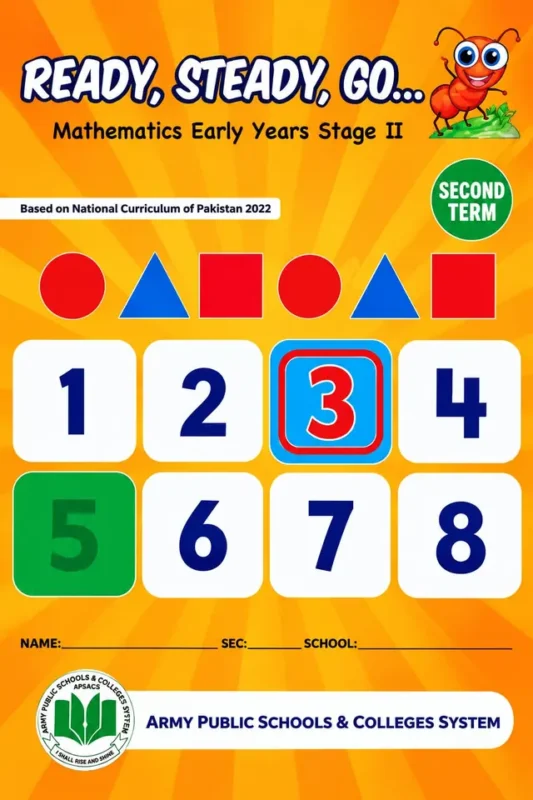
The cover is a bright orange page with a row of red, blue and green shapes above a number grid from 1 to 8 (the number 3 is highlighted, the number 5 is green), with lines for the child’s name, section and school at the bottom. It is built on the National Curriculum of Pakistan 2022, and the units are numbered 7 to 12 because they continue straight on from the First Term book.
Full table of contents: Units 7 to 12, every topic and page
Each unit mixes number pages (one number at a time) with concept pages and a reinforcement activity. Here is the complete list exactly as printed, followed by a plain-language note on why each unit matters.
Unit 7: Numbers 21 to 26, ordinals and days (pages 1 to 12)
- Reinforcement Activity (p. 1)
- Number 21 (p. 3)
- Number 22 (p. 4)
- Number 23 (p. 5)
- Number 24 (p. 6)
- Ordinal Numbers (p. 7)
- Days of the week (p. 8)
- What comes before (p. 9)
- Add two more (p. 10)
- Number 25 (p. 11)
- Number 26 (p. 12)
Why it helps: The term opens with a reinforcement page so that the child warms up with numbers they already know. Ordinal numbers (first, second, third) and the days of the week turn counting into real language, ‘What comes before’ builds sequencing, and ‘Add two more’ is the child’s first taste of addition.
Unit 8: Numbers 27 to 30, weight and backward counting (pages 13 to 20)
- Heavy & Light (p. 13)
- Number 27 (p. 15)
- Number 28 (p. 16)
- Backward Counting (p. 17)
- Number 29 (p. 18)
- Number 30 (p. 19)
- Reinforcement Activity (p. 20)
Why it helps: Comparing heavy and light objects is the first step toward measurement, and counting backward is the first step toward subtraction. A reinforcement activity closes the unit so that numbers 27 to 30 are practised again before moving on.
Unit 9: Sets, numbers 31 to 36, time and take-away (pages 21 to 32)
- Sets (p. 21)
- Number 31 (p. 23)
- Number 32 (p. 24)
- Time (p. 25)
- Before and After (p. 26)
- Number 33 (p. 27)
- Number 34 (p. 28)
- Take away (Subtract) (p. 29)
- Number 35 (p. 31)
- Number 36 (p. 32)
Why it helps: Sets teach a child to group objects, which is the foundation of later maths. This unit also introduces time and the idea of taking away, with ‘Before and After’ reinforcing order. By the end the child can count to 36 and can show a simple subtraction with objects.
Unit 10: Patterns, numbers 37 to 40 and ordering shapes (pages 33 to 41)
- Patterns (p. 33)
- Number 37 (p. 35)
- Number 38 (p. 36)
- Ordering Shapes (p. 37)
- Number 39 (p. 39)
- Number 40 (p. 40)
- Reinforcement Activity (p. 41)
Why it helps: Spotting patterns is an early algebra skill, and ordering shapes combines it with geometry. Reaching number 40 gives the child a sense of the bigger numbers they will meet next year.
Unit 11: Numbers 41 to 46 and position words (pages 45 to 53)
- Number 41 (p. 45)
- Number 42 (p. 46)
- Above and Below (p. 47)
- Over and Under (p. 48)
- Number 43 (p. 49)
- Number 44 (p. 50)
- Two Less (p. 51)
- Number 45 (p. 52)
- Number 46 (p. 53)
Why it helps: Above, below, over and under teach the language of position, and ‘Two Less’ gives subtraction a gentle second practice. These words appear in every maths and English book later, so learning them now saves confusion.
Unit 12: Patterns, numbers 47 to 50 and final reinforcement (pages 54 to 59)
- Patterns (p. 54)
- Number 47 (p. 55)
- Number 48 (p. 56)
- Number 49 (p. 57)
- Number 50 (p. 58)
- Reinforcement Activity (p. 59)
Why it helps: The final unit finishes the count to 50 and returns to patterns, which shows the child how everything connects. The closing reinforcement activity is the best page for parents to check before the year-end test.
Who is this book for, and how does it fit into the school year?
It is for Nursery students at Army Public Schools, aged around four, and for parents who want to support maths at home. It is the Second Term book, meant for the second half of the year after the First Term maths book. Do not rush the numbers: one number per day with objects such as buttons, pebbles or bangles is the best way to make the page meaningful.
- What: a 59-page Nursery maths book covering numbers 21 to 50 in six units.
- Why: to build number sense, sets, patterns, time and simple take-away before Prep.
- When: Second Term of Nursery.
- Whom: Nursery children, parents and teachers.
- Where: Army Public Schools & Colleges, and at home.
Frequently asked questions
Does this book start from number 1?
No. It is the Second Term book and starts at number 21 (Unit 7). Numbers 1 to 20 are in the First Term maths book.
What are ‘Reinforcement Activity’ pages?
They are revision pages placed at the end of a group of numbers so the child can practise what was just learned.
Is the book based on the new curriculum?
Yes. The cover says it is based on the National Curriculum of Pakistan 2022.
Buy the Nursery Mathematics Second Term book from us online and pay when it reaches your door (Cash on Delivery, all over Pakistan). We also ship prepaid orders to Saudi Arabia, UAE, Oman, Qatar, Bahrain and Kuwait.