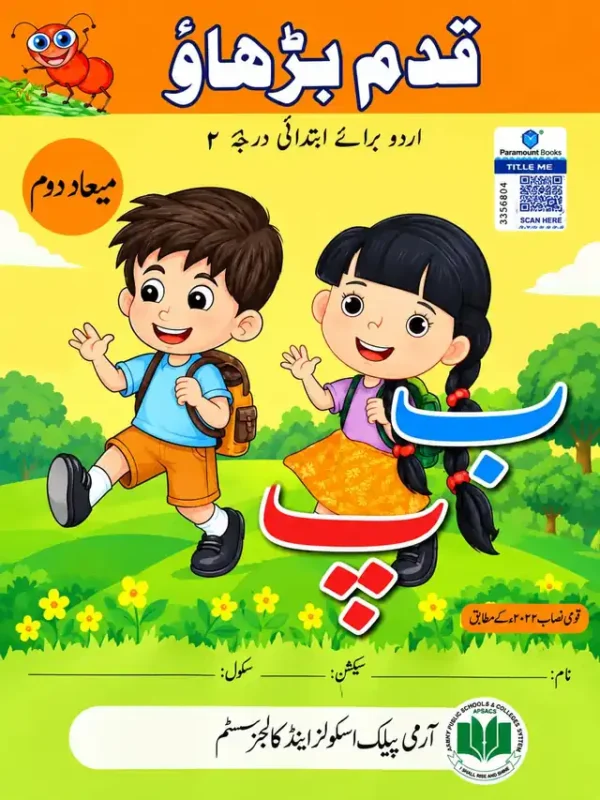
Qadam Barhao (literally ‘Step Forward’) is the Nursery Urdu book of the Army Public Schools & Colleges System, and this edition is the Second Term (Mayaad Doum) volume, titled ‘Urdu for Early Years 2’ on its cover. Army Public School Urdu books are split into two terms: the First Term book (Mayaad Awal) is taught in roughly the first six months, and this Second Term book (Mayaad Doum) is taught in the next six months. Available to order now for the 2027-28 session.
The cover shows a smiling boy and girl with school bags walking on a green path beside the Urdu letters Bay and Pay, and the Paramount Books mark with a QR code is printed on the front. If your child is in Nursery at an Army Public School and has finished the first-term book, this is the book that comes next, and it carries the child through the rest of the Urdu alphabet from Seen to Yay.
Full table of contents: Chapters 7 to 12 (Baab 7 to 12), page by page
The Second Term book continues the chapter numbers from the First Term book, so it opens at Chapter 7 (Baab 7). The headings of the book are in Urdu; here they are given in Roman Urdu with an English meaning, in the same order as the contents page. ‘Aada’ means revision, and ‘tasveeri mushahida’ means observing a picture.
Chapter 7 (Baab 7): Seen, Sheen and Suad (pages 1 to 10)
- Aada (Revision) (p. 1)
- Harf Seen ka taaruf (Introducing the letter Seen) (p. 4)
- Tasveeri tabadla-e-khayal (Picture discussion) (p. 5)
- Harf Sheen ka taaruf (p. 6)
- Tasveeri mushahida (Picture observation) (p. 7)
- Harf Suad ka taaruf (p. 8)
- Awazon ki pehchan (Recognising sounds) (p. 9)
- Tasveeri mushahida (p. 10)
Why it helps: A revision page opens the chapter, so the child is reminded of old letters before meeting new ones. Seen, Sheen and Suad look and sound alike, which is why the book spaces them with picture discussions, and the ‘Awazon ki pehchan’ page trains the ear to hear the difference.
Chapter 8 (Baab 8): Zuad, Toay and Zoay (pages 11 to 18)
- Harf Zuad ka taaruf (p. 11)
- Tasveeri mushahida (p. 12)
- Harf Toay ka taaruf (p. 13)
- Tasveeri mushahida (p. 14)
- Aada (Revision) (p. 15)
- Harf Zoay ka taaruf (p. 16)
- Tasveeri mushahida (p. 17)
- Aada (Revision) (p. 18)
Why it helps: These heavy letters are the hardest for small children to pronounce. Every letter is paired with a picture-observation page and the chapter ends with two revision pages, so the child gets repeated exposure before moving on.
Chapter 9 (Baab 9): Ain, Ghain and Fay (pages 21 to 28)
- Harf Ain ka taaruf (p. 21)
- Tasaveer par tabadla-e-khayal (Discussion on pictures) (p. 22)
- Harf Ghain ka taaruf (p. 23)
- Tasaveer par tabadla-e-khayal (p. 24)
- Aada (Revision) (p. 25)
- Naram sakht (Soft and hard) (p. 26)
- Harf Fay ka taaruf (p. 27)
- Tasaveer par tabadla-e-khayal (p. 28)
Why it helps: The soft-and-hard page brings in a concept lesson in the middle of the letters, which breaks the routine and builds vocabulary. Talking about pictures for each letter encourages the child to speak in Urdu, not just copy it.
Chapter 10 (Baab 10): Qaaf, Kaaf, Gaaf and Laam (pages 29 to 36)
- Harf Qaaf ka taaruf (p. 29)
- Khurdara mulaim (Rough and smooth) (p. 30)
- Harf Kaaf ka taaruf (p. 31)
- Harf Gaaf ka taaruf (p. 32)
- Tasveeri mushahida (p. 33)
- Harf Laam ka taaruf (p. 34)
- Tasaveer par tabadla-e-khayal (p. 35)
- Tasveer banayen aur rang bharen (Draw the picture and colour it) (p. 36)
Why it helps: Kaaf and Gaaf are taught back to back because they differ by one mark, which helps the child compare them. The rough-and-smooth page adds another opposite pair, and the closing draw-and-colour page turns the chapter into a creative activity.
Chapter 11 (Baab 11): Meem, Noon, Waaw, Hay and Hamza (pages 37 to 48)
- Harf Meem ka taaruf (p. 37)
- Tasveeri mushahida (p. 38)
- Aada (Revision) (p. 39)
- Harf Noon ka taaruf (p. 40)
- Sehat o safai (Health and cleanliness) (p. 41)
- Harf Waaw ka taaruf (p. 42)
- Tasaveer par tabadla-e-khayal (p. 43)
- Harf Hay ka taaruf (p. 44)
- Halka bhari (Light and heavy) (p. 45)
- Harf Hamza ka taaruf (p. 46)
- Tasaveer par tabadla-e-khayal (p. 47)
- Aada (Revision) (p. 48)
Why it helps: This is the longest chapter and it holds five letters, so revision pages come in the middle and at the end. Its health-and-cleanliness page and its light-and-heavy page tie language to daily habits and to early science ideas.
Chapter 12 (Baab 12): Yay, Bari Yay, reading words and titles (pages 49 to 57)
- Huroof Yay aur Bari Yay ka taaruf (Introducing the letters Yay and Bari Yay) (p. 49)
- Aada (Revision) (p. 50)
- Tasveeri mushahida (p. 53)
- Alfaz ki parhai (Reading words) (p. 54)
- Tasveeri mushahida (p. 55)
- Kahaniyon ke naam (Names of stories) (p. 56)
- Nazmon ke naam (Names of poems) (p. 57)
Why it helps: The last chapter finishes the alphabet and then does something important: it asks the child to read whole words, and it introduces story and poem titles. By the final page the child has moved from single letters to reading, which is the point of the whole year.
Who is this book for, and how should it be used?
It is for Nursery students in Army Public Schools, usually four-year-olds, and for parents who want to practise Urdu at home. Because it covers six chapters in 57 pages, a sensible pace is one letter every two or three school days, with the revision pages used as weekend practice. Ask your child to say the letter, find it in the picture and then trace it in the air before using the pencil.
- What: the Second Term (Mayaad Doum) Nursery Urdu book, Chapters 7 to 12.
- Why: to finish the Urdu alphabet and start reading simple words.
- When: the second half of the Nursery year, after the First Term book.
- Whom: Nursery children and the adult helping them.
- Where: Army Public Schools & Colleges, and at home.
Frequently asked questions
What does Mayaad Doum mean?
Mayaad Doum means ‘Second Term’. Army Public School Urdu books are divided into Mayaad Awal (First Term) and Mayaad Doum (Second Term).
Do I need the First Term book as well?
The First Term book teaches the earlier letters and Chapters 1 to 6, so most children use both books in sequence during the year. We stock the First Term edition on request.
Is the writing in Urdu script?
Yes. The book is printed entirely in Urdu, with large clear letters and pictures for each lesson.
We deliver Qadam Barhao to every city in Pakistan with Cash on Delivery, and you are welcome to collect it from our Lahore shop. If your school sent a book list, send it to us on WhatsApp and we will put the whole set together.