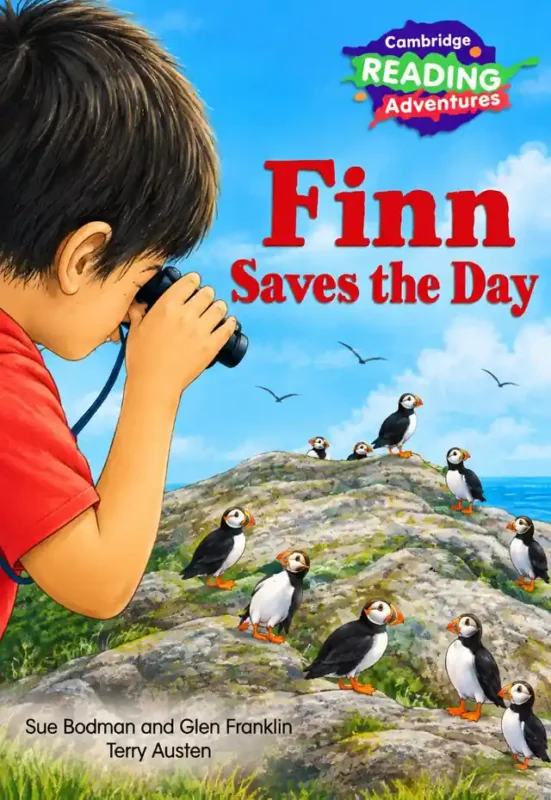
Finn Saves the Day is an Orange band adventure story in the Cambridge Reading Adventures series, used for Class 2 at Lahore Grammar School (LGS). The cover credits Sue Bodman and Glen Franklin (the series’ reading experts) and the illustrator Terry Austen, and shows a boy looking through binoculars at puffins on a rocky shore above a deep-blue sea.
It is a good book for a child who is ready for a proper story. In the 2027-28 session, Class 2 readers meet a hero who uses his eyes and his sense to notice that something is wrong.
What happens in the book
According to the teaching notes, this adventure story takes place over an afternoon on a beach. Finn is an avid bird watcher and makes friends with a small boy on the beach as they look for puffins. Finn puts his observation skills to good use when he notices that something is not right when the boy and his family do not return from a boat ride around the bay. Finn works in his father’s shop, which hires out boats, so he cannot just play on the beach: when the story begins he would rather see whether there are any puffins.
Sentence structures are more complex, with two or more ideas (‘It was a sunny day, but the shop was not busy.’), and dialogue is used to move the story forward. Less familiar words such as ‘puffin’ and ‘binoculars’ are not directly explained in the text, and a wider range of verbs (‘raced’, ‘steered’, ‘passed’) communicates precise meaning. The notes remind us the story is set in a cool, windy country, which may be quite unlike where your child lives.
What your child learns from it
The publisher’s teaching notes list these learning outcomes. A child who reads this book can:
- maintain meaning over a sequence of events;
- apply phonic knowledge and skills to new, unfamiliar words while holding on to a sense of the story events;
- problem-solve longer words by breaking them apart using familiar syllables, for example ‘binoculars’ and ‘petrol’;
- consider events and provide reasons why they might have happened.
How to read it together at home
The guided reading lesson printed in the book gives a simple routine you can follow:
- Talk about a trip to the beach. Explain that this story is set in a cool and windy place, and ask what your child can tell from the cover.
- Say: this story is about a boy who lives by the sea. He likes watching birds. One day he meets some people on the beach. Let’s find out what happens.
- On pages 2 and 3, ask your child to search the text for what Finn would rather be doing (‘I want to see if there are any puffins’).
- Look at the cover to see puffins on the rocks, then read the sentence ‘It was a sunny day, but the shop was not busy’, leaving a pause at the comma.
- Ask your child to explain, in their own words, why Finn thinks something is wrong.
Fun learning links beyond the book
For PSHE, the boat shop should have a list of safety precautions to share with customers, including checking the petrol. Discuss what else should be on it, and have children work in groups to write a guidance sheet. For language development, the shop might expand into guided tours of the island and coast by boat, so children could write a script for Finn to use.
About the Orange band
Orange band texts use more complex sentence structures, with two or more ideas in one sentence, and a wider range of verbs to express precise meaning.
Who, when, where and why
Whom: Class 2 children (about seven years old). When: during the 2027-28 session. Where: at school and at home. Why: to practise reading a longer, more complicated adventure story. Book lists at LGS are almost the same from campus to campus, with a few campuses following their own for some subjects, so message us your campus name first and we will confirm this exact book with you.
Frequently asked questions
What is a puffin?
A seabird with a colourful beak; the word is not explained in the text, so your child may need a picture.
What band is it?
Orange band.
Who illustrated it?
Terry Austen is credited on the cover.
We deliver Finn Saves the Day to every city in Pakistan with Cash on Delivery, and you are welcome to collect it from our Lahore shop. If your school sent a book list, send it to us on WhatsApp and we will put the whole set together.