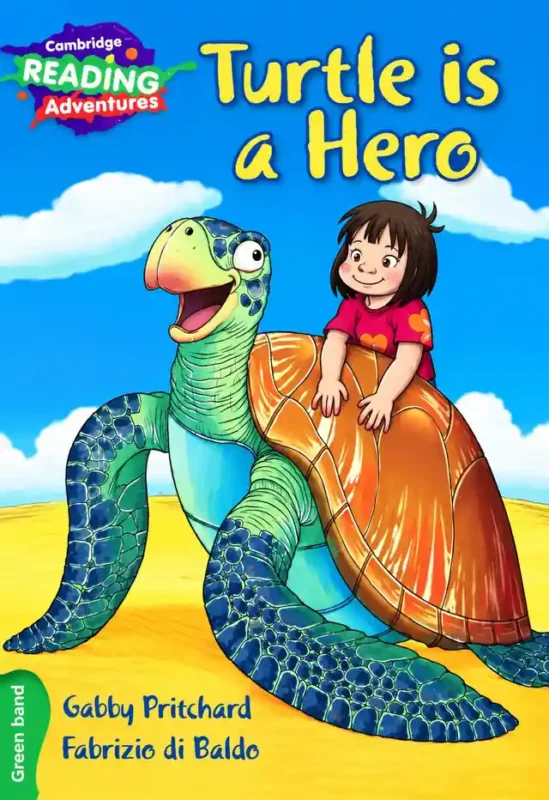
Turtle Is a Hero by Gabby Pritchard (illustrated by Fabrizio di Baldo, as credited on the cover) is a Green band reader from Cambridge Reading Adventures for Class 2 at Lahore Grammar School (LGS). The cover shows a child riding on the back of a huge sea turtle on a golden beach, under a bright blue sky.
It is a story about two very different creatures who become friends, and about who turns out to be strong. For the 2027-28 session, it gives Class 2 readers a lot to think about and talk about.
What happens in the book
According to the teaching notes, this story has elements of an often-used idea: a little and seemingly weak creature helping a bigger creature. Initially the little boy only sees the differences between himself and the turtle. They become friends, and the turtle is able to save the boy when he gets into difficulty in the sea. To understand why the turtle should help the boy, readers need to infer things about character, for example why the boy is wary at first and why the turtle is not.
The language is descriptive: ‘golden sand’, ‘strong shell’, ‘deep, green sea’, ‘cool place’. The word ‘wrinkly’ is a challenge in this context, and the /ee/ sound is spelled in different ways in ‘deep’, ‘green’, ‘sea’ and ‘beach’. On page 8 the little boy thinks that Turtle is a dinosaur: why might he think that? (The text describes wrinkly skin, feet with claws and a beaked nose.) On pages 10 and 11 the turtle is made for living in the sea, but the boy says that if he lived in the sea he would ‘look just like an old man’.
What your child learns from it
The publisher’s teaching notes list these learning outcomes. A child who reads this book can:
- read fluently with attention to punctuation;
- discuss and interpret character and plot to support meaning.
How to read it together at home
The guided reading lesson printed in the book gives a simple routine you can follow:
- Read the title and give each child a book. Say: in this story, a little boy meets a turtle who has swum all the way to the beach. At first the boy only notices how different Turtle looks, but maybe they could be friends.
- On page 2, ask where Turtle normally swims, and find the part that says ‘the deep green sea’.
- On page 4, ask whether Turtle makes a hole in the sand, and which part of the text tells us.
- On page 8, ask why the little boy thinks Turtle is a dinosaur, and pick out the words of the description.
- On pages 12 and 13, the boy runs off to play and seems to be in trouble: who will come and help him?
Fun learning links beyond the book
For social studies, the story could link to a topic called ‘People who help us’, where children research people in the community who help keep them safe. Other stories that deal with strong versus weak would reinforce it, for example ‘The Lion and the Mouse’ and ‘King Fox’ in Cambridge Reading Adventures; these could be read aloud to your child.
About the Green band
Green band readers handle longer texts and trickier words, and the teaching notes treat these books as a step up in independence.
Who, when, where and why
Whom: Class 2 children (about seven years old). When: during the 2027-28 session. Where: at school, at home and, why not, at the beach. Why: to practise inference about character, and to talk about friendship across differences. Most LGS campuses use the same books, though a few follow their own list in some subjects. Tell us your child’s campus on WhatsApp and we will check before the parcel leaves.
Frequently asked questions
What is the theme?
A small creature helping a big one, and friendship across differences.
Who illustrated it?
Fabrizio di Baldo is credited on the cover.
What band is it?
Green band.
Buy Turtle Is a Hero from us online and pay when it reaches your door (Cash on Delivery, all over Pakistan). We also ship prepaid orders to Saudi Arabia, UAE, Oman, Qatar, Bahrain and Kuwait.