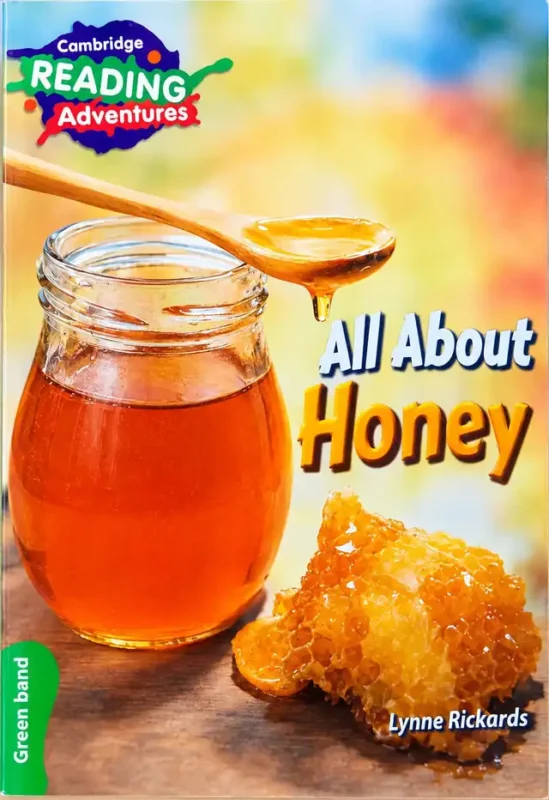
All About Honey by Lynne Rickards is a non-fiction Green band reader from Cambridge Reading Adventures, used for Class 2 at Lahore Grammar School (LGS). The cover is a warm photograph of a jar of golden honey with a wooden dipper dripping honey, and a piece of honeycomb in front.
Honey is a favourite in Pakistani homes, so the topic feels close to every child. For the 2027-28 session, this book explains where it comes from, step by step, and also shows why bees need our protection.
What the book is about
According to the teaching notes, this non-fiction text explains how bees make honey. It is predominantly an explanation text, but it also incorporates features of report and of persuasion in considering bees as an endangered species. The mixed-genre approach and the challenging content make it particularly suitable for older readers at Green band. Non-fiction features such as a glossary, an index and facts boxes are included, and captions help comprehension.
Sentence conventions follow the text type: the present tense for explanation (for example on page 8) and the past tense for the historical report (page 3). The specialised vocabulary used to explain the process includes ‘nectar’, ‘pollen’ and ‘hive’, with definitions in the glossary. Captions are punctuated as complete sentences.
What your child learns from it
The publisher’s teaching notes list these learning outcomes. A child who reads this book can:
- read for meaning, and monitor when the meaning is unclear;
- recognise the key features of the text type;
- use the facts boxes, glossary and captions to support comprehension of the information in the main text.
How to read it together at home
The guided reading lesson printed in the book gives a simple routine you can follow:
- Give your child the book, read the title and the blurb, and ask them to predict what the book will be about; establish that it is non-fiction.
- Ask: what do you expect to see in a book like this? Flick through to find the index, the glossary, the fact boxes and the captions.
- Talk about what you have eaten that uses honey, then read: this information explains how honey is made.
- Read pages 2 to 4, which introduce bees and the history of bee-keeping, and use the glossary for the technical words on page 4.
- On page 6, find the present-tense verbs that tell what the bees do, and chunk the words ‘pollen’ and ‘nectar’ into syllables.
Fun learning links beyond the book
For science, include honey in studies about the five senses, especially the sense of taste; the notes link this book to an earlier title, ‘Our Senses’ at Red band. For PSHE, bees are an endangered species with many traditional habitats being destroyed, so older children could investigate how conservationists are working to protect the world’s bee population. A taste test of different honeys, with the parent’s help, makes a memorable class or family activity.
About the Green band
Green band is a step for confident early readers, with longer texts and more demanding vocabulary.
Who, when, where and why
Whom: Class 2 children (about seven years old). When: during the 2027-28 session. Where: at school and at home. Why: to learn how an explanation text works and how bees give us honey. Lahore Grammar School campuses follow almost the same book list, but a few campuses use their own list for some subjects. Send us your child’s campus on WhatsApp and we confirm the title before we dispatch.
Frequently asked questions
Is it a story?
No. It is mainly an explanation text with report and persuasion features.
Who wrote it?
Lynne Rickards.
What are the hard words?
Nectar, pollen and hive, all explained in the glossary.
Order All About Honey online with Cash on Delivery across Pakistan, or visit our shop in Lahore. Message us the class and campus on WhatsApp and we will confirm the edition before we dispatch.