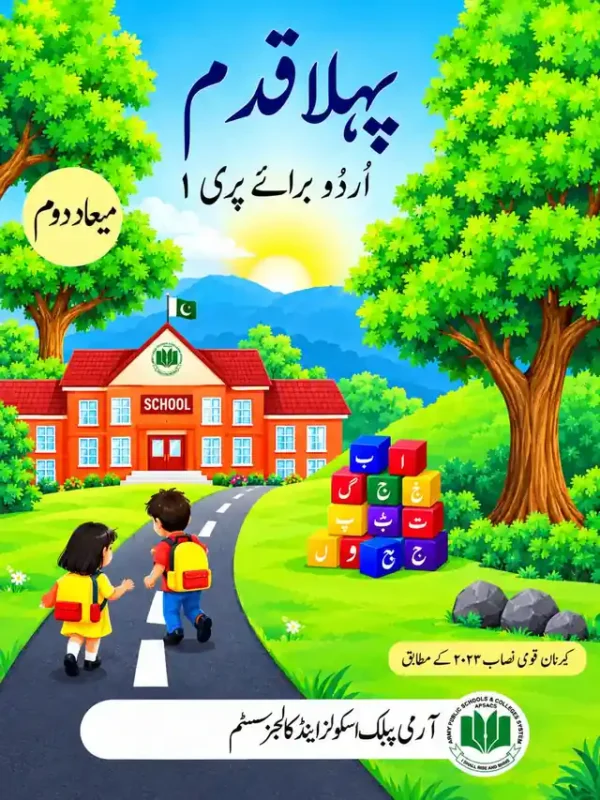
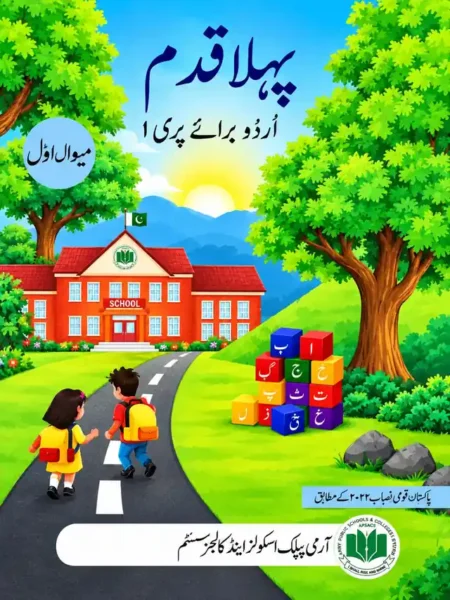
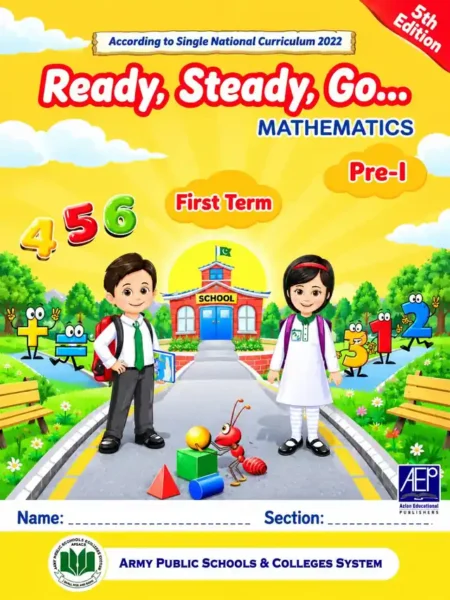
Pahla Qadam, Mayaad Doum is the Second Term Urdu book for Pre 1 (Prep) at Army Public Schools & Colleges. It follows the Mayaad Awal book, so it is the book for the second six months of the year. The cover has the same school scene as the First Term book, with a yellow badge that says ‘Mayaad Doum’, and the line ‘According to the National Curriculum 2022’. Available to order now for the 2027-28 session.
If the First Term book teaches a child to recognise and write the letters, this Second Term book teaches them to use Urdu: to read a poem, build words, handle aspirated letters (bh, ph, th, jh and more), write plurals and genders, count in Urdu words and make sentences.
Full table of contents: 38 lessons of Mayaad Doum
All 38 lessons are given in Roman Urdu, in book order, with English meanings. ‘Tasveer par tabadla-e-khayal’ means discussion on a picture.
Lessons 1 to 4: A poem, introduction and word building (pages 1 to 4)
- 1. Parhai: Nazm ‘Main ik achha bacha hoon’ (Reading: the poem ‘I am a good child’) (p. 1)
- 2. Mera taaruf (My introduction) (p. 2)
- 3. Alfaz banayen (Make words) (p. 3)
- 4. Alfaz ki pehchan (Recognising words) (p. 4)
Why it helps: The book opens with a poem about being a good child, which sets a friendly tone, followed by a page where the child writes about themselves. Building and recognising words moves from letters to whole words.
Lessons 5 to 10: Bh, Ph, and my beloved Pakistan (pages 5 to 10)
- 5. Bh, Ph ki parhai (p. 5)
- 6. Bh ka istemaal (p. 6)
- 7. Ph ka istemaal (p. 7)
- 8. Tasveer par tabadla-e-khayal (p. 8)
- 9. Mera pyara Pakistan (My beloved Pakistan) (p. 9)
- 10. Jorr ke torr likhen (p. 10)
Why it helps: Aspirated (breathy) letters are a special feature of Urdu and are taught in pairs with reading and usage pages. A page on ‘My beloved Pakistan’ adds pride and vocabulary.
Lessons 11 to 14: Th and Tth (pages 11 to 14)
- 11. Th, Tth ki parhai (p. 11)
- 12. Th ka istemaal (p. 12)
- 13. Tth ka istemaal (p. 13)
- 14. Tasaveer par tabadla-e-khayal (p. 14)
Why it helps: The same reading-then-usage pattern keeps lessons predictable, so the child can follow the routine without help from the adult.
Lessons 15 to 19: Jh, Chh, strangers and manners (pages 15 to 19)
- 15. Jh, Chh ki parhai (p. 15)
- 16. Jh ka istemaal (p. 16)
- 17. Chh ka istemaal (p. 17)
- 18. Ajnabi se door rehna (Staying away from strangers) (p. 18)
- 19. Guftagu ke adaab (Manners of conversation) (p. 19)
Why it helps: Two life lessons are placed here: staying away from strangers and speaking politely. They teach safety and manners in the child’s own language.
Lessons 20 to 26: Singular and plural, this and that, counting in words (pages 20 to 29)
- 20. Parhai: Wahid, jama (Singular, plural) (p. 20)
- 21. Wahid ke jama likhen (Write the plurals) (p. 21)
- 22. Parhai: Yeh aur woh ka istemaal (Use of ‘this’ and ‘that’) (p. 22)
- 23. Jumlon mein aam istemaal hone wale alfaz likhen (Write common words used in sentences) (pp. 23-24)
- 24. Mera aur meri (khali jagah pur karen) (Mera and meri: fill in the blanks) (p. 25)
- 25. Alfaz mein ginti (Counting in words) (pp. 26-28)
- 26. Tasveer dekh kar khali jagah mein ginti likhen (Look at the picture and write the count in the blank) (p. 29)
Why it helps: This stretch teaches Urdu grammar the easy way: plural forms, pronouns like yeh and woh, and mera and meri. Counting in written words ties maths and language together.
Lessons 27 to 34: Masculine and feminine, more counting, sentences (pages 30 to 39)
- 27. Parhai: Muzakkar, muannas (Masculine, feminine) (p. 30)
- 28. Muzakkar ke muannas likhen (Write the feminine of masculine words) (p. 31)
- 29. Parhai (p. 33)
- 30. Alfaz mein ginti likhen (pp. 34-35)
- 31. Tasaveer ginen aur ginti likhen (Count pictures and write the number) (p. 36)
- 32. Alfaz ke jumle banayen (Make sentences from words) (p. 37)
- 33. Jorr ke torr likhen (p. 38)
- 34. Tasaveer par tabadla-e-khayal (p. 39)
Why it helps: Making sentences from words is the key skill of the second term. By the end of this group the child can use gender, count in words and build a simple sentence.
Lessons 35 to 38: Dh, Ddh, Rh, Rrh (pages 40 to 43)
- 35. Dh, Ddh ki parhai (p. 40)
- 36. Dh ka istemaal (p. 41)
- 37. Ddh ka istemaal (p. 42)
- 38. Rh, Rrh ki parhai (p. 43)
Why it helps: The last four lessons finish the aspirated letters, so the child has met every sound family in Urdu by the end of Pre 1.
Who, when and how
It is for Pre 1 students at Army Public Schools in the second half of the year, after the Mayaad Awal book. A good home routine is two lessons a week with a ruled copy: read aloud, then write one line. Children who read the poem on page 1 aloud to family build confidence quickly.
- What: Urdu for Pre 1, Second Term (Mayaad Doum), 38 lessons.
- Whom: Pre 1 students.
- When: the last six months of the year.
- Where: school and home.
Frequently asked questions
Is this the second book?
Yes. ‘Mayaad Doum’ means Second Term, and it comes after Mayaad Awal.
What are Bh, Ph, Th and Jh?
They are the aspirated (breathy) letter forms in Urdu that are taught in the Second Term.
Does it teach grammar?
Yes. It covers singular and plural, masculine and feminine, and the words yeh, woh, mera and meri.
Ready to order? Send us a WhatsApp message with the class, and we will confirm availability and dispatch Pahla Qadam (Mayaad Doum) the same way we send every Army Public School book: carefully packed, with Cash on Delivery across Pakistan.