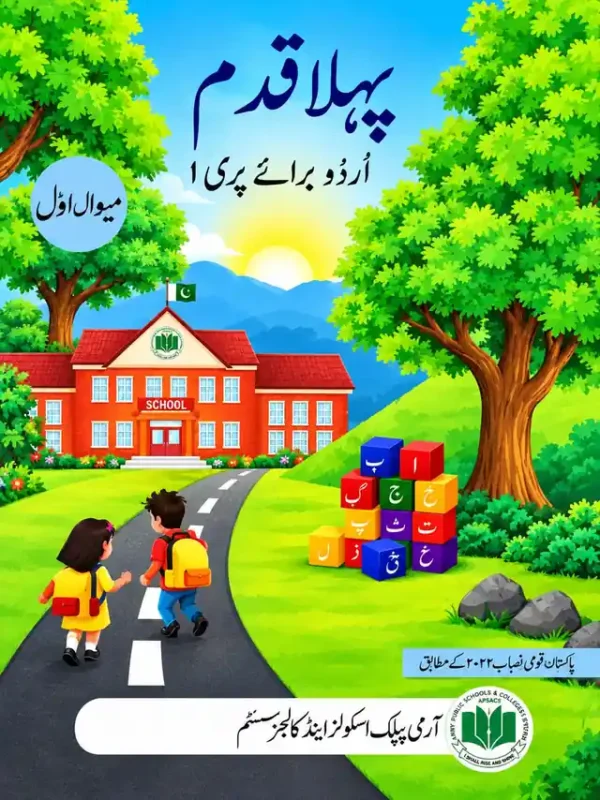
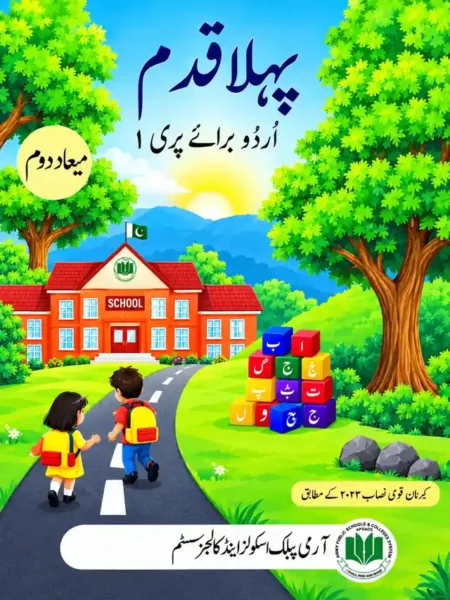
Pahla Qadam (literally ‘The First Step’) is the Urdu book for Pre 1 (Prep) at Army Public Schools & Colleges, and this is the First Term, Mayaad Awal volume. Army Public School Urdu books are divided into two parts: Mayaad Awal is done in the first six months of the year, and Mayaad Doum is done in the next six months. Available to order now for the 2027-28 session.
The cover shows a red-brick school, a tree, children walking to school with backpacks and colourful alphabet blocks, with the words ‘Urdu for Pre 1’ and ‘according to the National Curriculum 2022’. It is the book that teaches a five-year-old to read and write Urdu letters properly, one letter at a time.
Full table of contents: 40 lessons of Mayaad Awal
The contents page lists 40 numbered lessons. They are given here in Roman Urdu, in book order, with an English note. ‘Parhai’ means reading, ‘istemaal’ means usage, ‘aada’ means revision, and ‘khush khati’ means handwriting.
Lessons 1 to 3: Hamd, Naat and the alphabet (pages 1 to 3)
- 1. Hamd (Praise of Allah) (p. 1)
- 2. Naat (Praise of the Prophet, peace be upon him) (p. 2)
- 3. Huroof-e-tahajji (The alphabet) (p. 3)
Why it helps: The book opens, as Urdu books do, with a hamd and a naat. This puts the child’s first words in Urdu into a prayerful, respectful setting, and gives parents a poem to recite together. The alphabet page shows all the letters before the child learns them one by one.
Lessons 4 to 7: Joining letters with Alif and Alif-Madda (pages 4 to 7)
- 4. Huroof ko Alif se joren (Join letters with Alif) (p. 4)
- 5. Alif ki parhai (Reading Alif) (p. 5)
- 6. Alif-Madda (Aa) ki parhai (p. 6)
- 7. Tasaveer ko Alif se milayen / Aa se alfaz banayen (Match pictures with Alif; make words with Aa) (p. 7)
Why it helps: Alif is the simplest shape of all, so it is the right place to start. The first joining lesson shows a child how letters connect in a word, and matching pictures to Alif words makes the letter mean something.
Lessons 8 to 12: Bay and Pay (pages 8 to 12)
- 8. Bay ki parhai (p. 8)
- 9. Bay ka istemaal (p. 9)
- 10. Pay ki parhai (p. 10)
- 11. Pay ka istemaal (p. 11)
- 12. Huroof ko Alif se joren (p. 12)
Why it helps: Each letter gets a reading page and a usage page, so the child first recognises the shape and then sees it inside words. Joining letters with Alif again keeps older learning fresh.
Lessons 13 to 19: Tay, Ttay, Say and revision (pages 13 to 19)
- 13. Tay ki parhai (p. 13)
- 14. Tay ka istemaal (p. 14)
- 15. Ttay ki parhai (p. 15)
- 16. Ttay ka istemaal (p. 16)
- 17. Say ki parhai (p. 17)
- 18. Say ka istemaal (p. 18)
- 19. Aada (Revision) (p. 19)
Why it helps: Bay, Pay, Tay, Ttay and Say share the same body and differ only by dots, so learning them together teaches the child to look closely. The revision lesson (19) is placed right after the group.
Lessons 20 to 28: Waaw, Jeem, Chay, Hay, Khay and handwriting (pages 20 to 29)
- 20. Huroof ko Waaw se joren (pp. 20-21)
- 21. Jeem ki parhai (p. 22)
- 22. Jeem ka istemaal (p. 23)
- 23. Chay ki parhai (p. 24)
- 24. Chay ka istemaal (p. 25)
- 25. Hay ki parhai (p. 26)
- 26. Khay ki parhai (p. 27)
- 27. Hay aur Khay ka istemaal (p. 28)
- 28. Khush khati (Handwriting) (p. 29)
Why it helps: This group teaches the second family of letters and joins them with Waaw. Lesson 28 is a handwriting page, which gives the child time to slow down and form the letters neatly.
Lessons 29 to 32: Joining with Yay and Bari Yay, revision, join-and-break (pages 30 to 35)
- 29. Huroof ko Yay se joren (pp. 30-31)
- 30. Huroof ko Bari Yay se joren (pp. 32-33)
- 31. Aada (Revision) (p. 34)
- 32. Jorr ke torr likhen (Write the separate letters of a joined word) (p. 35)
Why it helps: Yay and Bari Yay end many Urdu words, so joining with them is a key skill. The ‘join and break’ exercise teaches the child to take a word apart into letters and build it back.
Lessons 33 to 40: Daal, Ddaal, Zaal, Raay (pages 36 to 43)
- 33. Daal ki parhai (p. 36)
- 34. Daal ka istemaal (p. 37)
- 35. Ddaal ki parhai (p. 38)
- 36. Ddaal ka istemaal (p. 39)
- 37. Zaal ki parhai (p. 40)
- 38. Zaal ka istemaal (p. 41)
- 39. Raay ki parhai (p. 42)
- 40. Raay ka istemaal (p. 43)
Why it helps: The book ends with the non-joining letters Daal, Ddaal, Zaal and Raay, each with a reading page and a usage page. By page 43 the child has met and practised the letters from Alif to Raay.
Who, when and how
It is for Pre 1 children at Army Public Schools and is used in the first six months of the year. Pair it with a hamd and naat recited aloud, and keep a ruled copy for the handwriting pages. When it is finished, the Second Term book, Mayaad Doum, continues with the remaining letters and sentences.
- What: the First Term (Mayaad Awal) Urdu book for Pre 1, 43 pages, 40 lessons.
- Whom: Pre 1 (Prep) students.
- When: the first six months of the year.
- How: read, trace, say, and write in the copy.
Frequently asked questions
What is the difference between Mayaad Awal and Mayaad Doum?
Mayaad Awal is the first-term book (about the first six months) and Mayaad Doum is the second-term book (the next six months). They are sold separately.
Is it all in Urdu?
Yes, the book is printed in Urdu with pictures.
Does it include handwriting?
Yes. Lesson 28 is a handwriting page, and each letter has reading and usage pages.
Buy Pahla Qadam (Mayaad Awal) from us online and pay when it reaches your door (Cash on Delivery, all over Pakistan). We also ship prepaid orders to Saudi Arabia, UAE, Oman, Qatar, Bahrain and Kuwait.