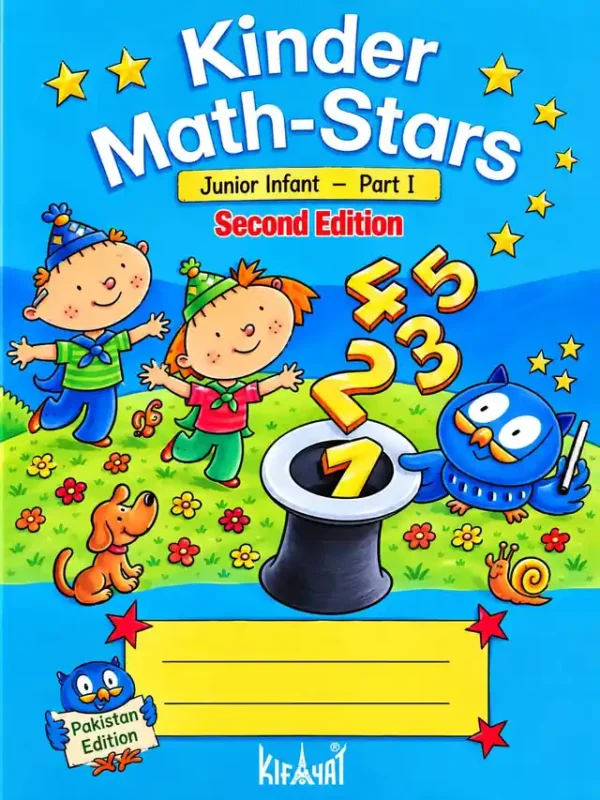
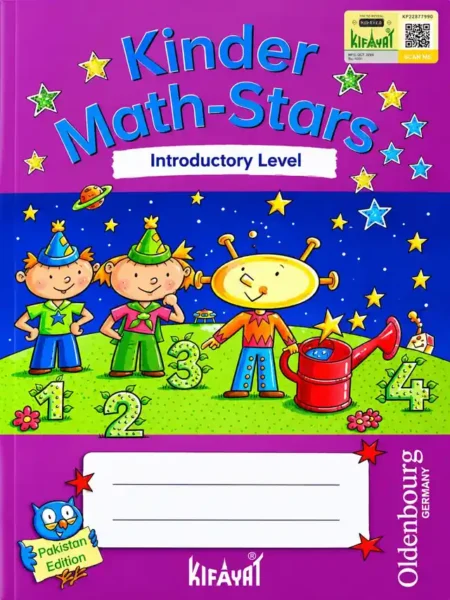
Kinder Math-Stars, Junior Infant, Part I (Second Edition) is the sky-blue maths workbook in the Kinder Math-Stars series. Its cover shows a magician’s top hat with the number 7 popping out, floating numbers, stars, a puppy, a snail and a blue owl, with a yellow box for the child’s name. Like the Introductory Level, it carries the Kifayat mark and the words ‘Pakistan Edition’. Lahore Grammar School (LGS) Play Group families buy it alongside the Introductory book for the 2027-28 session.
‘Junior Infant’ is the Irish and British name for the first school year, and the Second Edition of this book is a richer, bigger workbook than the Introductory Level: its contents page runs to five sections and nearly one hundred pages. Where the first book starts with colouring, this one starts with perception, which means learning to notice small differences, a skill that sits underneath both reading and maths.
Full table of contents: five sections, page by page
The contents page lists five sections. Each entry is given as printed, with its page number.
Perception promotion
- Take me home (p. 4)
- Matching together (p. 5)
- Find the twins (p. 10)
- Match the halves (p. 12)
- Recognizing size (p. 13)
- Odd one out (p. 14)
- Make sets (p. 16)
- Where am I? (p. 27)
- Detect shadows (p. 42)
- Find the difference (p. 66)
Why it helps: Perception pages teach a child to look closely. Finding twins and matching halves trains visual memory; recognising size introduces big and small; ‘odd one out’ and ‘find the difference’ build careful observation; and ‘make sets’ is the first step to counting groups. These skills decide how easily a child will later read letters that look alike, such as b and d.
Shapes and bodies
- Circle (p. 6)
- Triangle (p. 19)
- Recognizing shapes (p. 40)
- Colour the shapes (p. 70)
- Square (p. 72)
Why it helps: Three shapes are introduced here: circle, triangle and square, with recognising and colouring pages in between. The slow spread across the book (page 6 to page 72) means shapes are revisited, not taught once and forgotten.
Recognize and continue patterns
- Recognizing patterns (p. 8)
- Pretty patterns (p. 68)
- Patterns (p. 69)
- Pretty patterns (p. 74)
- Recognizing sequence (p. 75)
Why it helps: Patterns are early algebra. A child who can say what comes next in a red-blue-red-blue chain is already thinking about rules, and ‘recognizing sequence’ prepares them for ordering numbers.
Count and write
- One to one mapping (p. 22)
- Counting to 1 (p. 24)
- Counting to 2 (p. 28)
- Counting to 3 (p. 32)
- Counting up to 3 (p. 38)
- Counting to 4 (p. 44)
- Counting up to 4 (p. 49)
- Counting to 5 (p. 50)
- Counting up to 5 (p. 55)
- Counting to 6 (p. 56)
- Counting up to 6 (p. 63)
- Colour by numbers (p. 64)
- Counting to 7 (p. 76)
- Counting up to 7 (p. 80)
- Counting to 8 (p. 82)
- Counting to 9 (p. 86)
- Count and circle (p. 89)
- Counting to 10 (p. 90)
- How many? (p. 93)
- Counting up to 10 (p. 94)
Why it helps: This is the heart of the book. Each number from 1 to 10 has a ‘Counting to’ page, and most have a matching ‘Counting up to’ page that revises all the numbers learned so far. The title is ‘Count and write’, so children also begin to form the numerals. ‘How many?’ at the end checks the whole section.
Space experience and orientation
- Trace the route (p. 18)
- Trace the route (p. 43)
- Take me home (p. 67)
- Take me school (as printed) (p. 96)
Why it helps: Tracing a route with a pencil is a pre-writing exercise and also teaches left, right, up and down. The last page, a route to school, makes the book end on something real.
Introductory Level or Junior Infant Part 1?
Both are Play Group maths books for LGS and both appear in our shop. The Introductory Level is a simpler first workbook of colouring, sorting, five shapes and counting to 10. Junior Infant Part 1 (Second Edition) is the bigger one, with perception pages, patterns and a longer count-and-write section. Message us your child’s campus and we will confirm whether the school asks for one or both.
Who, when, where and why
Whom: Play Group children (about three to four years old) and the adult who works with them. When: through the 2027-28 session, a page a day in the early weeks. Where: at school and at home. Why: to build observation, shape, pattern and counting skills before the formal maths of Nursery. Lahore Grammar School campuses follow almost the same book list, but a few follow their own for some subjects, so tell us your child’s campus on WhatsApp.
Frequently asked questions
Is this the Second Edition?
Yes. The cover says Second Edition, Junior Infant, Part I and carries the Kifayat Pakistan Edition mark.
How is it different from the Introductory Level?
It is a larger workbook with perception, patterns and count-and-write sections, and runs to about 96 pages.
Is there a Part 2?
The cover says Part I. Ask us on WhatsApp about later parts.
We deliver Kinder Math-Stars Junior Infant Part 1 to every city in Pakistan with Cash on Delivery, and you are welcome to collect it from our Lahore shop. If your school sent a book list, send it to us on WhatsApp and we will put the whole set together.