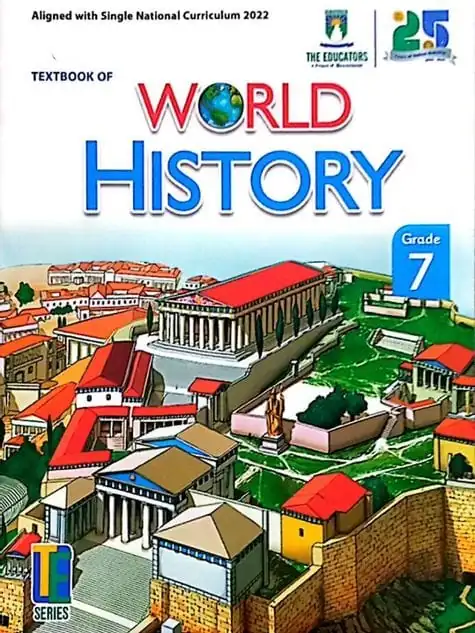
Textbook of World History, Grade 7 is the Class 7 history textbook of The Educators (a project of Beaconhouse) for the 2027-28 session. The cover, marked ‘Aligned with Single National Curriculum 2022’ and with the TE Series badge and The Educators’ 25-year emblem, shows a bird’s-eye view of a Greek-style city: a temple with columns, red-roofed houses, courtyards and stone walls.
History in Class 7 is the year a student stops memorising dates and starts asking why things happened. This book covers 1,000 years of Europe and the Muslim world in five large units, from the Middle Ages to the Renaissance, and puts Muslim history at the centre rather than at the edge.
Full table of contents: 5 units, page by page
The contents page is printed as five large entries, each with its starting page. Every entry is given below as printed, with a note on why it matters.
Unit 1: Middle Ages in Europe (500-1500)
- Middle Ages in Europe (500 – 1500) (p. 4)
Why it helps: The book opens with a thousand years of European history, beginning around 500 CE. Students learn how the Roman world broke up, how kings, lords and the Church shaped daily life and why the period matters for what followed. It sets the stage and gives the dates against which the later units make sense.
Unit 2: Spread of Islam in Europe and Asia
- Spread of Islam in Europe and Asia (p. 20)
Why it helps: The second unit turns to the rise of Islam and its spread across two continents. It shows students how trade, scholarship and faith travelled together, and helps them see that the Middle Ages in Europe were happening at the same time as a flourishing Muslim civilisation elsewhere.
Unit 3: Muslim Dynasties (Seljuk, Ayyubid, Fatimid, Safavid, Ottoman) and Crusades
- Muslim Dynasties (Seljuk, Ayyubid, Fatimid, Safavid, Ottoman) and Crusades (p. 33)
Why it helps: Five great dynasties and the Crusades in one unit. Students compare how each state was run, what it achieved and how it met outside challenges, and the Crusades link back to Europe’s Middle Ages in Unit 1.
Unit 4: Muslims in South Asia (Delhi Sultanate, Mughal Empire)
- Muslims in South Asia (Delhi Sultanate, Mughal Empire) (p. 50)
Why it helps: The longest unit of the book, beginning on page 50 and running to the start of Unit 5 on page 95. It brings the story home to South Asia, the Delhi Sultanate and the Mughal Empire, and explains the history of the land where students live.
Unit 5: Modern Period in Europe (Renaissance and Enlightenment)
- Modern Period in Europe (Renaissance and Enlightenment) (p. 95)
Why it helps: The book ends with the Renaissance and the Enlightenment, when Europe’s art, science and ideas changed. Students see how the ideas of this period shaped the modern world, and compare them with the developments in the Muslim world they have just studied.
Why this book suits Class 7
The five units are arranged so that Europe and the Muslim world are studied side by side, then the story comes home to South Asia, then moves forward to modern ideas. A student leaves Class 7 with a map of world history in their head and a better idea of how their own region fits in. The book follows the Single National Curriculum 2022, so what the student learns matches what the school will test.
Who, when, where and how
Whom: Class 7 students at The Educators schools (about twelve years old), and parents who help them revise. When: through the 2027-28 session. Where: in class and at home with an atlas. How: build a timeline on the wall, adding each unit’s key dates as you go.
Frequently asked questions
How many units are there?
Five, as printed on the contents page.
Is it based on the new curriculum?
The cover says ‘Aligned with Single National Curriculum 2022’.
Is there a Class 6 history book?
Yes, a World History book for Class 6 is listed separately.
World History, Class 7 is available now. Order online, pay on delivery anywhere in Pakistan, or collect it in Lahore. Buying the whole class list? WhatsApp us the list and we will confirm every title in one go.