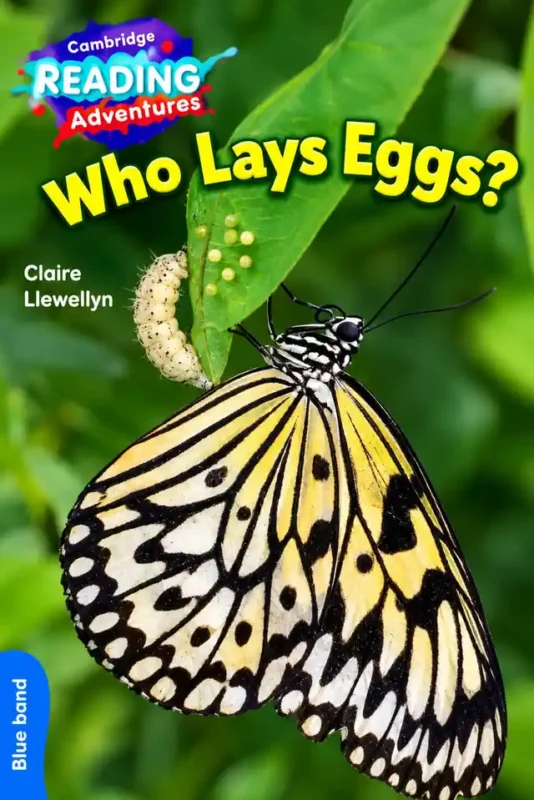
Who Lays Eggs? by Claire Llewellyn is a non-fiction reader in the Cambridge Reading Adventures series, used for Nursery at Lahore Grammar School (LGS). On the cover, a rice-paper butterfly with black-and-cream wings hangs from a green leaf, with its tiny white eggs on the stem.
Most first readers are stories. This one is a fact book, which makes it a fresh and useful addition for the 2027-28 session: your child learns that books can tell us about the world, as well as entertain us.
What the book is about
According to the teaching notes, this non-fiction report gives information on the ways animals keep their eggs safe. It works differently from a story and has simple captions naming the animals. Children need guiding to see that the text refers to whole groups of animals (all lizards, for example), not just the one in the picture. Three language structures are used on each page, so tracking three lines of text is a real challenge that the teacher or parent should rehearse first.
The technical words in the book are ‘lays’, ‘soil’, ‘log’, ‘nest’ and ‘leaf’, and the pronoun ‘it’ is used for the animal being discussed. The frequent words are ‘in’, ‘eggs’, ‘are’, ‘the’ and ‘A’. The animals include a bird, a bee, a wasp, a lizard and a snake.
What your child learns from it
The publisher’s teaching notes list these learning outcomes. A child who reads this book can:
- know that print carries meaning and is read from left to right and from top to bottom;
- read some high-frequency words and use phonics to work out simple words;
- indicate how information can be found in a non-fiction text.
How to read it together at home
The guided reading lesson printed in the book gives a simple routine you can follow:
- Read the title and say: in this book we find out which animals lay eggs and where they lay them to keep them safe.
- On page 2, check that your child knows the names of the animals; give the names they do not know and use first letters to help (bee and wasp, lizard and snake).
- On page 4, ask where the bird lays her eggs (in a nest), put a finger under ‘nest’ and find another word that sounds the same.
- Ask: do you think the eggs are safe? Can you find the word that says ‘safe’?
- Turn through the other pages and let your child name each animal.
Fun learning links beyond the book
The notes suggest using the book in science and nature lessons to talk about which animals lay eggs (some are reptiles, some are birds, some are fish) and the different ways they keep their young safe. Older children could use other books to make charts of predators and prey. At Nursery level, a walk in the garden to look for a nest, a feather or a snail is plenty.
About the band label
This copy’s cover is labelled Blue band, while the teaching notes inside are printed for the Pink B band, so the book may be listed under either. Pink B books, according to the publisher, have about 30 to 60 words, colourful illustrations and plenty of repetition.
Who, when, where and why
Whom: Nursery children (about four years old). When: during the 2027-28 session. Where: at school, at home and in the garden. Why: to show children that reading can answer questions about the world. Lahore Grammar School campuses follow almost the same book list, but a few campuses use their own list for some subjects. Send us your child’s campus on WhatsApp and we confirm the title before we dispatch.
Frequently asked questions
Is it a story?
No. It is a non-fiction report with simple captions.
Who wrote it?
Claire Llewellyn.
Why does it say Blue band on the cover?
The cover of our copy is labelled Blue band; the notes inside use the earlier Pink B label.
Who Lays Eggs? is available now. Order online, pay on delivery anywhere in Pakistan, or collect it in Lahore. Buying the whole class list? WhatsApp us the list and we will confirm every title in one go.