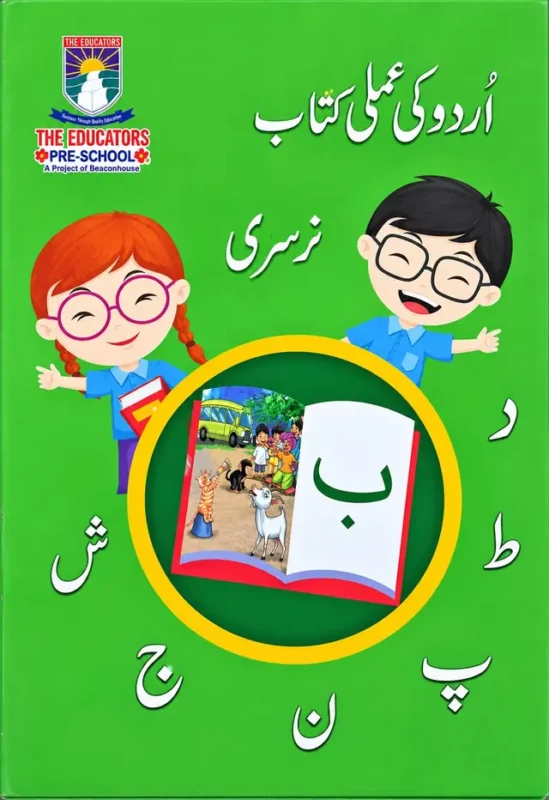
Urdu Ki Amli Kitab, Nursery (the practical or practice book of Urdu) is the Nursery Urdu workbook of The Educators Pre-School, a project of Beaconhouse, as printed on the cover, available to order now for the 2027-28 session. The cover is bright green with a smiling girl and boy in glasses, an open book showing the letter Be with a bus, children, a cat, a monkey and a goat, and a scatter of Urdu letters around the edge. The title is printed in Urdu. The inside pages say the book is Edition 2023, made under the Academic Department of The Educators, and printed by Albakio International.
“Amli” means practical: this is not a reading primer to be read aloud, it is a book for doing. For each letter, the child recognises the picture, says the sound, traces the letter and then writes it. Then, every few letters, a review page asks the child to circle the right letter, colour the right picture or write the first letter of a picture. By the last pages the child is joining letter shapes into the first words.
The contents page (Fehrist) is printed in Urdu in two columns. Below it is given in Roman Urdu with a short English note, so every parent can see how the book moves.
Full table of contents: every letter, review and page
Each letter page is titled, in Urdu, “Recognising the pictures related to this letter, and writing practice”. Page numbers are as printed.
Pages 1 to 14: Alif to Khay
- Alif (p. 1), Aa (Alif madda) (p. 2), Be (p. 3), Pe (p. 4), Te (p. 5), Tte (p. 6), Se (p. 7)
- Review: circle the correct letter (p. 8)
- Jeem (p. 9)
- Review: colour the correct picture for the letter (p. 10)
- Che (p. 11), Bari Hay (p. 12), Khay (p. 13)
- Review: write the first letter of each picture (p. 14)
Why it helps: The book opens with the letters in the order a child hears them in school, three or four at a time, so no new letter arrives before the last one has been practised. Seeing a picture first (the first sound of a word) links the written shape to a sound the child already knows, which is why picture-to-letter practice is the usual way to start Urdu reading. The review pages at p. 8, 10 and 14 are different kinds of exercise, so the child practises recall, not just copying.
Pages 15 to 28: Daal to Zuad
- Daal (p. 15), Ddaal (p. 16), Zaal (p. 17), Re (p. 18)
- Review: colour the correct picture for the letter (p. 19)
- Rre (p. 20), Ze (p. 21), Zhe (p. 22)
- Review: circle the correct letter (p. 23)
- Seen (p. 24), Sheen (p. 25), Suad (p. 26), Zuad (p. 27)
- Review: write the first letter of each picture (p. 28)
Why it helps: Daal, Ddaal and Zaal look alike and Re, Rre, Ze and Zhe differ by a dot or a small mark. Practising them in a group, each on its own page, lets a child see the difference side by side. The review pages after each group are a good place for a parent to check what has stuck.
Pages 29 to 50: Toay to Ye
- Toay (p. 29), Zoay (p. 30), Ain (p. 31), Ghain (p. 32)
- Review: circle the correct letter and colour the pictures (p. 33)
- Fe (p. 34)
- Review: colour the correct picture for the letter (p. 35)
- Qaaf (p. 36), Kaaf (p. 37), Gaaf (p. 38)
- Review: circle the correct letter and colour the pictures (p. 39)
- Laam (p. 40), Meem (p. 41)
- Review: write the first letter of each picture (p. 42)
- Noon (p. 43), Waw (p. 44), Hay (p. 45)
- Review: circle the correct letter (p. 46)
- Review: colour the correct picture for the letter (p. 47)
- Hamza (p. 48), Choti Ye and Bari Ye (p. 49)
- Review: write the first letter of each picture (p. 50)
Why it helps: The harder letters (Toay, Zoay, Ain, Ghain) come after the child has already finished most of the alphabet, so they arrive with confidence. The set closes with Hamza and the two Yes, which complete the alphabet. By page 50 the child has met every letter in Urdu, seen it in a picture, traced it and written it.
Pages 55 to the end: half shapes and the first words
- Practice of the half shapes of letters (p. 55)
- Writing the half shapes joined to Alif (p. 58)
- Writing the half shapes joined to Waw, Choti Ye and Bari Ye (p. 62)
- Making words by joining letters (the page number is not visible in the photo)
Why it helps: In Urdu most letters change shape when they join, so reading a word means recognising the half shape of each letter. This last section is where Nursery Urdu stops being a list of letters and starts being reading: the child joins half shapes to Alif, Waw and Ye, and then makes the first simple words. It is good to see this step given its own pages instead of being left to Class 1.
What your child gains
- The shapes, names and sounds of the whole Urdu alphabet, with a picture for each one.
- Pencil control for tracing and writing right-to-left, preparing for Class 1 handwriting.
- Practice in picking out the right letter and the first letter of a word, the foundation of spelling.
- A start on joining letters, which makes Class 1 reading much smoother.
Who, what, when, where and how
Whom: Nursery students (about three to four years old) of The Educators, and any parent teaching Urdu at home. What: the Urdu practice book, Edition 2023. When: through the 2027-28 session; one letter every two or three days is a comfortable pace. Where: at school, and at home at a table with good light. How: say the letter and the picture together, let your child trace it with a finger and then with a pencil, and praise neat effort rather than speed.
Frequently asked questions
Is the book in Urdu?
Yes. The title and the contents page are printed in Urdu. This page gives the contents in Roman Urdu for convenience.
Is it a workbook or a textbook?
It is a practice book: the child writes, colours and circles in it, so each child needs their own copy.
Which edition is this?
The edition printed inside is 2023, made by the Academic Department of The Educators.
Order Urdu Ki Amli Kitab online with Cash on Delivery across Pakistan, or collect it from our Lahore shop. Message us your child’s class and campus on WhatsApp and we will confirm the edition before we dispatch.