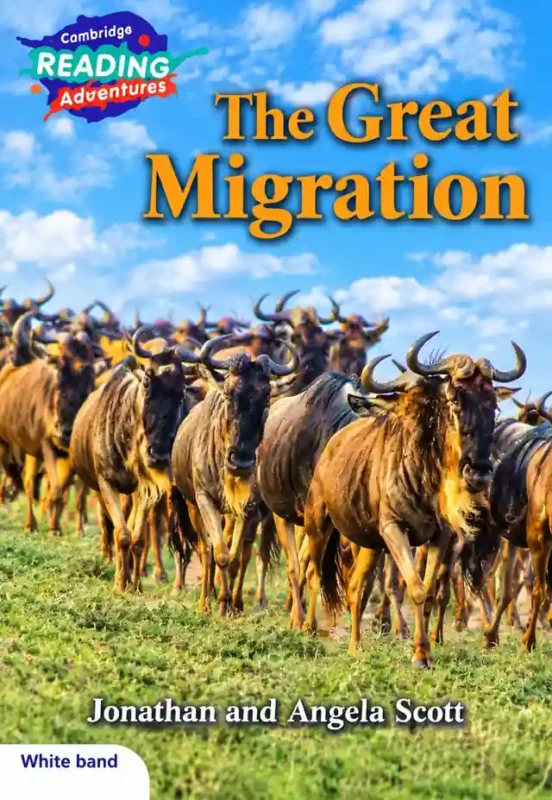
The Great Migration by Jonathan and Angela Scott is a White band non-fiction reader from Cambridge Reading Adventures, used for Class 3 at Lahore Grammar School (LGS). The cover is a wide photograph of a vast herd of wildebeest crossing golden grassland, with the authors’ names at the bottom.
Few natural events are as spectacular as the yearly journey of millions of animals across East Africa. In the 2027-28 session, this book lets Class 3 readers follow it month by month, with photographs, maps and a time-line.
What the book is about
According to the teaching notes, this non-fiction text recounts the movement of animals throughout the year from the Serengeti plains to the Masai Mara Game Reserve. It begins to widen the range of genre and writing style and uses both recount and non-chronological report conventions. Information is more detailed and conveyed using a range of non-fiction features (diagrams, maps and time-lines), and specialised vocabulary is defined in a glossary. Modal verbs and complex sentences require a higher level of inference.
Sentences are longer, with more subordinate clauses, for example ‘As more animals arrive, they become more uneasy and nervous.’ Time and causal connectives navigate the reader through events: ‘Soon they must be ready …; the herds cannot stay here too long because there is not enough grass.’ Topic words include ‘waterhole’, ‘migration’ and ‘minerals’. There are maps on pages 3 and 8 and a time-line on pages 28 and 29. The book also explains that meat-eating animals would die of hunger without the grass-eating animals to eat.
What your child learns from it
The publisher’s teaching notes list these learning outcomes. A child who reads this book can:
- read silently most of the time;
- search for and find information in texts more flexibly;
- show increased awareness of vocabulary and precise meaning;
- express reasoned opinions about what is read, and compare texts.
How to read it together at home
The guided reading lesson printed in the book gives a simple routine you can follow:
- Read the title and the blurb together, then ask your child to read pages 2 and 3 silently.
- Ask: can you explain what the Great Migration is? Take us to the section in the text that tells us this.
- Establish that this is an information text, and ask which features you would expect: maps, diagrams, a time-line, a glossary.
- Look at the maps on pages 3 and 8 and the time-line on pages 28 and 29.
- Notice that the book mixes genres: some parts are a non-chronological report (page 6), others a recount of events across the year (page 16).
Fun learning links beyond the book
For geography, use atlases, globes and internet sites to find Tanzania and to track the migration across the seasons (see page 8). For social studies, it is not only animals that migrate: people also migrate as they move to a new area or country. Why do we move? Do we always want to? The notes also mention possible links to religious texts that consider mass movement of people.
About the White band
White band books, according to the publisher, tend to explore why-questions and use more complex sentences with a wider range of grammar, so they suit confident readers.
Who, when, where and why
Whom: Class 3 children (about eight years old) who are confident readers. When: during the 2027-28 session. Where: at school and at home, with an atlas. Why: to practise reading longer non-fiction with maps, time-lines and a glossary. Book lists at LGS are almost the same from campus to campus, with a few campuses following their own for some subjects, so message us your campus name first and we will confirm this exact book with you.
Frequently asked questions
Where does the migration happen?
From the Serengeti plains to the Masai Mara Game Reserve, in East Africa.
Does it have a glossary?
Yes, specialised vocabulary is defined in a glossary.
What band is it?
White band.
Ready to order? Send us a WhatsApp message with the class and school, and we will confirm availability and dispatch The Great Migration carefully packed, with Cash on Delivery across Pakistan. Prefer to see it first? Our Lahore shop is open to visitors.