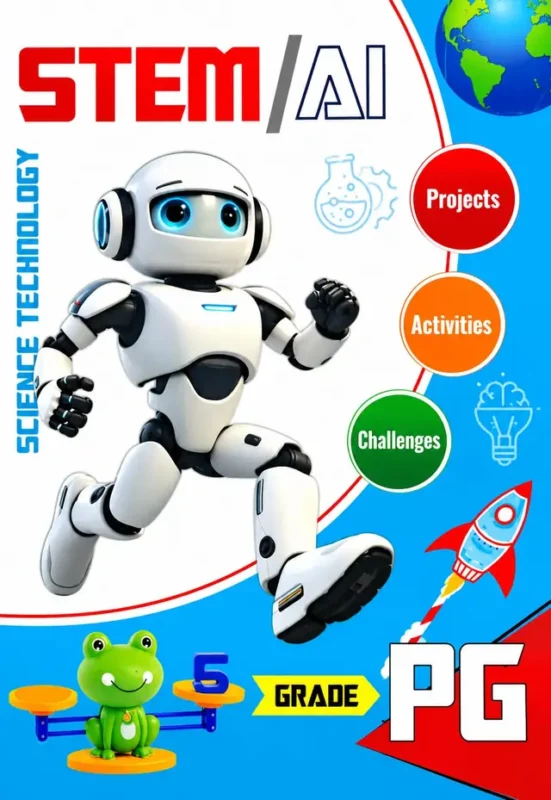
STEM/AI: Projects, Activities and Challenges (Play Group) is the science, technology, engineering and maths book on the Allied School Play Group list for the 2027-28 session. A smiling white robot runs across the cover beside three circles reading Projects, Activities and Challenges, a rocket, a frog on a balance with a number 5, and a big PG badge.
STEM/AI for a three-year-old does not mean screens. It means asking ‘what will happen if…?’ and then trying it: does an egg float, how do you make things move, how tall can a tower go. The contents page lists 19 such activities, and the last pages touch on robotics and sequencing.
Full table of contents: 19 activities, page by page
The printed list numbers the activities up to 21, but numbers 7 and 8 are not shown on the contents page; we list exactly what is printed.
Floating, moving and unseen writing
- 1. The egg that floats and sinks (p. 1)
- 2. Forcing things to move (p. 2)
- 3. Invisible ink (p. 5)
- 4. Balancing act (p. 6)
Why it helps: Four science experiments open the book. A floating egg shows density, pushing and pulling things shows force, invisible ink is a kitchen-chemistry surprise, and a balancing act is the first lesson in weight and balance.
Building and engineering
- 5. Skyscraper structure (p. 7)
- 6. Paper plan (p. 8)
- 9. Rocket engineering (p. 10)
- 10. Building bridges (p. 12)
- 16. Building a tower (p. 20)
Why it helps: Building is the heart of early engineering. Skyscrapers, paper plans, a rocket, bridges and towers all teach that stronger shapes hold more, and that a failed first try is part of the process.
Water, number and balance
- 11. Water transfer using different things (p. 13)
- 12. Counting frogs to balance the machine (p. 14)
Why it helps: Moving water between containers teaches volume without a single formula, and counting frogs on a balance, the picture on the cover, joins number sense with weight.
Robotics, AI and play
- 13. Robotics/AI (Sequencing) (p. 16)
- 14. Lego tiger (p. 17)
- 15. Magnetic loop blocks (p. 18)
Why it helps: Sequencing is the root of programming: doing steps in the right order. The Lego tiger and magnetic loop blocks are hands-on ways to introduce that idea without a computer.
Sound, nature and air
- 17. Pan flutes (p. 21)
- 18. Floating marker fish (p. 22)
- 19. Let’s plant! (p. 23)
- 20. Paper wind bag (p. 24)
- 21. Air powered car (p. 26)
Why it helps: The last group covers sound (pan flutes), floating, planting a seed, wind and an air-powered car. They end the book on activities children want to repeat at home.
Why STEM and AI at three
Curiosity is at its peak at this age. Simple experiments teach children to predict, test and observe, the same loop used by scientists. Activities such as sequencing give a gentle first view of how robots and programs work. The book also teaches patience and cooperation.
Who, when, where and how
Whom: Play Group students at Allied Schools (about three years old) and the adult who sits with them. When: through the 2027-28 session. Where: at school and at home, with adult supervision for water, small parts and anything that can spill. How: ask your child to guess before every experiment, then test.
Frequently asked questions
Does it need a computer?
No. The robotics and AI pages use sequencing and building activities.
How many activities are there?
Nineteen are printed on the contents page.
Is there a Prep version?
Yes, a STEM/AI book for Prep is listed separately.
We deliver STEM/AI for Play Group to every city in Pakistan with Cash on Delivery, and you are welcome to collect it from our Lahore shop. If your school sent a book list, send it to us on WhatsApp and we will put the whole set together.