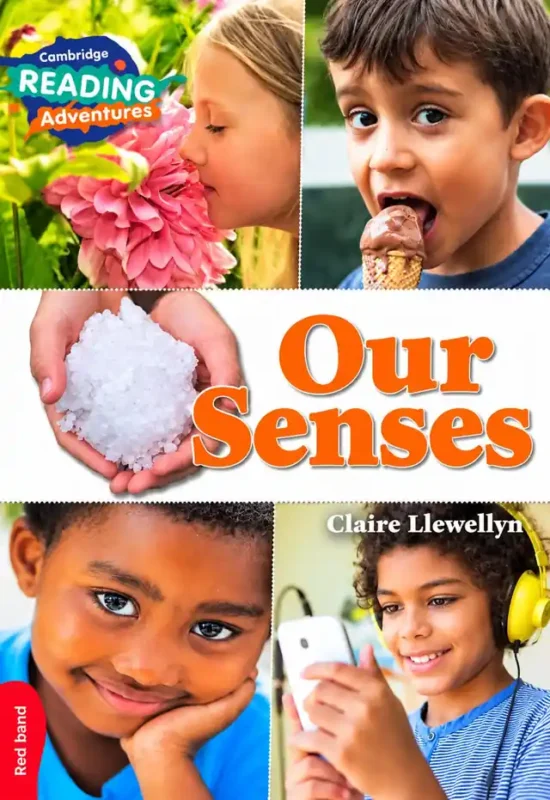
Our Senses by Claire Llewellyn is a non-fiction Red band reader in Cambridge Reading Adventures, used for Prep at Lahore Grammar School (LGS). The cover is a collage of four photographs: a girl smelling a pink flower, a boy enjoying an ice-cream cone, a pair of hands holding crushed ice, and a boy in yellow headphones holding a phone, with the title in orange letters across the middle.
The five senses are the first science lesson most children can do with their own bodies. In the 2027-28 session, this book turns that lesson into a reading lesson for Prep, with real photographs and short sentences.
What the book is about
According to the teaching notes, this is a simple non-chronological report that incorporates early features of non-fiction texts and explores the five senses. It includes common experiences with which young children will be familiar. There is no contents page, but the first two pages give an overview, thought bubbles are introduced, and a simple table on pages 14 and 15 provides additional information in graphic form. Short, clear sentences follow natural language patterns, with three repeated sentence structures strongly supported by the pictures, all in the present tense.
The notes list subject vocabulary such as ‘taste’ and ‘tasting’ and ‘smell’ and ‘smelling’, which also lets children notice how the spelling of the root word changes when ’-ing’ is added. The high-frequency words that repeat are ‘with’, ‘Here’ and ‘my’. On page 4, a girl says ‘Here are my eyes’, and the text goes on ‘I can see with my eyes’.
What your child learns from it
The publisher’s teaching notes list these learning outcomes. A child who reads this book can:
- read known high-frequency words in context quickly and fluently;
- read a range of simple sentences independently across two lines of text and across a two-page spread;
- use simple non-fiction features, such as tables, to support comprehension.
How to read it together at home
The guided reading lesson printed in the book gives a simple routine you can follow:
- Ask your child about their favourite food, or the food they don’t like, or a favourite smell, to get them interested.
- Read the title and the blurb. Say: this book is about our five senses. It tells us things we can see, hear, smell, taste and touch.
- On pages 2 and 3, discuss each picture, name the senses and look at the first letter of each; notice the second letters of ‘taste’ and ‘touch’ to tell them apart.
- On page 4, read ‘I can see with my eyes’ with your child pointing to each word; practise recognising the words quickly.
- Turn to the table on pages 14 and 15 and talk about how it gives the information in another form.
Fun learning links beyond the book
For science, there are endless experiments on the topic of senses: feely boxes filled with different materials for friends to identify, tasting or smelling to identify hidden items, and listening for sounds in the environment or identifying musical instruments while blindfolded. For maths, those experiments can lead to bar charts of children’s favourite tastes or their worst smells.
About the Red band
At Red band the aim is for a child to read smoothly, tracking the print mostly with their eyes and pointing only when a word is tricky.
Who, when, where and why
Whom: Prep children (about five years old). When: during the 2027-28 session. Where: at school, at the kitchen table and in the garden. Why: to connect reading with the body, and to practise reading across two lines. Most LGS campuses use the same books, though a few follow their own list in some subjects. Tell us your child’s campus on WhatsApp and we will check before the parcel leaves.
Frequently asked questions
Is it fiction?
No. It is a non-fiction report with thought bubbles and a simple table.
Who wrote it?
Claire Llewellyn.
Does it have a contents page?
No, but the first two pages give an overview, according to the teaching notes.
Buy Our Senses from us online and pay when it reaches your door (Cash on Delivery, all over Pakistan). We also ship prepaid orders to Saudi Arabia, UAE, Oman, Qatar, Bahrain and Kuwait.