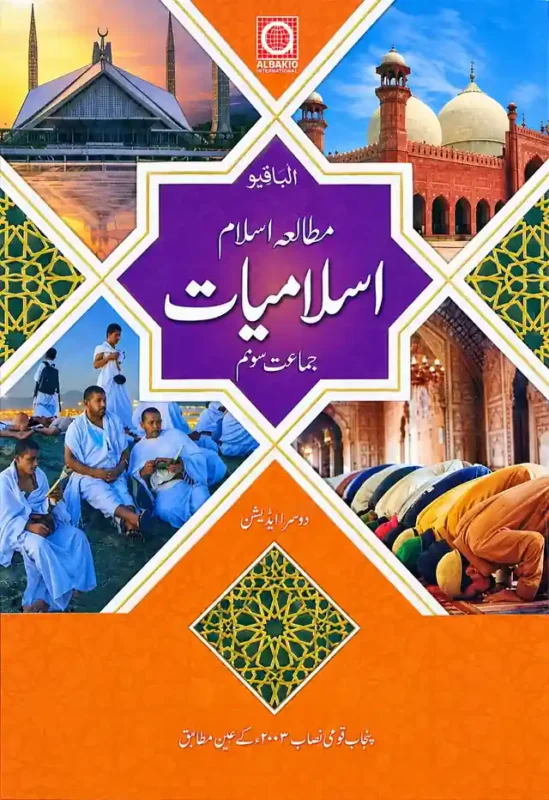
Islamiat (Mutalia Islam), Class 3 (Jamaat Soum) is the Class 3 Islamic studies book for Allied School, published by Albakio International, available to order now for the 2027-28 session. The cover is orange, with a purple star at the centre carrying the Urdu title, the Albakio International logo at the top, the words “Second Edition” and a banner at the bottom saying it follows the Punjab national curriculum 2003 “exactly”. Around the star are photographs of the Faisal Mosque, a red-sandstone domed mosque, pilgrims in white sitting on a hillside with their books, and worshippers in sajda.
The book is in Urdu, so the contents (Fehrist) below are given in Roman Urdu with a short English note. It has seven chapters (Baab), the same layout as the later Islamiat books, and about a hundred pages. By Class 3 a child can read Urdu independently, so the book adds more practical teaching (wudu, the five daily prayers) and the first biographies.
Full table of contents: all 7 chapters, every lesson and page
Page numbers are as printed.
Chapter 1 (Baab Awwal): Quran Majeed aur Hadith-e-Nabawi (the Quran and the Hadith)
- 1. Nazra Quran Majeed (p. 1)
- 2. Hifz-e-Quran Majeed (p. 2)
- 3. Hifz o Tarjuma (memorisation and translation) (p. 4)
- 4. Hadith-e-Nabawi (p. 6)
- 5. Duain, zabani (supplications recited by heart) (p. 8)
Why it helps: A short chapter of nine pages, which makes it easy to cover in the first weeks. The same five-part routine as in earlier classes (read, memorise, understand, a hadith, a dua) keeps the child’s Quran habit going without feeling new.
Chapter 2 (Baab Doum): Imaniyat o Ibadat (faith and worship)
- Part A: Imaniyat (faith): 1. Tauheed ka Taaruf (an introduction to tauheed) (p. 10)
- Part A: 2. Nubuwwat o Risalat (prophethood and message) (p. 15)
- Part B: Ibadat (worship): 1. Kalima Shahadat (p. 20)
- Part B: 2. Azan (p. 24)
- Part B: 3. Wuzu (ablution) (p. 28)
- Part B: 4. Namaz (prayer) (p. 32)
- Part B: 5. Qibla o Masjid (the direction of prayer and the mosque) (p. 39)
Why it helps: The largest chapter, 35 pages, and the practical heart of the book. After the beliefs (tauheed, prophethood), the book walks through the order a person actually follows when they pray: the Kalima, the azan, wudu, the prayer, the qibla and the mosque. A child who has studied this chapter can wash for wudu and stand for prayer with understanding, not only imitation.
Chapter 3 (Baab Soum): Seerat-e-Tayyaba (the life of the Prophet, peace be upon him)
- 1. Hazrat Muhammad Rasoolullah (peace be upon him) ki Hayat-e-Tayyaba (qabl az besat), the Prophet’s life before the announcement of prophethood (p. 45)
- 2. His Sadaqat, Amanat aur Husn-e-Muamalat (truthfulness, trustworthiness and good dealings) (p. 53)
- 3. His Rawadari aur Sabr o Tahammul (tolerance, patience and endurance) (p. 59)
Why it helps: Three long lessons that tell the story in the order of his life, then pick out the qualities that are most worth copying: honesty, trust, fair dealing, tolerance and patience. These are the habits parents most want a Class 3 child to practise, and the lessons give a child’s own words for them.
Chapter 4 (Baab Chaharum): Akhlaq o Adaab (character and manners)
- 1. Sach ki Ahmiyat (the importance of truth) (p. 64)
- 2. Guftagu ke Adaab (manners of speaking) (p. 70)
Why it helps: Truthfulness and polite speech get their own lessons straight after the Prophet’s example, so the child sees the connection between his character and their own behaviour at school and at home.
Chapter 5 (Baab Punjum): Husn-e-Muamalat o Muashrat (good dealings and living in society)
- 1. Bahmi Talluqaat (mutual relations) (p. 75)
Why it helps: A single lesson on relationships with family, neighbours and friends. It gently broadens the child’s world from “me” to “us”.
Chapter 6 (Baab Shashum): Hidayat ke Sarchashme aur Mashahir-e-Islam (sources of guidance and famous figures of Islam)
- 1. Hazrat Adam (peace be upon him) (p. 80)
- 2. Hazrat Nuh (peace be upon him) (p. 85)
- 3. Khalifa Awwal Hazrat Abu Bakr Siddiq (may Allah be pleased with him), the first Caliph (p. 89)
Why it helps: The stories chapter, with the first prophet, the prophet of the flood and the first Caliph of Islam. Stories are how children hold on to what they learn, and this chapter often becomes the one a child retells at dinner.
Chapter 7 (Baab Haftum): Islami Taalimat aur Asr-e-Hazir ke Taqaze (Islamic teachings and the needs of the present time)
- 1. Sehat o Tan Durusti (health and fitness) (p. 95)
Why it helps: The book ends with a modern topic, health. It shows a child that Islam teaches care of the body and everyday habits as well as worship.
What your child gains
- A steady Quran routine: reading, memorising, translation and duas.
- A working knowledge of the basics of faith, wudu and prayer.
- Three portraits of the Prophet’s character, and the manners that follow from them.
- Stories of Hazrat Adam, Hazrat Nuh and Hazrat Abu Bakr (peace be upon them / may Allah be pleased with him), and a lesson on health.
Who, what, when, where and how
Whom: Class 3 students of Allied Schools (about eight years old). What: the printed Class 3 Islamiat book, Mutalia Islam, Second Edition. When: order before the 2027-28 session starts, or in the first weeks of term. Where: in class and at home, where parents can listen to recitation and watch wudu. How: go through one lesson at a time, ask your child to retell the story or lesson in their own words, and practise wudu and prayer together once they have reached those pages.
Frequently asked questions
Is it in Urdu?
Yes, the book is printed in Urdu; this page gives the contents in Roman Urdu for convenience.
Which edition and curriculum?
The Second Edition (Doosra Edition), published by Albakio International. The cover banner says it follows the Punjab national curriculum 2003 “exactly”.
Is there a version for other classes?
Yes, Mutalia Islam continues in other classes (Class 1, 2, 4, 5 and 6 are each listed on their own page).
Order Islamiat (Mutalia Islam) Class 3 online with Cash on Delivery across Pakistan, or collect it from our Lahore shop. Message us your child’s class and campus on WhatsApp and we will confirm the edition before we dispatch.