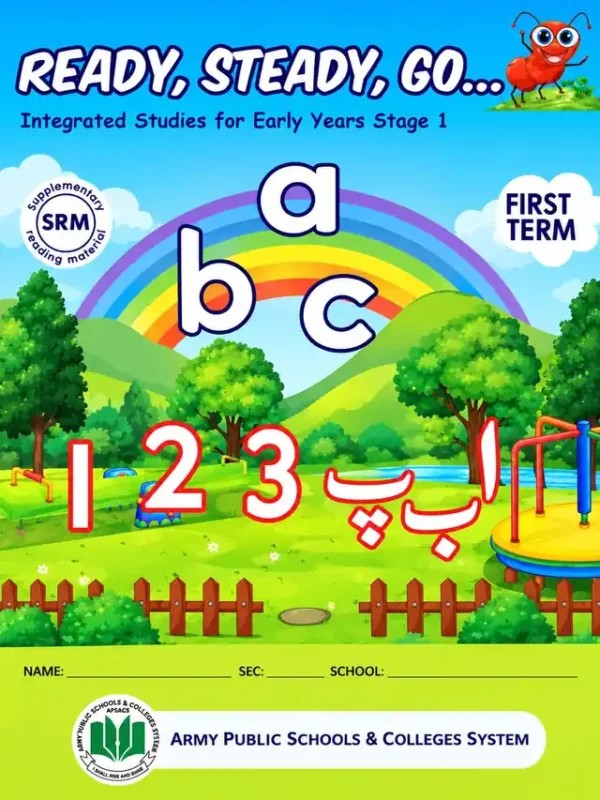
Ready, Steady, Go… Integrated Studies for Early Years Stage 1 (First Term) is the Play Group book of the Army Public Schools & Colleges System (APSACS). It is marked SRM, which stands for Supplementary Reading Material, and it brings the first-term learning of a three-year-old into a single book: English letters, Urdu letters, early numbers, shapes, and everyday lessons on safety, manners and the world around the child. Available to order now for the 2027-28 session.
If your child has just been admitted to Play Group in an Army Public School, this is the first book their teacher will ask them to open. The cover shows the idea at a glance, a rainbow over a playground with the English letters a, b, c, the numbers 1, 2, 3 and the Urdu letters Alif, Bay, Pay all in one picture, with space on the front for the child’s name, section and school. We stock this exact First Term edition, so you do not have to search shop to shop for it.
Why one integrated book works for Play Group
At three years old a child does not separate English, Urdu and maths into different subjects. They learn by tracing a line, naming a fruit, saying a letter aloud and counting a few objects, often on the same page spread. An integrated book follows that natural rhythm: a single topic such as ‘My Family’ or ‘Plants’ is followed by a letter to say and trace, a number to trace and a practice page of lines and shapes. For parents it also means one book to cover, one book to carry and one book to follow at home.
Full table of contents: all 6 units, every topic, with what it teaches
The contents pages list 84 numbered topics in six units, from page 1 to page 126. Topics written in Urdu in the book are given below in Roman Urdu with an English note, so that parents who do not read Urdu can follow along too. Every topic is shown exactly as printed, in book order.
Unit 1: About me, my family and my school (pages 1 to 11)
- My Photograph (p. 1)
- My Hand Print (p. 2)
- My Body (p. 3)
- My Face (p. 4)
- My Family (p. 5)
- Home Sweet Home (p. 6)
- I Love My School (p. 7)
- Things in My Classroom (p. 8)
- Trace the lines (pp. 9-10)
- Yeh duniya kis ne banayi hai? (Who made this world?) (p. 11)
Why it helps: The first unit starts with the child themselves: their photograph, hand print, body, face and family. Children settle into school faster when the first pages are about something familiar, and the hand print and photograph give parents a keepsake from the very first week. ‘Things in My Classroom’ builds the vocabulary a Play Group child needs to follow instructions, ‘Trace the lines’ begins pencil control, and the closing question about who made the world opens the child’s first conversation about faith.
Unit 2: Plants, fruits, vegetables and the first letters (pages 12 to 30)
- Plants (pp. 12-13)
- Say and Trace “a” (pp. 14-15)
- Urdu letter Alif: tracing and recognition (Alif ki tracing aur pehchan) (pp. 16-17)
- Trace the number 1 (p. 18)
- Trace the lines (p. 19)
- Fruits, Vegetables (pp. 20-21)
- Say and Trace “b” (pp. 22-23)
- Urdu letter Alif-Madda (Aa): tracing and recognition (pp. 24-25)
- Shapes (p. 26)
- Vegetables (p. 27)
- Paudon ki dekh bhaal (Looking after plants) (p. 28)
- Trace the lines (pp. 29-30)
Why it helps: Unit 2 introduces the first English letters (a and b), the first two Urdu letters and the number 1 alongside a theme that children can touch and taste: plants, fruits and vegetables. Linking a letter to something real helps it stay in memory. The lesson on caring for plants teaches responsibility, and the repeated ‘Trace the lines’ pages build the grip and wrist movement needed before real writing.
Unit 3: My country, Pakistan, and more letters (pages 31 to 52)
- My Country (p. 31)
- Say and Trace “c” (pp. 32-33)
- Urdu letter Bay: tracing and recognition (pp. 34-35)
- Trace the number 2 (p. 36)
- Trace the curves (pp. 37-38)
- Flag of Pakistan (p. 39)
- Say and Trace “d” (pp. 40-41)
- Urdu letter Pay: tracing and recognition (pp. 42-43)
- Shapes (p. 44)
- Personalities of Pakistan (p. 45)
- Say and Trace “e” (pp. 46-47)
- Urdu letter Tay: tracing and recognition (pp. 48-49)
- Long and short (p. 50)
- Trace the curved lines (p. 51)
- As-salam-o-alaikum (the Islamic greeting) (p. 52)
Why it helps: This unit gives the child their first sense of belonging to a country: the flag, well-known Pakistani personalities and the greeting every child hears at home. Meanwhile the letters c, d and e and the Urdu letters Bay, Pay and Tay keep the alphabet moving, ‘Long and short’ introduces comparison, and the curve-tracing pages prepare the hand for rounded letters such as c, d and e.
Unit 4: Animals, birds and the sea (pages 53 to 73)
- Wild animals, pet animals (pp. 53-54)
- Say and Trace “f” (pp. 55-56)
- Urdu letter Ttay: tracing and recognition (pp. 57-58)
- Trace the number 3 (p. 59)
- Water / sea life (p. 60)
- Say and Trace “g” (pp. 61-62)
- Urdu letter Say: tracing and recognition (p. 63)
- Shapes (p. 64)
- Birds (p. 65)
- Trace the circles (p. 66)
- Say and Trace “h” (pp. 67-68)
- Urdu letter Jeem: tracing and recognition (pp. 69-70)
- Big and small (p. 71)
- Janwaron se sulook (Kindness towards animals) (p. 72)
- Khane ke adaab (Eating manners) (p. 73)
Why it helps: Animals are the favourite topic of this age group, so Unit 4 uses them to teach sorting (wild or pet), size (big and small) and the number 3. The page on kindness towards animals and the page on eating manners add the first lessons in good behaviour. Tracing circles prepares for letters such as o and for the shapes pages that follow.
Unit 5: Seasons, clothes, day and night (pages 74 to 94)
- Seasons (p. 74)
- Trace the line (p. 75)
- Say and Trace “i” (pp. 76-77)
- Urdu letter Chay: tracing and recognition (pp. 78-79)
- Trace the number 4 (p. 80)
- Trees in different Seasons (p. 81)
- Say and Trace “j” (pp. 82-83)
- Urdu letter Hay: tracing and recognition (pp. 84-85)
- Shapes (p. 86)
- What do we wear? (p. 87)
- Say and Trace “k” (pp. 88-89)
- Urdu letter Khay: tracing and recognition (pp. 90-91)
- Day and Night (p. 92)
- Trace the lines (p. 93)
- Hazrat Muhammad (Peace Be Upon Him), the Last Prophet (p. 94)
Why it helps: Seasons, clothing and the cycle of day and night are the child’s first science lessons, taught through what they see outside the window. The letters i, j and k, the number 4 and three more Urdu letters continue the steady pace of the term. The unit ends with a page about the Prophet Muhammad (peace be upon him), which gives parents a ready starting point for storytelling at home.
Unit 6: Cleanliness, safety, last letters and the term review (pages 95 to 126)
- Keeping Clean (p. 95)
- Road Safety (p. 96)
- Say and Trace “l” (pp. 97-98)
- Urdu letter Daal: tracing and recognition (pp. 99-100)
- Trace the number 5 (p. 101)
- Trace the zigzags (p. 102)
- Say and Trace “m” (pp. 103-104)
- Urdu letter Ddaal: tracing and recognition (pp. 105-106)
- Urdu letter Zaal: tracing and recognition (p. 107)
- Shapes (p. 108)
- Stranger Danger (p. 109)
- Sharp and Hot Objects (p. 110)
- Light and Heavy (p. 111)
- Trace the lines (p. 112)
- Larai jhagra (Fights and quarrels) (p. 113)
- Review and Assess (pp. 114-125)
- I have finished First Term (p. 126)
Why it helps: The last unit is the one parents notice most, because it covers safety: keeping clean, crossing the road, not going with strangers, and staying away from sharp and hot objects. These short lessons can save a child from real harm. The final letters (l and m, Daal, Ddaal and Zaal), the number 5 and zigzag tracing complete the first-term skills, and the 12-page Review and Assess section lets the teacher and parents check what the child has actually learned before the term ends.
Who is this book for, and when is it used?
It is written for Play Group students at Army Public Schools & Colleges (APSACS), usually three-year-olds in their very first year of school. The ‘I have finished First Term’ page at the end of the book tells you it belongs to the first half of the school year. Buy it before the session starts or in the first week of term, so your child never has to share a book.
- What: a 126-page integrated workbook, not a storybook: tracing, saying, matching and colouring.
- Whom: Play Group children and the parent or teacher who sits beside them.
- When: the First Term of the Play Group year, in book order, one topic or two per school day.
- How: read the topic aloud, let the child say the letter or name the picture, then trace together with a pencil or crayon.
- Where: in class, and at home as 10 to 15 minutes of daily practice.
Frequently asked questions
Is this the First Term or Second Term book?
It is the First Term book. The cover says ‘First Term’ and the last page of the contents says ‘I have finished First Term’.
Does it include Urdu as well as English?
Yes. Alongside English letters a to m, the book teaches the Urdu letters from Alif to Zaal, with tracing and recognition pages for each one, plus lessons such as the Islamic greeting.
Do I also need a notebook or a separate maths book?
Check your school’s book list. This book already contains number tracing for 1 to 5 and shape pages, but individual schools may ask for copies as well. Message us your list and we will confirm.
Order the Play Group Integrated Studies book online with Cash on Delivery across Pakistan, or visit our shop in Lahore. Message us the class and campus on WhatsApp and we will confirm the edition before we dispatch.