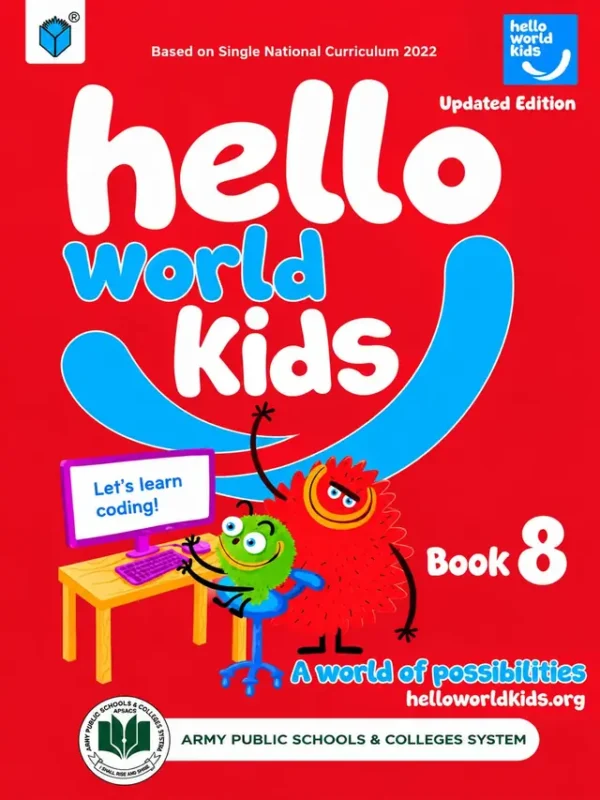
Hello World Kids, Book 8 (Updated Edition) is the Class 8 computer book of the Army Public Schools & Colleges System. The red cover has the series’ red and green characters, the line ‘Let’s learn coding!’ and the words ‘Based on Single National Curriculum 2022’. It is the last book of the eight-book series and brings the six-unit structure to its conclusion. Available to order now for the 2027-28 session.
Class 8 students work with networks and spreadsheets, learn to design algorithms and understand which problems computers cannot solve, compare visual and textual programming, and study computer security, antivirus software and the laws against cybercrime. The final unit looks at marketing, business plans, payments and e-commerce.
Full table of contents: Units 1 to 6, every topic and page
Every entry of the contents page is given exactly as printed, with a note on what each unit gives the student.
Unit 1: ICT Fundamentals (page 5)
- Introduction to Networks (p. 8)
- Applications of ICT (p. 14)
- Emerging Technologies (p. 19)
Why it helps: Networks are how computers talk to each other, and understanding them is the first step towards understanding the internet. The unit also looks at how ICT is used across society and at emerging technologies.
Unit 2: Digital Skills (page 25)
- Working with Spreadsheet (p. 28)
Why it helps: Spreadsheets are among the most useful skills a student can learn: organising data, using formulas and making charts. The unit is a full 19 pages, the biggest practical unit of the book.
Unit 3: Algorithmic Thinking and Problem Solving (page 47)
- Simple Vs. Complex Problems (p. 50)
- Designing Algorithms (p. 52)
- Problems Computers Cannot Solve (p. 59)
- Important Concepts in Algorithms Design (p. 61)
Why it helps: Students learn to design algorithms and, importantly, to recognise problems that computers cannot solve, which gives a realistic view of what technology can and cannot do.
Unit 4: Programming (page 69)
- Programming Constructs Using Scratch (p. 72)
- Visual Programming Vs. Textual Programming (p. 78)
Why it helps: Scratch is used to practise programming constructs, and the comparison of visual and textual programming prepares students for languages such as Python in later years.
Unit 5: Digital Citizenship (page 85)
- Computer Security Threats (p. 88)
- Antivirus (p. 91)
- Cyber Crimes: Consequences and Laws (p. 92)
Why it helps: Students learn about viruses and other threats, how antivirus software protects them, and the laws and consequences surrounding cybercrime. It prepares them for responsible use of technology.
Unit 6: Entrepreneurship in the Digital Age (page 99)
- Marketing and Digital Marketing (p. 102)
- Business Plan (p. 105)
- Payment and Transaction (p. 108)
- How E-Commerce Helps Entrepreneurs Increase Revenues? (p. 109)
Why it helps: The last unit shows how a business works online: marketing, planning, payments and e-commerce. It ties the whole series together by showing technology as a means to create value.
Who, when and where
Whom: Class 8 students at Army Public Schools (about thirteen years old). When: in the weekly computer period through the year. Where: in the school computer lab, with the book beside the keyboard. How: practise the spreadsheet unit with real data, such as a family budget or cricket scores.
- What: Hello World Kids Book 8, Updated Edition, based on the Single National Curriculum 2022.
- Whom: Class 8 students.
- Why: to teach spreadsheets, algorithms, programming, cyber safety and e-commerce.
- Where: Army Public Schools & Colleges.
Frequently asked questions
Does it teach spreadsheets?
Yes. Unit 2 is Working with Spreadsheet.
Does it cover cyber laws?
Yes. Unit 5 includes ‘Cyber Crimes: Consequences and Laws’.
Is it the last book in the series?
Yes. Hello World Kids has eight books, for Class 1 to Class 8.
Order Hello World Kids Book 8 online with Cash on Delivery across Pakistan, or visit our shop in Lahore. Message us the class and campus on WhatsApp and we will confirm the edition before we dispatch.